Level: Introductory
Duane Merrill (duane@duanemerrill.com), Writer, Freelance
08 Aug 2006
Updated 16 Oct 2006
Mashups are an exciting genre of interactive Web applications that draw upon content retrieved from external data sources to create entirely new and innovative services. They are a hallmark of the second generation of Web applications informally known as Web 2.0. This introductory article explores what it means to be a mashup, the different classes of popular mashups constructed today, and the enabling technologies that mashup developers leverage to create their applications. Additionally, you’ll see many of the emerging technical and social challenges that mashup developers face.
More dW content related to: mash up + architecture
Promises were not honored, a report says, raising the threat of economic sanctions.
From the Associated Press
December 12, 2006
WASHINGTON — The Bush administration Monday criticized China’s record on opening its markets and said the U.S. would not hesitate to seek economic sanctions if that record did not improve.
Calling China’s performance “decidedly mixed,” U.S. Trade Representative Susan Schwab released a 100-page report that accused China of failing to live up to commitments it made five years ago, when it joined the World Trade Organization.
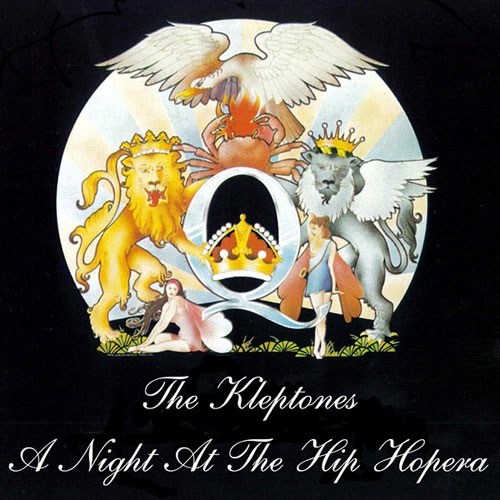
A Night at the Hip-Hopera, by the Kleptones, is the best mash-up I’ve heard, at least since Strictly Kev’s Raiding the 20th Century. (The Disney Corp. is taking legal action to suppress Hip-Hopera; the Kleptones are no longer allowed to host the mp3s on their own site. But they list other sites that carry the files; these won’t go offline until Disney gets around to contacting each of them individually with cease-and-desist orders. And if these don’t work, Google has a lot of links to it too).
A Night at the Hip-Hopera consists of music by Queen (whose copyright is owned by Disney, hence the cease-and-desist orders), together with vocal tracks taken mostly from various hip hop artists (both current and old skool, ranging from Afrikaa Bambaataa to Vanilla Ice to the Beastie Boys to Grandmaster Flash to Dilated Peoples to Missy Elliott) together with a few non-hip-hop bands (Electric Six, Morris Day), plus a montage of soundbites from (real and fake) news broadcasts, interview tapes, and old low-budget SF movies (not to mention attacks on copyright law and exhortations in favor of piracy/sampling/remaking). (There’s a fairly complete list of sample sources here).
After great comments and good conversations, i want to take a second stab at explaining the shift i was asking for wrt copyright and remix. My argument is that we stop thinking of remix as production, but as active consumption. Remix happens as a bi-product of consumption. What we’re remixing is culture and the active consumption of culture is part of identity development and living as a social creature in society.
Think about clothing consumption. Few people buy all of the items on the mannequin. You buy different pieces and mix and mash them. You might even decide to alter them by adding patches, by dying them, by cutting them up. You make the clothing yours. And then you share your consumption with the world by parading on the streets. In this way, you make the clothing tell your story. (tx Kevin Bjorke)
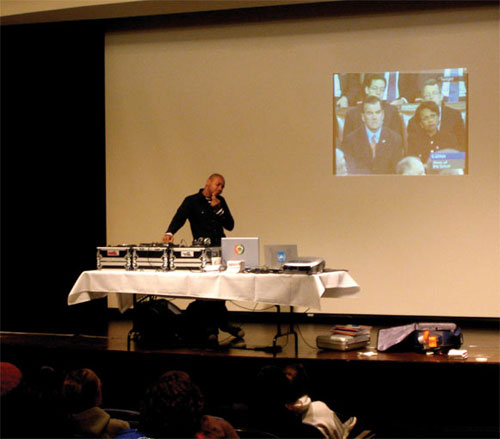
Standing quietly behind his chrome-encased digital turn tables, Paul Miller, a.k.a. DJ Spooky, affably channels the virtues of communism into the auditory world of music creation. As do many in DJ culture, Miller composes by sampling and remixing previously existing songs and images into an audio-visual collage all his own—essentially a de-privatization of the sonic landscape. But rather than adding drum lines to borrowed melodies and claiming the product as his own (see Diddy’s “I’ll Be Missing Youâ€), Miller completely reworks his source material into a creation entirely of his own making.
During the heyday of debates on post-modern, at least one critic in America noticed the connection between post-modern pastiche and computerization. In his book After the Great Divide (1986), Andreas Huyssen writes: “All modern and avantgardist techniques, forms and images are now stored for instant recall in the computerized memory banks of our culture. But the same memory also stores all of pre-modernist art as well as the genres, codes, and image worlds of popular cultures and modern mass culture.” [1] His analysis is accurate – except that these “computerized memory banks” did not really became commonplace for another fifteen years. Only when the Web absorbed enough of the media archives it became this universal cultural memory bank accessible to all cultural producers. But even for the professionals, the ability to easily integrate multiple media sources within the same project – multiple layers of video, scanned still images, animation, graphics, and typography – only came towards the end of the 1990s.
“The new frame of reference – unlike that of postmodernism and deconstructivism – will no longer be dictated by the unique, the authentic or the specific, but by the universal.”1
It is hard to imagine anyone uttering these words a mere five years ago. In fact, in North America, it can be argued that architectural discourse during the last decade was substantially preoccupied with work defined by the particular, the authentic, and the site-specific. But it was only little more than thirty years ago that the great cultural monolith of modernism began to erode, making way for the pluralistic onslaught of postmodernism. And since that time, our schools of architecture, periodicals, and then cities have witnessed the rise and then demise of historicist postmodernism, deconstructivism, and presently our latest infatuation with authenticity and its tectonic and place-making manifestations.
A big thanks to Gabriela Perez del Pulgar for taking, summarizing and revising the notes for publication. A very special thanks to Belen Gache and Gustavo Romano who organized the seminar.
———-
Resumen del taller
“El remix es un segundo mix de algo pre-existente, y el material que es mixeado por segunda vez necesita ser reconocido, de lo contrario, la obra podrÃa ser entendida erróneamente como algo nuevo, se volverÃa plagio.Sin una historia, el remix no puede ser Remix.â€
–EDUARDO NAVAS
Eduardo Navas, artista, historiador y escritor especializado en nuevos medios, compartió en este taller las lÃneas de investigación que actualmente realiza en torno al fenómeno de Remix Culture o Cultura Remix, presentando tanto sus propios trabajos como los de otros artistas y analizando los de los asistentes con el fin de reflexionar sobre la producción artÃstica ligada a los nuevos medios y las implicaciones del remix en la cultura contemporánea.
Five years ago on this coming Monday, the World Trade Center ceased to exist. On the way to a dinner party recently on the upper West side of Manhattan, I stopped at the site where it once stood to take some photographs. There’s not much to capture though, as five years after the Twin Towers came down there is still little more than a gaping void in the ground.
What will eventually go up in their place is the Freedom Tower, a long debated and long planned memorial to those who died on September 11. But the rebuild in that space has been hampered by security concerns, power grabs, and what’s of particular interest to the commons community – a debate about the originality of the planned 1,776-foot building.