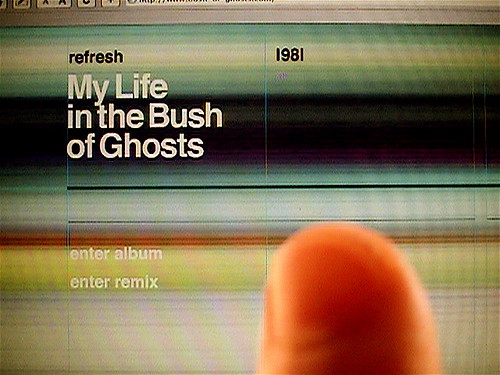
This past week I spent my time among two disparate crowds — in San Francisco with Supernova’s new media digerati, content anarchists, and self-publishing blogging media visionaries, among others, and in Los Angeles with Hollywood’s “Masters of the Universe”, those responsible for producing the most mainstream of mainstream film and TV, and individuals who are architecting the strategies for media empires making their shift to the Internet.
Time Code — the Live Mix at ZeroOne San Jose will feature Mike Figgis’ new interpretations of this seminal work he started in 2000. For this performance Mike Figgis will be “playing†with the image and “re-mixing†the sound to create a new way to experience this story. Shot simultaneously on four cameras and presented in four frames, Time Code tracks the lives of a smitten lesbian lover as she obsesses over her partner’s dalliances and the tense goings-on of a Hollywood film production company. Time Code is, as one of its critics point out, is one of the “first films shot in real time in one take, to be truly interactive, and to present four different concurrent stories filmed simultaneously.â€
1. “Help Me Help Me” – AllThatFall
2. “If You Make Your Bed in Heaven” – Roddy Schrock
3. “Leftover Secrets to Tell” – Pocka
4. “Secret Life Remix” – Stephane Leonard
5. “The Black Isle (Byrne/Eno Remix)” – (dj) morsanek
6. “Hit Me Somebody (Help Me Somebody Remix)” – MrBiggs
7. “Being and Nothingness (A Secret Life Remixed)” – john kannenberg
8. “Somebody Help Us” – My Fun
9. “Hey” – Mark Rushton
10. “My Bush in the Secret Life of Ghosts” – Prehab
11. “Not Enough Africa” – Ego Response Technician
12. “Helping (Help Me Somebody Remix)” – doogie Read the rest of this entry »
While music manufacturers struggle to create “integrated hardware solutionsâ€, enterprising DJs and VJs are picking up US$40 Nintendo Wii remotes and having a blast. Here, the controller gets assigned to audio filters on the computer (I’m guessing the Max/MSP/Jitter external may be at work as it’s on a Mac), and controls glitchy visuals. I’ve been working with the Wii myself, and I’m not quite satisfied with the gestures I’ve gotten out of it yet — just as some of the early launch title games for Wii may not quite have the control scheme perfected yet, so, too, are these early performance attempts a bit limited. But another six months to a year, some more code, and I’m sure we’ll being having Wii DJ/VJ battles.
If there’s one sure thing about the future, it’s that it always takes longer to arrive than you think it will.
Skip to next paragraph
Illustration by Stuart Goldenberg
A Netflix screen that lets members watch movies instantly on their PCs. The rollout is scheduled to be complete by June.
Here we are in 2007, and the interstellar space travel depicted in “2001†is still a sci-fi fantasy. Heck, we haven’t even reached the society of mind control imagined in “1984.†(Insert your own joke about politics or advertising here.)
So when the pundits tell you that the death of the DVD is imminent, that we’ll soon get all our movies instantaneously from the Internet, some skepticism is in order.
Text source: http://www.artsandletters.fau.edu/
humanitieschair/cannibal.htmlÂ
1. In your study of rap in Pragmatist aesthetics (Oxford: Blackwell, 1992) you explicitly use the concept of cannibalism to describe rap’s aesthetic of appropriation, its sampling of prerecorded music and other sounds. You even refer to the early rappers, on page 203, as “musical cannibals of the urban jungle.” What has been the reaction to this characterization of rap? Read the rest of this entry »
If the concept of “The Beatles, remixed” saddens you, know that original Beatles producer George Martin was at the helm for this project, which serves as the soundtrack to the Vegas-based Cirque du Soleil show of the same name. The 26 mashed-up tracks here were augmented with additional instrumentation and vocals performed by The Beatles themselves, culled from hours of original demo and master tapes, with pieces of 130 songs ultimately represented in some form.
Alexis Petridis
Friday November 17, 2006
The Guardian
The Beatles Love
In about 2002, the bootleg mash-up was big news. A hopelessly named phenomenon that involved producers illegally mixing two unlikely old records together to make a third, the mash-up made celebrities of some strange figures – Brian “Danger Mouse” Burton and secretive producer Richard X among them – but the Beatles may have been the sub-genre’s true stars. They were involved both in its artistic zenith – the Grey Album, on which Danger Mouse pitted Jay-Z’s rapping against music from the White Album – and the moment when mash-ups meandered into pointlessness: Go Home Productions’ Paperback Believer, which used two fantastic records, Paperback Writer and the Monkees’ Daydream Believer, to make a noticeably less brilliant third.
Today we stand surrounded by a range and density of cultural materials. There are multiple sites of production of texts, images and sounds. These circulate with velocity through expanding and intricate networks of transmission. What is our relationship with this world of images and sounds; and what are the forms and practices that can bring us to appropriate and regenerate our own moments of insertion into these networks? What do we infringe on when we start inserting ourselves into these networks, and what possibilities do we create? Do we need remix?
Note from source: This email is part of a weekly series written by Lawrence Lessig and others about the history and future of Creative Commons.
Creative Commons is a young organization. And while we’ve been more successful than I ever imagined we’d be, we’ve also made mistakes. Some of these mistakes we’ve corrected. Some I hope to persuade us to correct. But throughout the three years since our launch, we have worked hard to build a solid and sustainable infrastructure of freedoms for creators.
Along the way, we have picked up some critics. I don’t have the space here to address every criticism. In this email, I’ll talk about just two — one directed at our NonCommercial license option, and the other at two of CC’s non-core licenses. But I’ll continue this discussion next year in a new forum that we’ll launch just for this purpose. Mark Shuttleworth is my model here, and I will be a part of that discussion whenever I can.