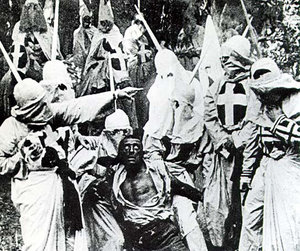
Latterrell defined her role in the panel by explaining her presentation is a collage and sampling of other voices so it is about remix as much as it is a remix. “Remix” is a modern metaphor for revision. She colored this point with examples of customized sneakers, the tuxedo t shirt, the tangelo, sprite remix, and my personal favorite, labradoodles. She then paired a quote by Emerson on quotation and originality with a remix of President Bush’s State of the Union address that reversed his intended meanings. The collage of images and quotes continues with animation of Office Space meets Super Friends in which Superman, Green Lantern, Batman and Robin talk about memos and office procedures in what Latterell called a “classic mash up” or sampling. Next she showed DJ Spooky’s “Rebirth of a Nation” which spoofed D.W. Griffith’s Birth of a Nation by showing clansmen almost dancing to the technorhythms from both soundtrack and visual beats. Sampling, Latterell asserts, implies breakdown. Then she quoted Johndan Johnson-Eilola from his book, Datacloud: Toward a New Theory of Online Work where he asserts breakdown and further discussion as the essence of remix. Latterell concluded with the idea that Lawrence Lessig asserted at last year’s conference—everything in life is remix.
James Porter, “Forget Plagiarism, Teach Filesharing and Fair Use”
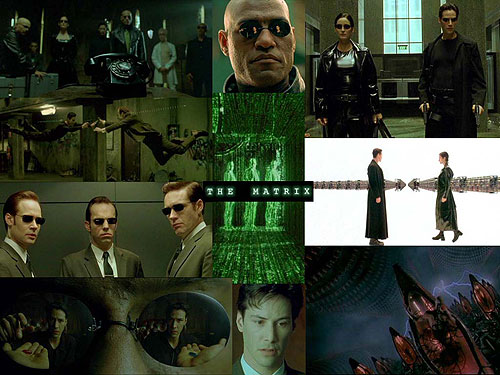
The basic idea is to turn all of the footage from that one trilogy into a 5-8 minute short film. We will then screen your parody on the internet and in real life at the end of April of 2006.
Choosing “The Matrixâ€, one would take all three installments, The Matrix, The Matrix Reloaded, and The Matrix Revolutions and edit down that footage into a parody of the original, adding or removing elements (voiceovers, scenes, etc) as necessary. You could even use only one of the films of the trilogy– the point is that the original footage of The Matrix is being used to make a short parody out of it. Read the rest of this entry »
Mix, mix again, remix: copyleft, cut ‘n’ paste, digital jumble, cross-fade, dub, tweak the knob, drop the needle, spin, merge, morph, bootleg, pirate, plagiarize, enrich, sample, break down, reassemble, multiply input source, merge output, decompose, recompose, erase borders, remix again. These are among many of the possible actions involved in what can be broadly labeled “remix culture” – an umbrella term which covers a wide array of creative stances and initiatives, such as: plunderphonics, detritus.net, recombinant culture, open source, compostmodernism, mash-ups, cut-ups, bastard pop, covers, mixology, peer to peer, creative commons, “surf, sample, manipulate”, and uploadphonix. Read the rest of this entry »
“free content fuels innovation”
– Lawrence Lessig, The Future of Ideas
I get asked what I think about sampling a lot, and I’ve always wanted to have a short term to describe the process. Stuff like “collective ownership”, “systems of memory”, and “database logics” never really seem to cut it on the lecture circuit, so I guess you can think of this essay as a soundbite for the sonically-perplexed. This is an essay about memory as a vast playhouse where any sound can be you. Press “play” and this essay says
“here goes”:
Side by side, twining, overlapping, influencing, borrowing from itself and mass culture – so runs the last one hundred years of Western art history. In turn, remix culture borrows from many movements within late and post-modernism: appropriation, collage, dada, graffiti, mail art, manipulated objects, photo montage, pop art, process art, scratch video – the beat goes on. The 20th Century avant garde understood the image as a representation, not a thing in itself. They sought to undermine its aura and authenticity, and open up its meaning, through shifting its context and interpretation.
Dada and Collage
Appropriation practices in 20th Century art start with modernism’s fascination with industrial revolution, with essence and progress. The term “collage” derives from the French coller (to glue), and first appears in the work of Picasso – specifically, Still Life with Chair Caning (1912), wherein he used actual chair cane as well as paint. Collage continued through the Dada movement, spilling into surrealism. Inspired by peeling layers of Parisian street posters, LÈo Malet invented dÈcollage: the removal of images from an existing surface. Collage appears in the work of Braque and Picasso, whose work was in turn iterative of early advertisements. Remix is a form of collage.
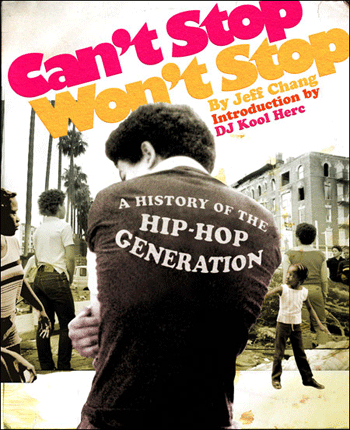
All of these books are as much about politics as popular culture and the art of the MC–not to mention his cousins the break dancer, the turntablist and the spray-can artist. This will surprise no one who knows that black art, black pop and black politics have long been intertwined modes of resistance in the African diaspora, from the coded liberation theology of plantation spirituals to the oppositional wit of Delta blues, New Orleans jazz, swing, bebop, Motown and Stax soul, free jazz, funk, black rock, salsa and reggae. Reading these books about hip-hop can provoke a sense of nostalgia and paradox for someone like this writer, who has watched and occasionally abetted the light-speed journey hip-hop has made in less than twenty years from folk culture to commercial subculture to global youth culture to global capitalist marketing tool. The nostalgia derives from a pronounced sense of loss, the kind former Black Panther Elaine Brown captured in the title of her memoir, A Taste of Power. Read the rest of this entry »
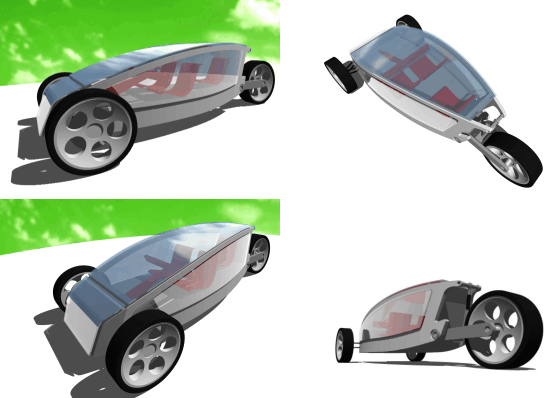
Inspired by Linux, the OScar project aims to build a car by tapping the knowledge of a volunteer team. It won’t be an easy ride, but their journey is important
The computer operating system Linux and the Web browser Firefox are generally considered the two biggest successes of the movement to develop open-source programs—software anyone can modify, transform, and redistribute back into the community. While there are thousands of other examples, Linux and Firefox have managed to mount serious competition to established commercial products, and have therefore come to represent this specific, collective mode of creation.
But Linux and Firefox are made of bits. They are immaterial. Bits can be shared and sent around easily, so that distant people can work on them concurrently; bugs can be corrected almost instantly; new versions containing updates, improvements, or fixes can be released virtually for free.
For a minima’s participation in Now, I have chosen four texts invested in the crossover of art, science and technology. The texts are “Nature?†by Marta de Menezes, “Observation, Interference and Evolutionary Relationships. (An overview of the Phumox project) – Phumox? What’s that?†by Andy Gracie, “Convergent Realities: art, technology consciousness from the planetary perspective†by Roy Ascott, “Artport†and “Not Just Art—from Media Art to Artware†by Christiane Paul. The first two texts, written by artists/researchers, could be read as honest attempts to cross over art, science and technology; the last two texts, written by theorists, can be read as reflections on such practices. The four texts are sensitive to contextualization and critical commentary, which are expected of art practice today, as well as the urge to do research for the sake of understanding the world and develop technology to do it, which is expected of science and technology.
Para la participación de a minima en Now, he escogido cuatro textos que se enfocan en el cruce cultural entre arte, ciencia y tecnologÃa. Los textos son “Nature?†por Marta de Menezes, “Observation, Interference and Evolutionary Relationships. (An overview of the Phumox project) – Phumox? What’s that?†por Andy Gracie, “Convergent Realities: art, technology consciousness from the planetary perspective†por Roy Ascott, “Artport†y “Not Just Art—from Media Art to Artware†por Christiane Paul. Los primeros dos textos, escritos por artistas/investigadores activos en el arte, podrian ser considerados atentos en cruzar entre el arte, ciencia y tecnologÃa; mientras que los dos últimos, escritos por teóricos, podrian ser reflecciones sobre tales practicas. Los cuatro textos son sensitivos a la contextualización y comentario crÃtico, los cuales son esperados de la practica del arte hoy, junto con el impulso de desarrollar investigaciones por la necesidad de comprender el mundo y desarrollar la tecnologÃa para hacerlo, lo cual es esperado de la ciencia y la tecnologÃa.
Text and image source: Ubu Web
A video documentary combining exhibition footage of the Situationist International exhibitions with film footage of the 1968 Paris student uprising, and graffiti and slogans based on the ideas of Guy Debord (one of the foremost spokesmen of the Situationist International movement). Also includes commentary by leading art critics Greil Marcus, Thomas Levine, and artists Malcolm Mac Laren and Jamie Reid. Branka Bogdanov, Director and producer. NTSC-VHS 22 min. 1989Â