About | Remix Defined | The Book | Texts | Projects | Travels/Exhibits | Remixes/Lists| Twitter
Loading...

Regressive and Reflexive Mashups in Sampling Culture, by Eduardo Navas
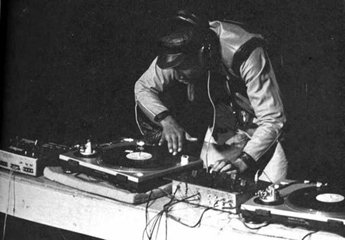

Grandmaster Flash on the Wheels of Steel some time in the early days of hip hop.

Image source: greatestcities.com

Update as of 8/13/10.  The revised version of this text is now available online as Remix Theory post 444.

Update as of 4/29/10: This text has been revised for the book publication Mashup Cultures. In the revised print version, I introduce a series of new terms along with a diagram.  The 2007 draft is shared below in the tradition of online sharing.  The final argument while it has not necessarily changed is more precise in the revised print version, which I encourage those interested to read.

This text was published on June 25, 2007 in Vague Terrain Journal as a contribution to the issue titled Sample Culture.

Today, sampling is practiced in new media culture when any software users including creative industry professionals as well as average consumers apply cut/copy & paste in diverse software applications; for professionals this could mean 3-D modeling software like Maya (used to develop animations in films like Spiderman or Lord of the Rings );[1] and for average persons it could mean Microsoft Word, often used to write texts like this one. Cut/copy & paste is a vital new media feature in the development of Remix. In Web 2.0 applications cut/copy & paste is a necessary element to develop mashups; yet the cultural model of mashups is not limited to software, but spans across media. Mashups actually have roots in sampling principles that were first initiated in music culture around the seventies with the growing popularity of music remixes in disco and hip hop culture; and even though mashups are founded on principles initially explored in music they are not always remixes if we think of remixes as allegories. This is important to entertain because, at first, Remix appears to extend repetition of forms in media, in repressive fashion; but the argument in this paper is that when mashups move beyond basic remix principles a constructive rupture develops that shows possibilities for new forms of cultural production that question standard commercial practice.
Read the rest of this entry »

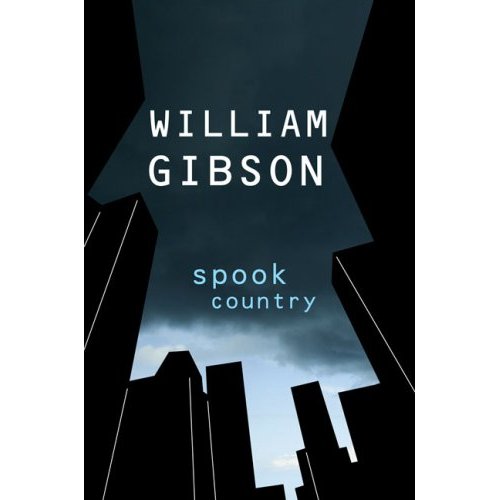
Spook Country: Some notes on William Gibson’s new novel, Spook Country, by Steven Shaviro

Image source: Amazon.com

Text source: The Pinocchio Theory

Note: A comment on this review was previously posted at Nettime.org by DJ Spooky.

“The door opened like some disturbing hybrid of bank vault and Armani evening purse, perfectly balanced bombproof solidity meeting sheer cosmetic slickness.” William Gibson’s prose is cool and precise: minimal, low-affect, attuned to surfaces rather than depths. It’s overwrought, filled to bursting with similes and allusions; yet somehow it still manages to feel as if it had been executed skeletally, entirely without flourishes. There’s a sense of density built up in layers, but packaged inside a bland and featureless box; this writing is like a nondescript cargo container (one of the book’s main images) filled with everything from expensive brand names, hi-tech geekery, and the detritus of popular culture to micro-perceptions of psychological shifts that take place just beneath the threshold of conscious attention.

At times, the effect of this prose is one of deadpan absurdity, as when townhouses in the Georgetown neighborhood of Washington, D.C. are described as radiating “the sense that Martha Stewart and Ralph Lauren would have been hard at work on interiors, together at last, sheathing inherently superior surfaces under hand-rubbed coats of golden beeswax.” At other times, it’s surreally dislocating, as when one of the protagonists is startled by the actions of her companion, so that “for an instant she imagined him as a character in some graphically simplified animation.” At still other times, it’s slyly mordant, as when one character is described as looking “like someone who’d be invited quail-shooting with the vice president, though too careful to get himself shot.”

Read the rest of this entry »

Entrevista a Eduardo Navas // artista, historiador y crítico especializado en nuevos medios, por: yto.cl

Online Project:
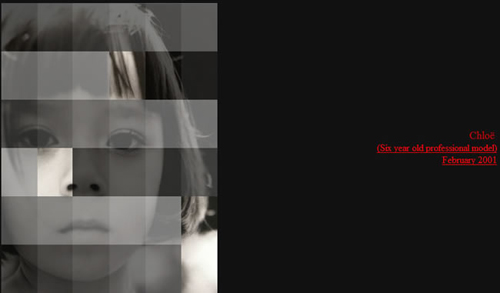
Chloë
(Six year old professional model)

February 2001

Note: This interview was originally published by Yto (Isabel Aranda) in the Magazine Escaner Cultural, August 2007, based in Santiago de Chile. It is currently only available in Spanish.

Image source: navasse.net/cloeyStart/

Text source: revista.escaner.cl/node/279

Eduardo Navas es artista, historiador y crítico especializado en nuevos medios; su obra y teorías han sido presentadas en varios lugares en Estados Unidos, Latino América y Europa. Ha sido jurado para ” Turbulence.org” en 2004, también fue jurado para las comisiones de “Rhizome.org” de 2006-07, en Nueva York.

Navas es fundador y editor contribuyente de “Net Art Review” (2003-2005), y co-fundador de “newmediaFIX” (desde 2005). Actualmente, Navas es docente de práctica de multimedia en la Universidad del Estado en San Diego (SDSU), y es candidato al doctorado en letras en el Departamento de Historia de Arte y Medios de Comunicación, Teoría y Crítica, en el programa de Bellas Artes en la Universidad de San Diego California (UCSD).

Cuéntame un poco sobre tu infancia, por favor…

Nací en 1969 en El Salvador, Centro América, y emigré a Los Estados Unidos en 1980, en donde he crecido como ciudadano naturalizado.

¿Cuándo descubriste que tu camino era el arte?

Siempre lo supe. Mis modelos fueron mis hermanos Max y Ricardo, quienes dibujaban mucho. Ellos coleccionaban paquines (historietas cómicas en forma de revista). Maximiliano, mi hermano mayor, había tenido un curso por correo para aprender a dibujar caricaturas. El nunca lo terminó, pero guardó todas las lecciones, las cuales yo terminé usando. Yo practicaba a dibujar los ejemplos en cada lección y después con los años comencé a copiar dibujos cómicos, más que todos de paquines de súper héroes. Mis favoritos eran del Hombre Araña, y los Cuatro Fantásticos. Pero en El Salvador más que todo se encontraban paquines de Superman y otros personajes de la compañía DC Comics. Así que cuando encontraba un paquin del Hombre Araña, publicado por Marvel, era prácticamente de oro para mí. Al llegar a los Estado Unidos me volví loco comprando paquines del Hombre Araña, Los Cuatro Fantásticos, entre otros. Era como un sueño poder ir a una tienda especializada de paquines y ver tantos de ellos ahí. Pero llegó un momento en el cual pude dibujar con facilidad y me pregunté que más se podría hacer con el arte, una vez que uno llega a dibujar más o menos bien. Creo que fue ahí donde mi interés en la práctica crítica comenzó.

Read the rest of this entry »

Ground Zero – Five Years Later


Image: SPI, dbox

Image and text source: Architectural Record

Note: This is a great resource offering several articles about design proposals for Ground Zero in NYC. Click on the above link to access all articles. It was published sometime in 2006.

Today, New Yorkers awoke to déjà vu. This crisp September morning, with fiercely white sunshine piercing a cloudless sky, was almost exactly like the day that greeted New Yorkers on September 11, 2001. While the similarity is uncanny, the platitudes are correct that the world is forever changed.

Words fail to fully communicate the experience of the terrorist attacks, and their transformative effect on society, politics, and the economy. Can the architecture that will replace and memorialize the Twin Towers fill the gaps?

We are getting closer to an answer. Despite the many conflicts about which commentators had forewarned us early on, Ground Zero’s rebirth inches toward reality. In the few weeks leading up to this fifth anniversary, news of progress has appeared with increasing frequency. Power switched hands, designs were revealed, steel was shipped. Ground Zero promises to be home to works by the generation’s most famous architects. That fact alone guarantees neither universal praise nor timelessness. But its completion will open a new chapter in which the public demands innovation and excellence throughout the built landscape, not just in rebuilding what’s lost.
ward reality. In the few weeks leading up to this fifth anniversary, news of progress has appeared with increasing frequency. Power switched hands, designs were revealed, steel was shipped. Ground Zero promises to be home to works by the generation’s most famous architects. That fact alone guarantees neither universal praise nor timelessness. But its completion will open a new chapter in which the public demands innovation and excellence throughout the built landscape, not just in rebuilding what’s lost.

North Quad Remix: It’s Over Your Head | Architecture Column, By Austin Dingwall

A view of the front side of the Frieze Building. (ALI OLSEN/Daily)
Image and text source: The Michigan Daily

Published: 9/13/06

niversity President Mary Sue Coleman and the other administrators were right to delay the North Quad project, choosing to perfect its architecture rather than accepting a mediocre design. The project’s completion may be pushed back a year, but the permanence and importance of this building will affect generations of students, faculty and Ann Arborites for decades to come. This structure is to be the gateway to Central Campus from the north, yet the recent March proposal from architecture firm Einhorn, Yaffee, Prescott showed a lackluster building, both piecemeal and uninviting. Most importantly, the proposed renderings did not express an externally unified charisma to harbor the building’s innovative interior.

In July, the University hired Robert A.M. Stern Architects to redesign North Quad while keeping Einhorn, Yaffee, Prescott on to retain the integrity of the interior programming. With this decision, the University is poised to get more of, if not exactly, what they want for North Quad. Time and time again, Robert A.M. Stern Architects have proven that they are masters at adapting to context while providing traditional, distinguished architecture.

Read the entire article at  The Michigan Daily

Learning By Remixing, by Mark Glaser

Image source: rconversation.blogs.com

Text source: PBS Media Shift

According to a 2005 study conducted by the Pew Internet & American Life Project, 57 percent of American teens who use the internet could be considered media creators. For the purpose of the study, a media creator was defined as someone who “created a blog or webpage, posted original artwork, photography, stories or videos online or remixed online content into their own new creations.” Most American teens online have done two or more of these activities. 33 percent of teens share what they create online with others. 19 percent create new works by remixing content they appropriated from another source.

America’s children are become media-makers: they are blogging, designing their own websites, podcasting, modding games, making digital movies, creating soundfiles, constructing digital images, and writing fan fiction, to cite just a few examples. As they do so, they are discovering what previous generations of artists knew: art doesn’t emerge whole cloth from individual imaginations. Rather, art emerges through the artist’s engagement with previous cultural materials. Artists build on, take inspiration from, appropriate and transform other artist’s work: they do so by tapping into a cultural tradition or deploying the conventions of a particular genre. Beginning artists undergo an apprenticeship phase during which they try on for size the styles and techniques of other more established artists. And even well established artists work with images and themes that already have some currency within the culture. Of course, this isn’t generally the way we talk about creativity in schools, where the tendency is still to focus on individual artists who rise upon or stand outside any aesthetic tradition.

Read the entire feature at  PBS Media Shift

Editing my doctoral thesis on stem cells in a blog: Why not? by attilachordash

Note: The following text actually exposes some of the anxieties in academia about blogs, and their effectiveness as valid research tools.

Image and text source: Pimm

June 4th, 2007

OK folks, after reading the official rules about how to get and manage a doctoral thesis, and after speaking with my supervisor asking for his permission, I’ve decided to edit my ongoing doctoral thesis in Pimm. Or at least the introduction of it, which is intended to be no other than a review-like summary of some current results in the stem cell biology of different tissues, organs. What will remain hidden in the first round (but can follow later): the data-heavy yet unpublished results and the discussion, conclusion session. Objectives, Materials & Methods: we shall see it. Sounds like there are complete parts of the thesis, but that’s dead wrong, at this time my doctoral thesis is in an embryonic form. Also no idea on how challenging, meaningful this project, a sub-series in Pimm, will be.

Read the rest of this entry »

Early custom Kraftwerk vocoder on the auction block, by Ryan Block

Image and text soure: Engadget

Jun 29th 2006

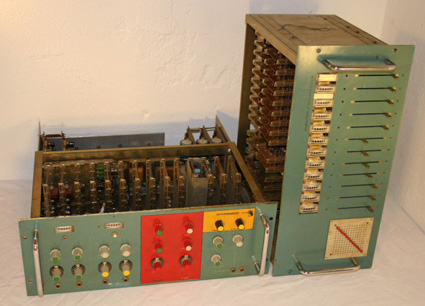
You wax faux-nostalgic about the heyday of early robo-Kraut-rock, your early signed pressing of Radio-Activity is rivaled only by your original Neu! Super / Neuschnee 7-inch, and you got a belly laugh at that one scene about the record the nihilists once cut in The Big Lebowski. Kraftwerk fans, today is your lucky day. The original one-of-a-kind prototype vocoder Kraftwerk pictured on the rear cover art of and used to record “Ananas Symphonie” and “Kristallo” on their 1973 release Ralf & Florian. As of the time of this writing it’s already up to five grand, so if you want yourself an extremely expensive piece of history for electronics and electronic music, you’d better get a move on, schnell.

Note: the above text was a comment on the following post from Music Thing:

Lots of people say things like ‘RARE legendary’ in eBay auctions for DX7s and Casio VL-Tones, but eBay item #300001522431 doesn’t go for hype, just saying “prototype VOCODER of german 70´s Electronic Pioneers”. What’s on offer is Ralf & Florian’s vocoder, built to order by a local electronics company, and later used on the intro to ‘Autobahn’. No bids so far at $3,800, with ten days to go. (Thanks, Kaden)
UPDATE: It went for $12,500!

Democrats Face Voter Questions in New Format

Text and image source: The News Hour

Note: We are definitely entering a new stage of mass opinion.  The fact that Youtube is playing a role in the next U.S. elections demonstrates the ease incorporation of web 2.0 in mainstream culture: the individual can apparently express opinions and be heard like never before, but how effective is this, really?  The analysts interviewed in the feature below express the outcome to be more or less business as usual as most candidates got to promote their own agendas, while immersing in new media culture.   

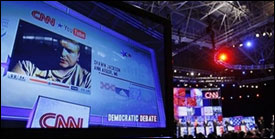
Democratic presidential hopefuls fielded questions directly from the voters Monday in a debate sponsored by CNN and the video sharing Web site YouTube. A reporter and political analyst discuss the candidates’ answers and new debate format.

GWEN IFILL: It was yet another candidates’ forum, but last night, the questions came from Internet-savvy Democrats.

REMY MUNASIFI, McLean, Virginia: My taxes put some kids through college, I can’t afford to send myself. Now, tell me, if you were elected president, what would you do to help?

GWEN IFILL: YouTube, the wildly successful Internet video-sharing service, joined with CNN to host the debate at the Citadel in Charleston, South Carolina. CNN screened 3,000 submissions. The ones that aired ranged from serious and emotional…

Read the entire feature at  The News Hour

IBM Executive Declares Web 2.0 Technology to Drive New Business Applications

Note: Archived for historical purposes.

Image source: http://www.twinsoft.fr/intl/fr/
cariocaweb/convertigo-ems-enterprise-mashup-server.htm

Text source: IBM

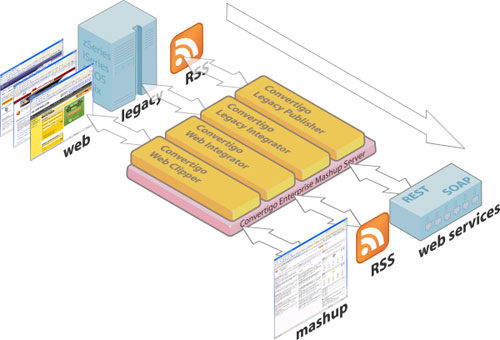
New “IBM Enterprise Mashup” Technology Allows for Creation of Five Minute Custom Applications

NEW YORK, NY – 15 Jun 2006: NY PHP Conference — In a keynote speech to leading technology executives, Rod Smith, IBM’s vice president of emerging Internet technologies, declared that the technologies underpinning blogs, wikis and innovative sites like Google Maps and Wikipedia on the Web will transform the way productivity applications are developed — in some cases in as little as five minutes — using the ever-expanding palette of Web 2.0 components available for free on the Internet.

According to Smith, the rapid adoption of Web 2.0 technologies is encouraging clients to experiment by marrying the growing combinations of online Web services with existing data and information from inside their business, enabling the creation of new applications that bring the experience and utility of popular next-generation Internet applications to business users.

Read the rest of this entry »

Current Projects


    Books


    Remix Theory | is an online resource by Eduardo Navas. To learn more about it read the about page.

    Logo design by Ludmil Trenkov

    http://www.mentalhealthupdate.com/