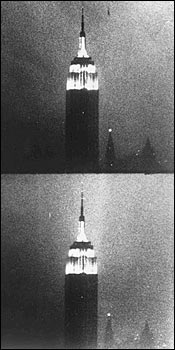
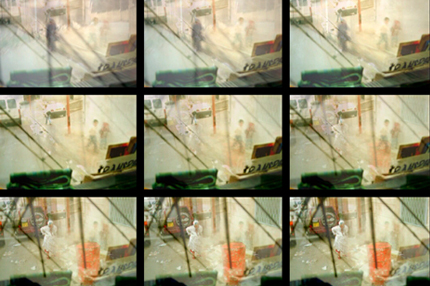
At eight hours, Andy Warhol’s 1964 film Empire is something that one watches, as its creator said, “to see time go by.†Officially, the only way to see the artist’s epic stationary shot of the Empire State Building is to borrow a 16-millimeter print from MoMA or attend one of the museum’s infrequent screenings (there’s one on November 20). But a one-hour edit appears on a new Warhol-film DVD, Four Silent Movies, released by the Italian company Raro Video. “It’s a bootleg!†says Geralyn Huxley, a curator at the Andy Warhol Museum in Pittsburgh, which owns the artist’s films. Raro says the disc is authorized; the museum disagrees and, says Huxley, may sue.
The qualities that make Empire a precursor to reality TV—no script, elevation of the mundane—would seem to encourage sampling. But defenders of the film (which Warhol slowed down; shot at 24 frames per second, it’s projected at 16) say it simply can’t be cut. “It’s conceptually important that it’s eight hours long,†says Callie Angell, director of the Whitney’s Warhol Film Project. “Some people show it at the regular sound speed to make it go by faster, and I just think that’s not the film.†Seeing the whole thing offers surprises, she adds. “[Warhol and Jonas Mekas] were shooting it from the office of the Rockefeller Foundation in the Time-Life building, and when they changed the reels they’d turn the lights on. In three reels, they started before they turned the lights back off, so you can see a reflection of Warhol and Mekas in the window. No one had ever mentioned that before. Probably no one ever had sat through the whole thing.â€
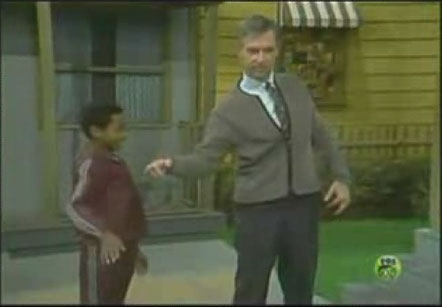
I recently ran into some interesting remixes of Mr. Rogers and a young breakdancer in Youtube. The original excerpt in which Mr. Rogers interacts with a young African American boy already has sexual and class tensions, which could be ignored by the average viewer. But these tensions are brought forth in a one minute remix titled, “Mr Roger’s Breakdance Remix” in which Mr. Rogers states repeatedly “Hey Jermaine”, “Breakdancing with your friend…” and “I really like the way you do that…”
And then there’s another remix titled, “Mr. Rogers Was a B-Boy MOFO ! (feat NWA)” which is subtle in its intervension: it leaves the entire video clip intact, except for the moment when the young boy performs. In this remix, the original musical composition, which is non-intrusive, middle of the road, and exudes enough funk for the young boy’s moves to feel authentically off the street, is replaced by one of NWA’s track “F__k the Police” from back in the day–cursing from beginning to end. And like the previous remix, this one also makes obvious the cultural tensions at play between the two individuals. Mr. Rogers’s pleasant stride feels a bit forced, and when the music is over, he appears a bit out of touch with the boy’s performance.
These are multiple readings that any Mr. Rogers fan may want to retaliate against or at least play down, but one only has to look at the original clip carefully to sense the tension that the two remixes have brought forth for critical reflection. And this does not necessarily mean that there is something “wrong” with Mr. Rogers’s behavior, or with his interest in featuring a young breakdancer in his popular show. It just means that the remixes are able effectively to make obvious the social codes that both Mr. Rogers and the boy carry based on their ethnicity, class and gender, that are already at play in culture and they both, as well as us (the viewers), should be aware of.
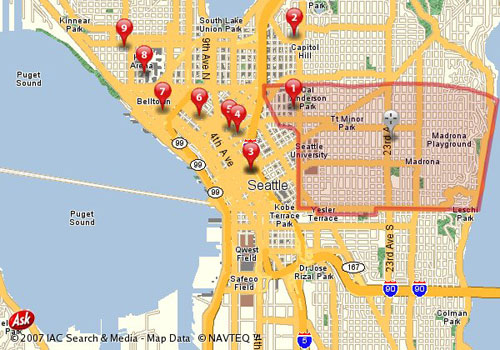
I’ve been a fan of Ask’s Maps product, Ask City, since it launched (Radar post). Now Ask has made its web app viral by adding embeddable maps.
Much like Google’s embedded maps (Radar post), this only requires a simple cut-n-paste to utilize the feature. You can use all of Ask’s mapping tools, including drawing tools and movie searches on an embeddable map.
I am surprised that Ask is the first of the major mapping portals to add this feature after Google. I don’t see this as a copy or a me-too feature. I see embeddable maps as one of the fundamental features that a user is going to expect from their mapping portal — just like one does a video or photo sharing site.
More types of websites are going to become easily, anonymously embeddable in the future. When users put work into customizing or upoading content, they are going to want to be able to put it on their own sites. Google has been experimenting with embeddable Ajax search widgets, but those widgets still exist under the Google Code umbrella. I bet that many of these search pages (multimedia, web and local) will soon have their own embed links.
Note: This text summarizes the expectations of an online project by the Washington Post, which is no longer active. The project is worth keeping in mind as a stepping stone and experiment to develop interesting tools for Web 2.0
The Washington Post Co. has launched a new site called Post Remix, described as “the Post’s official mashup center.” Available at http://blogs.washingtonpost.com/post_remix, Post Remix spotlights reader creativity with both washingtonpost.com RSS feeds and other streams of content The Post is making available. The site launched around mid-November, and that’s been plenty of time for interesting content to appear on it. A blog format provides an overview of reader-submitted projects, ordered by date. Among the spotlighted applications are a site that offers Amazon.com book suggestions based on washingtonpost.com content, automated text-to-speech podcasts of Post stories, and a “Tag Cloud” overview of washingtonpost.com content. All these applications use RSS feeds of washingtonpost.com content.
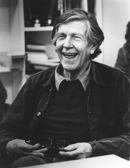
To mark the occasion of what would be John Cage’s 95th birthday, WNYC has put together an amazing collection of audio and video from their archives. Video of seminal performances, interviews with the artist, as well as a few oddities including his appearance on the 1960s show ‘I’ve Got a Secret’ are posted along with writings by the composer. Cage collaborators including Joan LaBarbara, Meredith Monk, and Merce Cunningham also share their stories and insights into Cage as both a collaborator and friend. The festival airs on WNYC2 from September 5th at 12PM until 12:33PM September 6th, with video, audio, and textual documents available on their website.
We are being hosted by CEOs for Cities member Doug Kridler at The Columbus Foundation this afternoon. Thirty locals from business, health care, nonprofits, government, and philanthropy have gathered to work through Charlie’s ideas using their own experiences.
Charlie has gone right to the point: How do you orchestrate contributions by large numbers of people to solve problems? Is it possible to attack the opportunities and challenges the way Google or
eBay would attack them?
Think of an egg. For any issue area, there is a small core of that egg that represents the institution, such as police, schools, hospitals, performing arts centers. But the rest of that egg is outside the institution – learning, safety, health, culture. While the institution is fixed cost and hierarchical with budgets and
buildings, the rest of the egg is fuzzy and distributed and complex.
On the hip-hop scene, “beatboxing” — the term for the art of creating rhythms and sound effects with the human voice — has taken a back seat to rapping, DJing, emceeing, break dancing and graffiti art since it surfaced in the ’80s.
Until now.
The popularity of beatboxing is growing, and one indication is the 2007 West Coast Open Human Beatbox Battle, which takes place Friday night at the Ashkenaz music and dance club in Berkeley, where artists will create all kinds of beats, sometimes while playing along with other instruments.
Thirty-seven-year-old Anthony Rivera (a.k.a. Click) has been beatboxing for 22 years. His work was heard in the 2002 Eminem movie “8 Mile.” Rivera says, “I’ve seen beatboxing change. People are starting to get more creative, getting closer to the actual sound (of percussion instruments) than we did back in the day.”
In the middle of last year, I invited Dion to meet with me and other members of Microsoft’s Data Programmability team to discuss REST in the context of data access over the web. Dion’s perspective is one of the reasons our team was able to recognise the potential of a RESTful programming model against relational data, manifested today as Project Astoria.
I’ve been waiting to read Dion’s thoughts on Project Astoria (via John Musser). It’s an interesting take, contextualizing Astoria within the overall architectural trends we’re seeing take place.
Note: Below are a couple of comments on Nine Inch Nails’ current project, which consists of inviting fans and music enthusiasts to mashup one of NIN’s new songs “Survivalism” to their hearts’ content. This project is welcomed and reminiscent of the pioneering project A Bush of Ghosts by Brian Eno and David Bowie. Also see: http://bushofghosts.wmg.com
———-
“Nine Inch Nails Invites Mashups,” by Jonathan at Ampheteme.org
Trent Reznor’s inviting you to mash-it-up. He invites you to go absolutely nuts with his latest creation, the tracks that come together to make the song “Survivalismâ€. Feel free to interpret the tracks any way you wish he says, and add your own. And he’s asking you (because of his partnership with Apple I presume) to use Garageband. I don’t mind. Garageband 3’s one pretty damn cool piece of work. At any rate, I’m a big NIN fan and I’m happy to see him once again inviting remix interpretation. Pick up all the details at yearzero.nin.com.
———-
“A mashup on Garageband takes music experiences to a new level,” by Stephen Abbott
Published on 3-26-07
Trent Reznor of Nine Inch Nails is pushing the boundaries of a music experience to new levels. According to an article in Digital Music News, Reznor is making a single from the upcoming album, Year Zero, available for “remix interpretation”. The interesting twist to this is that it is being done in a sort of collaboration with the latest release of Garageband 3, part of Apple’s iLife suite.
Garageband users can adjust a number of tracks that make up “Survivalism,” and add their own elements as well. Once created, the tracks can be shared, ripped and distributed at will. According to an Apple representative, other songs from the album are also on the way.
The ability to share and distribute the personal remixes is huge. Perhaps ability is the wrong word – the encouragement to distribute these remixes is incredible. The artist is giving open permission to use his work. There could be literally thousands of interesting and unique interpretations of NIN’s musical talent. Of course, there are going to be many more versions that suck, but those will fade away soon enough.
I’ve been a longtime fan of musician and artist Sebastian Meissner who releases beautiful and often unsettling ambient music under the moniker Klimek on Kompakt. I began a dialog with Sebastian when I tipped him off that I had used a Klimek track to score my Kamera Obscura project, and as we chatted back and forth I realized he was the creative force behind a number of other projects that have showed up on my radar over the years.
Sebastian is also behind or was involved in: Bizz Circuits, Autopoieses (with Ekkehard Ehlers) and Random Inc. In addition to the Klimek material that I find so mesmerizing, the Random Inc. record Walking In Jerusalem was one of my favourite albums of 2002, and Autopoieses’s locked-groove laden La Vie À Noir Transposed didn’t leave my crate for two years when I was still playing records.