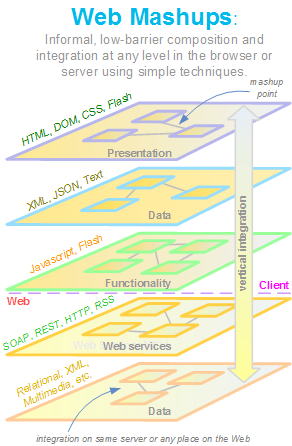
ZDNet blog colleague Joe McKendrick beat me to the punch earlier this week with an excellent analysis of the fascinating ramifications of IBM’s recent statements at the New York PHP Conference aimed at mainstreaming mashups and Web 2.0 technologies. If IBM is getting seriously involved in this, there must be something to it, and certainly Rod Smith’s comments are receiving considerable attention.
Interestingly, most enterprises I talk to these days barely have mashups on their radar, yet I also continually hear from those same folks about how hard it is to create increasingly integrated business applications, as well as the slow pace of rolling out new functionality to users and customers. There indeed seems to be a rising corporate appetite for faster, more effective ways of building applications particularly when reusing existing IT software and information assets.
Hip hop as a ding an sich is marked by some confusion. Consider the name; is it “hip hop,” “hip-hop” or “hiphop”? You will see all three used in titles in this bibliography. Hip hop is, at the same time, a cultural phenomenon that developed in the late 70’s in the projects in Brooklyn and the Bronx, and a musical style from that phenomenon. Nevertheless, hip hop has become a pervasive element of popular culture, as witnessed by this bibliography. There are hip hop exercise videos, children’s books as well as books, magazines, magazine articles and theses about it.
From this Friday until the beginning of August, Sao Paulo’s Galeria Vermelho hosts one of the most riveting exhibitions of the summer. Curated by local critics Fernando Oliva and Marcelo Rezende, ‘Communism of Form: Sound + Image + Time ? The Music Clip Strategy’ brings together works by 30 Brazilian and international artists that reflect, examine, or evoke the aesthetics of the music clip within contemporary visual culture. The show’s organizing principle takes on French critic Nicolas Bourriaud’s definition of ‘communism of form,’ an expression that identifies the current art practices based on an immense library of images, emotional states, and psychological experiences generated by post-Fordist societies that are shared both by the artists and the audience–as the music clip– that thus engage in a participatory relationship with the pieces. Many artists–such as Forsyth & Pollard (UK), Apichatpong Weerasethakul (Thailand), Nuevos Ricos (Mexico), Laibach (Slovenia), and Tetine (Brazil)–developed new works, addressing with different and surprising styles the fundamental elements of the music clip: sound, image, and time. As Oliva and Rezende say, ‘the music clip, with its absence of an hierarchy between the old and the new and the technological and the craft, puts in motion all the world�s repertoire.’ A blog comprising several posts–from film stills to YouTube videos–and a book with various commissioned essays and interviews discussing the theoretical frame of the show complements this project, expanding its original and very opportune features in unexpected ways and furthering the debate around this prominent cultural expression. – Miguel Amado
The Mass Museum of Contemporary Art (Mass MoCA) is located in North Adams, a small city (pop. 15,000), in northwest Massachusetts that is a three-hour drive from New York City or Boston. The museum is located in a former mill complex, built in the 1860’s. During the American Civil War (1861-65), the mill housed a textile company, the Arnold Print Works, until 1931; the Sprague Electric Company occupied the complex with more than 4,000 employees until 1985. Now that the museum is in place, the main factory with twenty-five adjoining buildings remains economically associated with this former New England mill town for over one hundred and forty years. [paragraph 1]
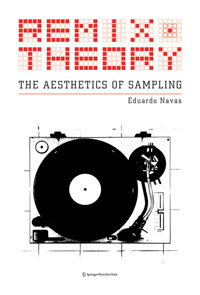
The following is a response to my brief posting about KnowProSE’s entry on a Cultural Remix. I have no comment at the moment, but KnowProSE’s response is worth considering. I’m sure to write something about it in the near future. For now I leave you with KnowProSE’s comment (which starts with a Quote from Remixtheory):
RemixTheory commented, based on this entry:
“This particular video is contextualized as a “Remix.†I’m not sure I would agree completely, because it is more of a performative hybrid of different styles–rather than a sampling of material. Regardless I do find the comments by KnowProSE worth quoting below.”
Well, I was speaking of the cultural remix – not a technical remix. It incorporates, as RemixTheory says, a hybrid of styles. So I watched the video again – it is a cool video – and I kind of have to disagree on the technical remix standpoint. The DJ isn’t scratching with empty records, but that’s hokey. However – the English is probably sampled — ‘Yeah… there there there it is…”.
Still, I meant it as a cultural remix, and a tribute to the ability to mix cultures effectively. It is not far removed from what Lawrence Lessig wrote of (and hopefully still writes of!), and it is also not far removed from protecting people from a patent process which is a little nuts.
Note: Though the term “Remix” may be over-extended in this particular video interview with Harold Bloom by Charlie Rose, one is more than likely to learn a few things about important literary texts and their current interpretations.
“Architecture is either the prophecy of an unfinished society or the tomb of a finished one.”
— Lewis Mumford, 1934. [1]
Of all the varying impacts of postmodernity (whatever we can or cannot agree that to mean) one of the most ubiquitous has been the preponderance of Lifestyle as ‘a life of style’ — the “Wallpaper*ization”[2] of the proposed environment we are meant to inhabit. The stylist, the designer, the imitator has sought to create a modernism within postmodern eclecticism. Yet this is a modernism that only embraces the totalitarianism internal to a mis-read Nietzschean-derived will to power and order.
While it could be argued that postmodernism was the triumph of theory over substance, it was a reversal of a Marxist derived modernism: now all that melts becomes solid in the air. Like melting substances, disorder became the form of representation. Like a melting substance, that which seemed ephemeral became attached, sometimes organic, sometimes as collage but always, and this is crucial, as a form of ornamentation.
29 June 2007
Working out how people use a city’s roads and planning for it, can be difficult, but research into mobile phone use may hold the key to preventing traffic jams in the future.
A map showing real-time data of mobile phone use
Mobile phone data can help planners see how people use a city
If you do not like crowds, congestion, chaos – and few do – then you might want to avoid Rome’s rush-hour. But congestion in the city might be about to ease a little as researchers use Italy’s passion for mobiles to combat Rome’s daily war on wheels.
Researchers from Massachusetts Institute of Technology (MIT) are using data from mobile-phone networks to create real time maps of people moving around the city.
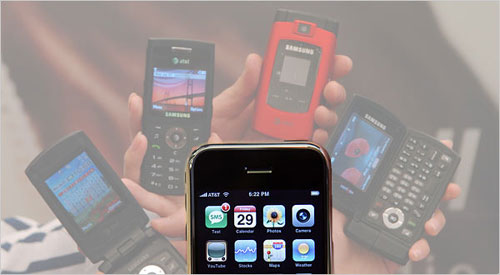
SEOUL, South Korea, June 29 — While Americans have been blitzed with news about the iPhone’s debut, many in South Korea’s and Japan’s technology industries initially greeted Apple’s flashy new handset with yawns.
Pantech’s design center in Seoul, South Korea. An executive at the company says that riding on Apple’s coattails may turn out to be the best business strategy.
Cellphones in these technology-saturated countries can already play digital songs and video games and receive satellite television. But now that analysts and industry executives are getting their first good look at the iPhone, many here are concerned that Asian manufacturers may have underestimated the Apple threat.
Remember the fairy godmother in “Cinderella� She’d wave her wand and turn some homely and utilitarian object, like a pumpkin or a mouse, into something glamorous and amazing, like a carriage or fully accessorized coachman.
Evidently, she lives in some back room at Apple.
Every time Steve Jobs spies some hopelessly ugly, complex machine that cries out for the Apple touch — computers, say, or music players — he lets her out.
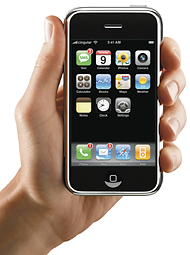
At the annual Macworld Expo in San Francisco, Mr. Jobs demonstrated the latest result of godmother wand-waving. He granted the wishes of millions of Apple followers and rumormongers by turning the ordinary cellphone into … the iPhone.