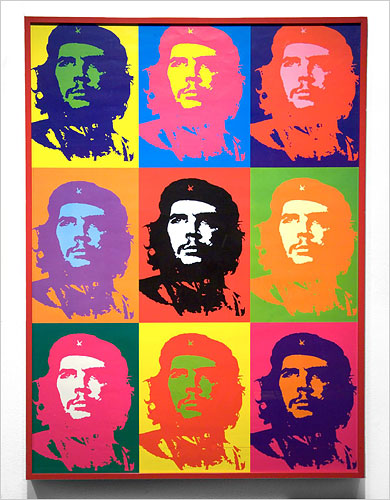
Che Guevara got some attention at the beginning of 2009 with Steven Soderberg’s film Che, starring Benicio del Toro. More recently, Che is the subject of a book titled, Che’s Afterlife, by Michael Casey. The book is reviewed by the New York Times as a detailed account of Che’s famous image taken by Alberto Díaz Gutiérrez, known professionally as Korda. The story goes that Korda took the photograph during a funeral in Cuba. Korda’s creativity was not only in knowing when to take the photograph, which is for what most photographers are praised, but also in knowing how to crop it. To quote directly from the New York Times:
“By radically cropping the shot, snipping out a palm tree and the profile of another man, Korda gave the portrait an ageless quality, divorced from the specifics of time and place.”
This divorce is what Walter Benjamin noted in the first half of the twenty century in his well-known essay “The Work of Art in the Age of Mechanical Reproduction.” An essay that many cultural critics have cited and will probably cite, because Benjamin foresaw many of the elements that today inform media culture in all areas of reproduction. (more…)
Note: The following interview was originally published on Digicult in February 2009. The introduction has been translated from the Italian by Lucrezia Cippitelli. It is here published as originally written. I would like to give a humble thanks to Lucrezia for her introduction, which I think gives me more credit than deserved.
Three years ago I had a long interview with Eduardo Navas about his editorial project, newmediaFIX, the online platform that republishes and redistributes texts and interviews from the most influential international magazines focused on art and media (between them Digicult) and which I collaborated with as editor for almost one year. Recently, I met Eduardo again by e-mail for another interview about his last online project, “Traceblog,” launched on October 2008. ”
The artist, theorist, curator and scholar from the United States works on software and web-resources for blogging. He reflects upon the dynamics of the Internet, the concept of Remix and distribution of concepts and information in culture, since the beginning of his artistic career. He is now one of the most influential voices on network cultures and use/abuse of its tools. As Eduardo asserts in this long chat, referring to “Traceblog” but it could be related with his art practice at large: “I aim to explore the implications of the growing pervasiveness of information flow and its manipulation. From this point of view, I see it in direct relation to my ongoing investment in blogging culture.”
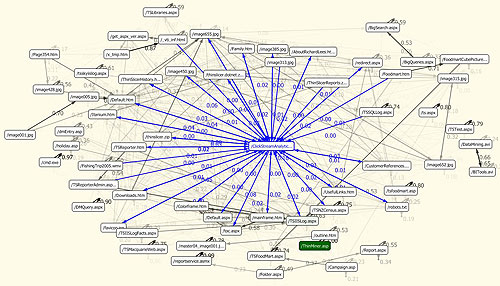
In line with his early net art projects as Goobalization and Diary of a Star, while simultaneously following Eduardo’s theoretical researches on blogging and remix, “Traceblog” is an online artwork that appropriates the free Firefox plug-in (Track me not), created by NYU developers and researchers Daniel C. Howe and Helen Nissenbaum. The plug-in is designed to obfuscate the transparency of the online activities of Internet users. As result, “Traceblog” publishes the pseudo logs of Eduardo’s daily online searches and activities on a web site http://navasse.net/traceblog/. The same website contains links to the explanation of the project, links to the Firefox plug-in and some tools that make users aware on how to hide search trails.
“Traceblog” makes visible how our daily Internet activity is tracked by the browser we use and produces an archive of all our data and information that could be used for commercial and control purposes. A fact is that data mining is totally out of control if we consider all the web 2.0 platforms, that stimulate Internet users’ obsession to expose themselves and constantly be in touch: just consider common tools as Blogger, propriety of a big commercial corporation as Google, just to make an example. We could name a few others such as Facebook, Twitter, Linkedin, and also (although they are not related with browsing), Skype, Msn, the free services for email and so on and so on… We talked with Eduardo about all that and much more.
One of the anxieties often cited by those who guard intellectual property is how artists who sample ultimately steal from those who created the “original” material, therefore taking away potential revenue from the original source. Another common argument is that the original source runs the danger of going unrecognized by those who enjoy the material composed of samples. Even if sampling artists may pay royalties, it is often argued by those who believe in creating things with their bare hands that artists who sample are simply unoriginal. Yet, as the article “What is your sampling Epiphany,” by Simon Reynolds entertains, at the moment, the republishing of material as a set of recordings sampled by well-known music studio artists has the potential of becoming a common trend–not to mention a major form of revenue for record companies.
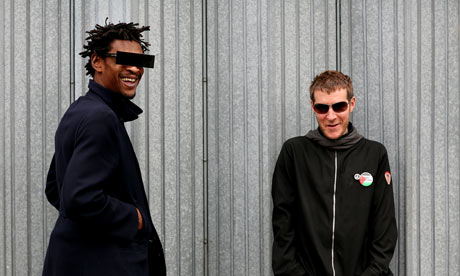
We have reached a state in the consumption of post-production when those who have developed a career based on other artists’ samples have become the ones who support renewed sales of the originating sources in the form of reissues. This is the case with Massive Attack’s Protected Massive Samples. Now, it appears remix culture is coming full circle. The implications of this trend might further complicate copyright law in the near future. This trend is worth keeping in sight.
The article by Reynolds ends with a very compelling citation of Virilio, which was actually forwarded to me by my colleague, Greg Smith. It reads more like an aphorism that exposes that dialectics of culture:
Critical Note: Janneke Adema recently wrote a long post on her blog Open Reflections about remix culture, titled “Schyzophonia. On Remix, Hybridization and Fluidity.” Aderna cites parts of my essay “Remix The Bond of Repetition and Representation” in order to extend her own views on remix culture. One thing that caught my attention is the concept of the “work in progress” which she entertains when citing an interview with Joe Farbrook. Farbrook’s propositions are parallel to my own views on constant updating, about which I wrote a couple of years ago in another essay titled “Regressive and Reflexive Mashups in Sampling Culture.” Adema interestingly enough considers knowledge remixable, and she cites my own position on history to support her argument. While I don’t think knowledge itself is necessarily remixable in terms of Remix proper, I am compelled by Adema’s argument. On this regard, the following question recurs: When should one stop calling cultural hybridity a form of remix? On her part, I think Adema does a good job in entertaining this preoccupation, ending with a reference to none other than Walter Benjamin. The article is worth a careful read. Other great resources are mentioned as well.
———–
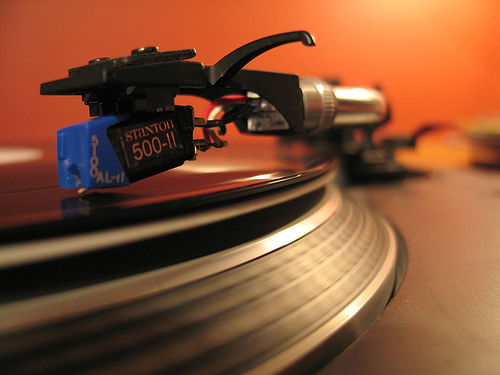
I read Lawrence Lessig’s Remix a few months ago, a great book with a stimulating positive approach to the whole piracy and copyright problema, focusing on finding solutions which cater to the increasingly prevailing remixed and remediated forms of digital art and culture, in which the hybrid has become common ground. Lessig discusses new musical ‘innovators’ like Girl Talk, who creates elaborate and eclectic remixes of current pop sounds and anthems, creating a new musical discourse which reflects, winks, ironizes and mocks, while still standing firmly on its own. These kind of adaptations, versionings or reinterpretations have been part of music since its beginnings, coming to the forefront mostly in dub, hiphop, turntablism and the use of samples in electronic music. Just think about all the beats, breaks, loops and glitches that have made a career for themselves and their derivative offspring in musical history.
Cultural Center of Spain invited me to lecture in San Salvador, El Salvador from March 8 to the 13, 2009. During this period I also learned about the contemporary art scene as well as the art history of El Salvador.
I presented my research on Remix at the Cultural Center on March 10, and I lectured on art and new media in the Department of Visual Arts at the University of El Salvador (popularly known as La Nacional) on March 11. I met artists from different generations, some who are becoming more established, and some who are up and coming. I also visited the Museum of Art (Marte) which currently is exhibiting a thorough survey of Art in El Salvador since the 1800’s
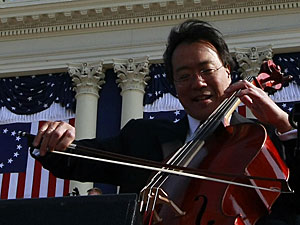
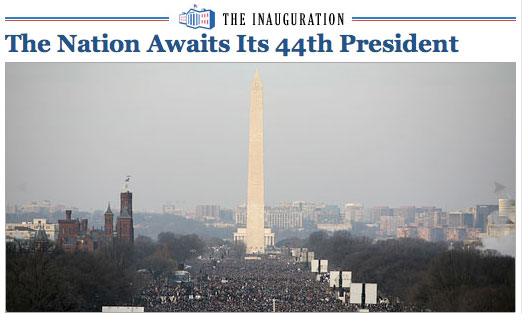
The millions of people that viewed on TV and online Barack Obama’s Presidential Inauguration may be surprised to learn that Yo Yo Ma and his quartet did not play live. They performed to a pre-recorded track. The argument for this maneuver is that the moment had to be perfect. The performance had to live up to the occasion and mistakes could not take place:
NPR intereviewed Yo Yo Ma, who was indifferent about the fact that he did not play live. He was quite comfortable with make-believe. The NPR correspondent did not question Yo Yo Ma’s performance for its artistic delivery. The discussion was more about the necessity for this type of simulacrum.
I wonder how far we have come since the days of Milli Vanilli, when the pop-duo saw an end to their careers because they lip-synced to pre-recorded tracks. It must be pointed out that Milli Vanilli did not actually sing at all, so in this sense Yo Yo Ma’s situation is quite different because, as he explained during the radio interview, the quartet had performed the composition the day before the Inaugural Ceremony. Regardless, the fact that, both, the New York Times as well as NPR appear to discuss Ma’s simulacrum with some comfort and amusement does expose the awareness by people and the media that recordings may be acceptable to use in special occasions. In the past, prior to the pervasiveness of recordings, rituals were bound to the immediacy of the moment. Now, rituals are bound to the ever more important perfect recording for posterity. It was more important in the name of history for the Inaugural to have a perfect performance, than to have a real performance.
Just a brief entry to mark the Inauguration of the 44th United States President. Already many articles are being written about Bararck Obama and this day. NY Times has written about Europe celebrating:
The new presidency stands for a new phase in the history of the United States as well as the entire world. People are aware that today is a historical day. This will be like other major events when one remembers where one was at the time it took place.
The following text was published in December 2008 in Inter/activos II by Espacio Fundacion Telefonica, Buenos Aires. The publication was produced in support of a new media workshop and theory seminar by the same name which took place in 2006, organized by curator and writer Rodrigo Alonzo. The text revisits my definition of Remix that has already been introduced in prior writings, such as Turbulence: Remixes and Bonus Beats. This definition can also be found in the section Remix Defined. “The Bond of Repetition and Representation” links the theory of Noise by Jacques Attali to my overall argument that Remix has its roots in DJ Culture starting in the seventies. In the conclusion it revisits and extends my analysis of Yann Le Guenec’s project Le Catalogue.
Some things have changed since I first wrote this essay in 2006. I did not expect the print publication to take as long as it did, but now that it has finally been published, as opposed to updating the text, I have chosen to release it online as it was originally written. While some cultural trends may be quite different from 2006, the argument proposed is still relevant. This analysis is part of a much larger and extensive project and will be eventually released in its remixed form in the future.
The term remix, today, is used to describe various cultural elements, from mash-up software applications[1] to projective architecture.[2] No matter what form it takes, the remix is always allegorical, meaning that the object of contemplation depends on recognition of a pre-existing cultural code.[3] The audience is always expected to see within the object a trace of history.
To entertain the importance of Remix in culture at large, we must come to terms with it according to its historical development. This will enable us to understand the dialectics at play within Remix, which at the beginning of the twenty-first century is the ideological foundation for remix culture. As it will become clear in this essay, in order for remix culture to come about, certain dynamics had to be in place, and these were first explored in music, around the contention of representation and repetition. This essay will focus on defining remix in relation to these two terms, and then move on to examine its role in media and art.
Image source NYTimes: Batman, Dark Night, Warner Bros. “Supporters say Blu-ray had a breakout year, crowned by “The Dark Knight,” which sold 600,000 Blu-ray copies in one day.”
Normally, I’m not so concerned with reflections on the old year at the beginning of the new. However, the NY Times article “Blu-ray’s Fuzzy Future” exposed some of the tendencies that developed in 2008, which will become more pronounced in 2009.
The article entertains how Blu-ray, even after displacing HD DVD in the digital video market is currently struggling. Blu-ray’s competitor this time is not another DVD based technology, but rather a networked technology. The Internet is Blu-ray’s next competitor, as the article notes. The preoccupation of Blu-ray developers is that it is very likely that people will be moving towards machines that allow for movie downloads much in the format of On Demand services in cable networks across the United States. So, Blu-ray is introducing in the near future a feature that will allow people to download material from the Internet:
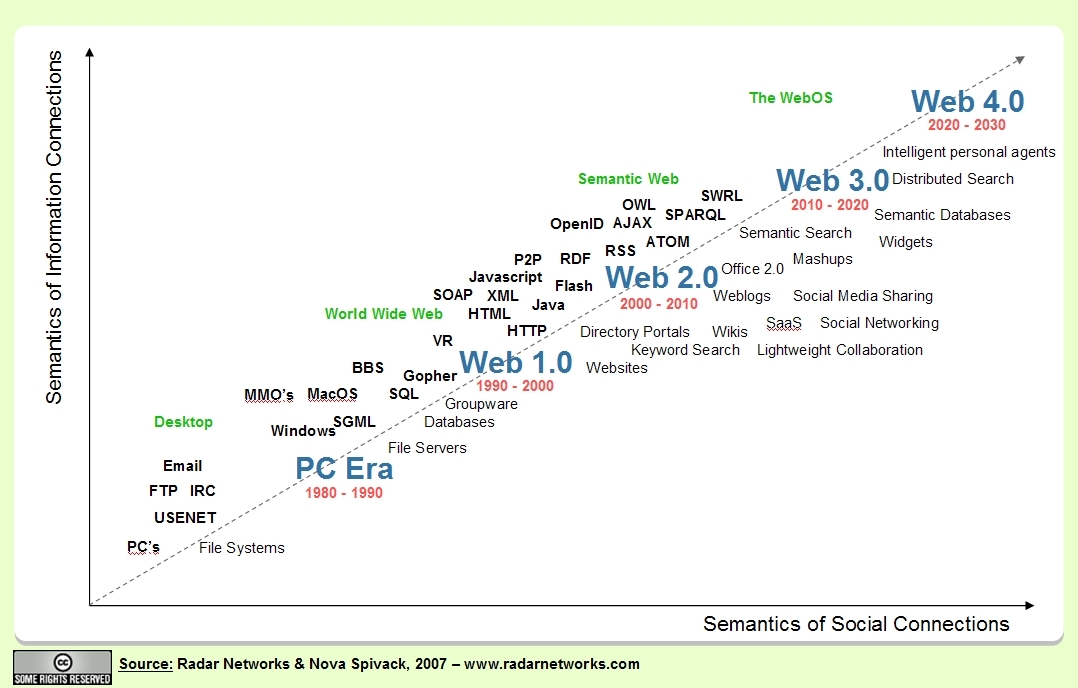
The past, present and future of the web are presented in the above diagram. The image is peculiar for proposing a linear development towards AI. It appears that we are about to enter Web 3.0,or perhaps we may already be there. The mashup, social media sharing, and social networking, are presented as transitional elements from Web 2.0 to 3.0. However, It is not clear to me what lightweight collaboration might be.
Below are some interesting articles on the future of the web:
Entrepreneurs See a Web Guided by Common Sense
By JOHN MARKOFF. Published: November 12, 2006 … Referred to as Web 3.0, the effort is in its infancy, and the very idea has given rise to skeptics who …November 12, 2006 – By JOHN MARKOFF – Business
What I Meant to Say Was Semantic Web – Bits Blog
Until web 3.0 comes around or the monitors allow our comments I would like to hear more. …. John Markoff. Reporter, San Francisco …October 19, 2007
John Markoff – Bits Blog By John Markoff. Radar Networks is introducing Twine.com, a service that uses semantic Web technology, sometimes called Web 3.0, to improve sharing …