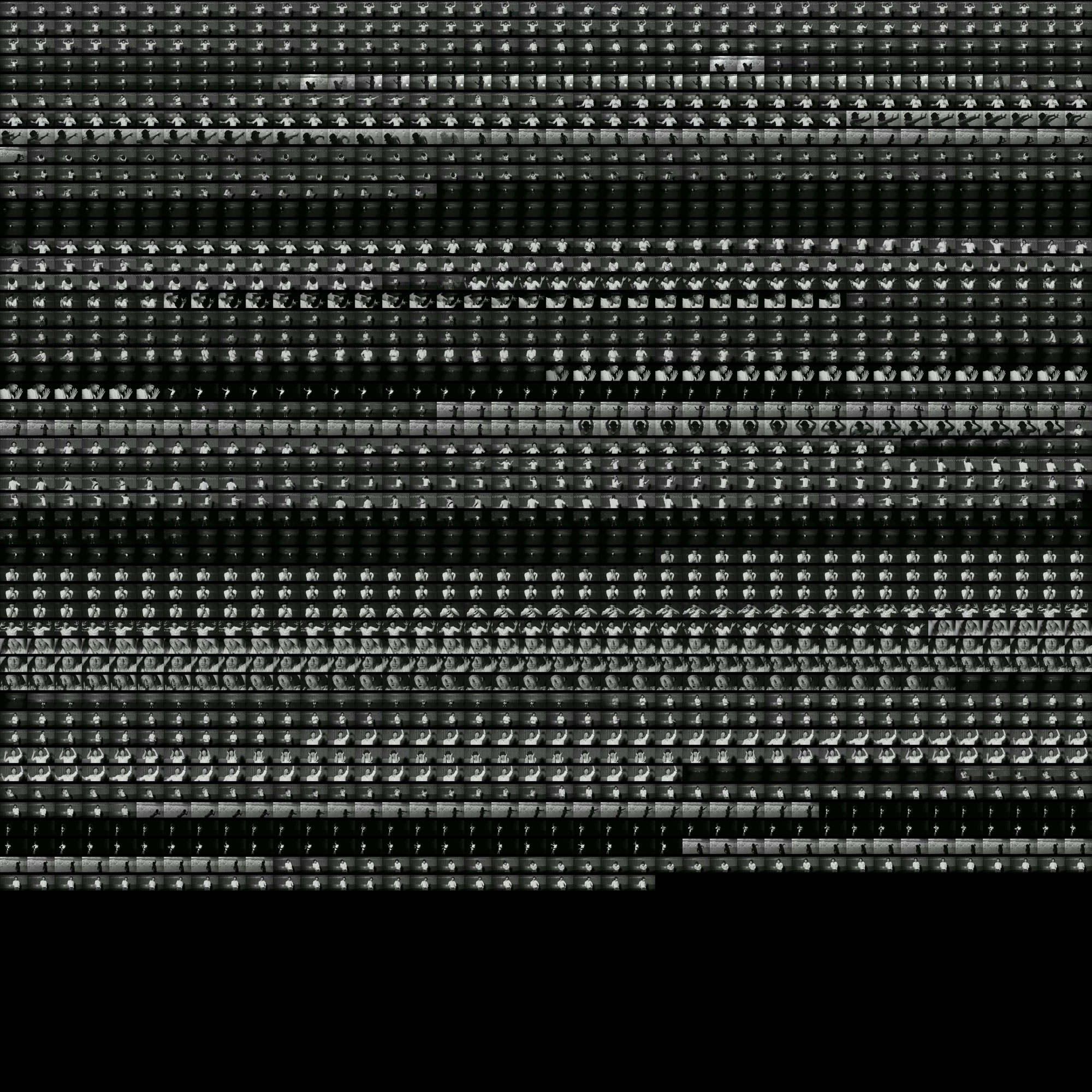
ImagePlot is a free software tool that visualizes collections of images and video of any size. (The largest set we tried so was: 1,074,790 one megabyte images).
ImagePlot works on Mac, Windows, and Lunix.
Max visualization resolution: 2.5 GB (2,684,354,560 grayscale pixels, or 671,088,640 RGB pixels).
ImagePlot was developed by the Software Studies Initiative (softwarestudies.com) with support from the National Endowment for Humanities (NEH), the California Institute for Telecommunications and Information Technology (Calit2), and the Center for Research in Computing and the Arts (CRCA).
Along with the program, we also distribute a number of articles by Lev Manovich, Jeremy Douglass and Tara Zepel that address methodologies for exploring large visual cultural data sets, and discuss our digital humanities projects which use ImagePlot. (The articles can be also downloaded directly from softwarestudies.com.)
Visualizations created with ImagePlot have been shown in science centers, art and design museums, and art galleries, including Graphic Design Museum (Breda, Netherlands), Gwangju Design Biennale (Korea), and The San Diego Museum of Contemporary Art.
ImagePlot software was developed as part of our Cultural Analytics research program.
Everything is a Remix is a four part web-film series directed and produced by Kirby Ferguson. It has been about a year since the first segment (above) was released. Since then, Ferguson has released parts two and three. The fourth and final installment is scheduled to be released this Fall of 2011, and I look forward to viewing it.
When I viewed part one, I really liked it, and thought that the title, while it may sound polemical to some degree (in a tongue-in-cheek sort of way), somewhat falls along the lines of how I view and have been discussing Remix as a form of discourse during the past few years. However, once I viewed the other two segments, I realized that the way some of the material is presented begins to water down the very foundation of the term “remix.”
For this reason, while I do like very much Ferguson’s series, and often share it as a reference with anyone who wants to get a sense of Remix as a form of discourse, I find the need to write down some of the issues that may be overseen in Ferguson’s series.
This oversight perhaps may be in part because short films cannot possibly cover in-depth analysis as a series of texts or a book would. On the other hand, it may be inevitably tempting to make an ever-expanding megamix about culture and media with a generalization that one cannot fully embrace (though in the spirit of remixing can truly like and admire). With both of these possibilities in mind, I briefly share my views on this series.
The main issue about remixes that comes up, even in the first video, is that there is no explanation of the relation between material sampling and cultural citation. as I previously explained in Regressive and Reflexive Mashups, there is a difference between a Medley and a Megamix: the former is played by a band, while the latter is composed in the studio usually by a DJ producer, who understands how to manipulate breaks on the turntables.
What this means is that a remix in the strict sense of its foundational definition has to be materially grounded on a citation that can be quantified, in other words, measured. This is one of the reasons why DJ producers quickly ran into trouble with copyright law: a lawyer could play a sample from a Hip Hop song, in direct juxtaposition with the originating source of the sample and make evident on purely material grounds that the sample was an act of plagiarism.
But this is not exactly what happened with Led Zeppelin. What happened with Zeppelin, as the example given in Ferguson’s first segment, was straight forward plagiarism within the tradition of covers and knock-offs. Two terms that are also mentioned in the first segment as forms of “legal remixes.” What these forms of recycling content do share with remixes is intertextual citation–the embedding of ideas by way of direct or even indirect reference, which often is not materially grounded, but rather made possible through well calculated emulation.
The best example of intertextual citation in the postmodern sense would be Quentin Tarantino’s films, which are also mentioned at the end of the credits of part two. Tarantino does not sample directly from the films he references in his own work, but rather recreates the scenes or shots to develop his own narratives. This allows him to claim autonomy of the material, much in the way that Zeppelin (in my view unfairly) can still keep their credibility, perhaps on the ground of reproducing material in a unique way that is their own–even if they failed to cite the sources from which they blatantly stole.
In other words, because, both, Tarantino and Zeppelin don’t materially take, but rather emulate with great precision, their productions are not remixes by definition, but rather informed by principles of Remix as a form of discourse. Their actions are cultural citations. These details are missed, unfortunately, in the first three parts of the series by Ferguson.
Now, as it is already obvious above, I do extend the concept of remix as Remix (with a capital “R”) to pretty much all the areas of culture that Ferguson mentions in his series, including the Apple computer. But when I do this, it is to emphasize that we are functioning under a paradigm ruled by acts of material appropriation and recyclability.
The attitude of remix made possible with the technology first introduced earlier in photo-collage and tape loops and eventually music samplers, has now become an attitude, an aesthetic that informs the way cultural material is produced. But this does not mean that “everything is a remix.” This may appear to be so, but as much as I myself would like this to be the case, it is not. What one could say is that “everything is intertextual,” which is closer to the tradition of sharing ideas in conceptual and material form, prior to the time of modernism. Historically all the material covered by Ferguson is certainly relevant in terms of recyclability, but it does not validate the catch-all statement “everything is a remix.”
Understandably, “everything is intertextual” (which could also be contested if one gets really picky) is not as catchy as “everything is a remix.” To go viral, one must use what is in vogue and quickly understood. Intertextuality had its time in the postmodern period. Now, it appears that remix is the catch all phrase.
And why is it important to point out such nuances that in the end a person enjoying Ferguson’s short films may find too nit-picky? Because if we actually take the time to differentiate the referencing of ideas in conceptual and material form (ideas, and actual products reused) then copyright law may actually be changed. If we keep referencing intellectual production in general fashion as Ferguson’s work unfortunately does, we will not be able to change laws on intellectual property. It is for this reason, only, why I write this entry, because I find that the film series could benefit from understanding the important differences between material samplings and cultural citations.
I should add a note to explain that my concern here is not academic by any means, even though I make a living by working with research institutions. I have been invested in remix culture long before the very term was coined. Before investing myself professionally as a media researcher and artist, I was a DJ for over fifteen years. And for this reason, as much as I would like everything to be a remix, I have to admit that this is not the case. To be blunt, from the point of view of cultural critics who are wary of hegemony, “Everything is a Remix” can be understood as a flip-on-the-script of diversity, paradoxically, to become a totalitarian statement–that anyone who is invested in difference is compelled to resist. I say this understanding that Ferguson probably does not mean it this way, which is why I do share his work as much as I can. Kudos to Ferguson.
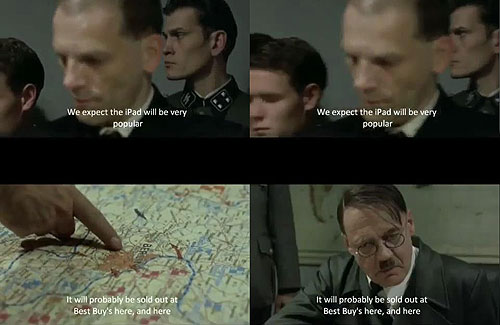
In the above video, Hitler rants about the iPad’s lack of features.
I learned about the Downfall remixes while doing research for the Charleston Style remixes. For a good assessment of its development, read Know your Meme’s blog post of August 1, 2011. These parodies consist of various excerpts from a not so well-known film titled Downfall, released in 2004, about the last days of Hitler and his inner circle before they all committed suicide. There are a few scenes that have been used for the remixes, but I chose the most popular, which is also the longest excerpt remixed, of about 3:59. The footage presents Hitler being told by key members of his inner circle that Berlin is surrounded and that it is only a matter of time before the enemy reaches them in the city. Hitler is upset about the fact that he was not told the truth sooner and rants for quite sometime to eventually come to terms with his certain defeat.
In the above video Hitler rants about not getting the role as the Joker in Batman.
The parodies consists of taking the original footage, and implementing subtitles in English that have nothing to do with what Hitler is actually saying in German. Instead, the subtitles present him ranting about the lack of features of the iPad, his realization that Pokemon does not exist, and his disbelief that Kanye West was extremely rude to Taylor Swift when West interrupted Swift’s acceptance speech at an MTV video awards to tell her that Beyonce was a much better music artist, among many other remixes. I made a definite decision to focus on the Downfall remixes after I ran into one that showed Hitler upset about the “fact” that the Lotus Flower remixes had surpassed the Downfall Parodies’ popularity on YouTube.
In the above video Hitler rants about the Lotus Flower remixes.
I consider this reference a way of coming full circle between the memes. With the Downfall parodies I was unable to find remixes before January 2007; and, therefore, I am not sure what the first parody may have been (check know your meme’s entry for a parody of 2006 that is no longer available); many which have been featured on articles by newspapers are no longer available on YouTube. Nevertheless, new ones keep showing up, as reflections and commentaries of current events.
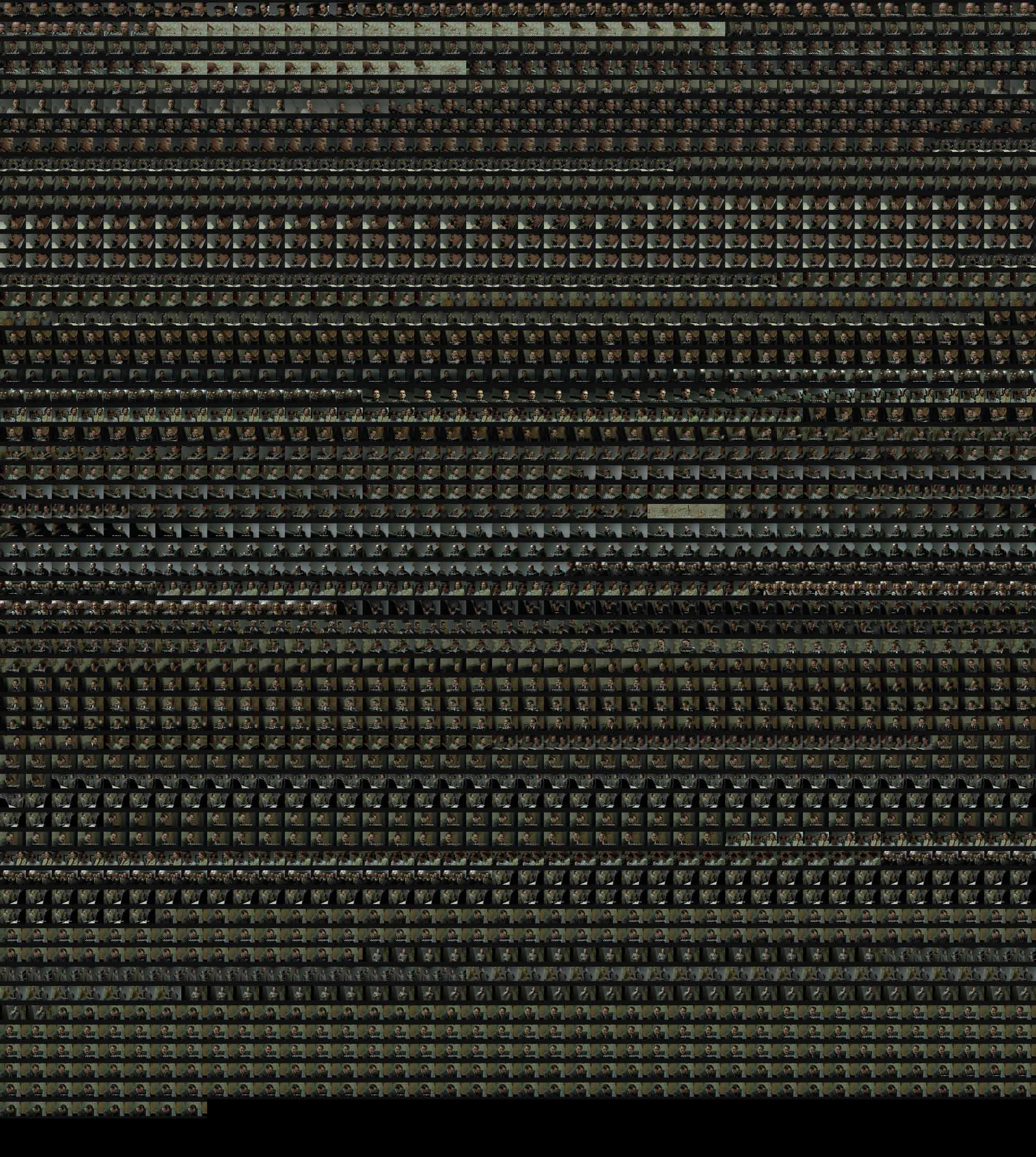
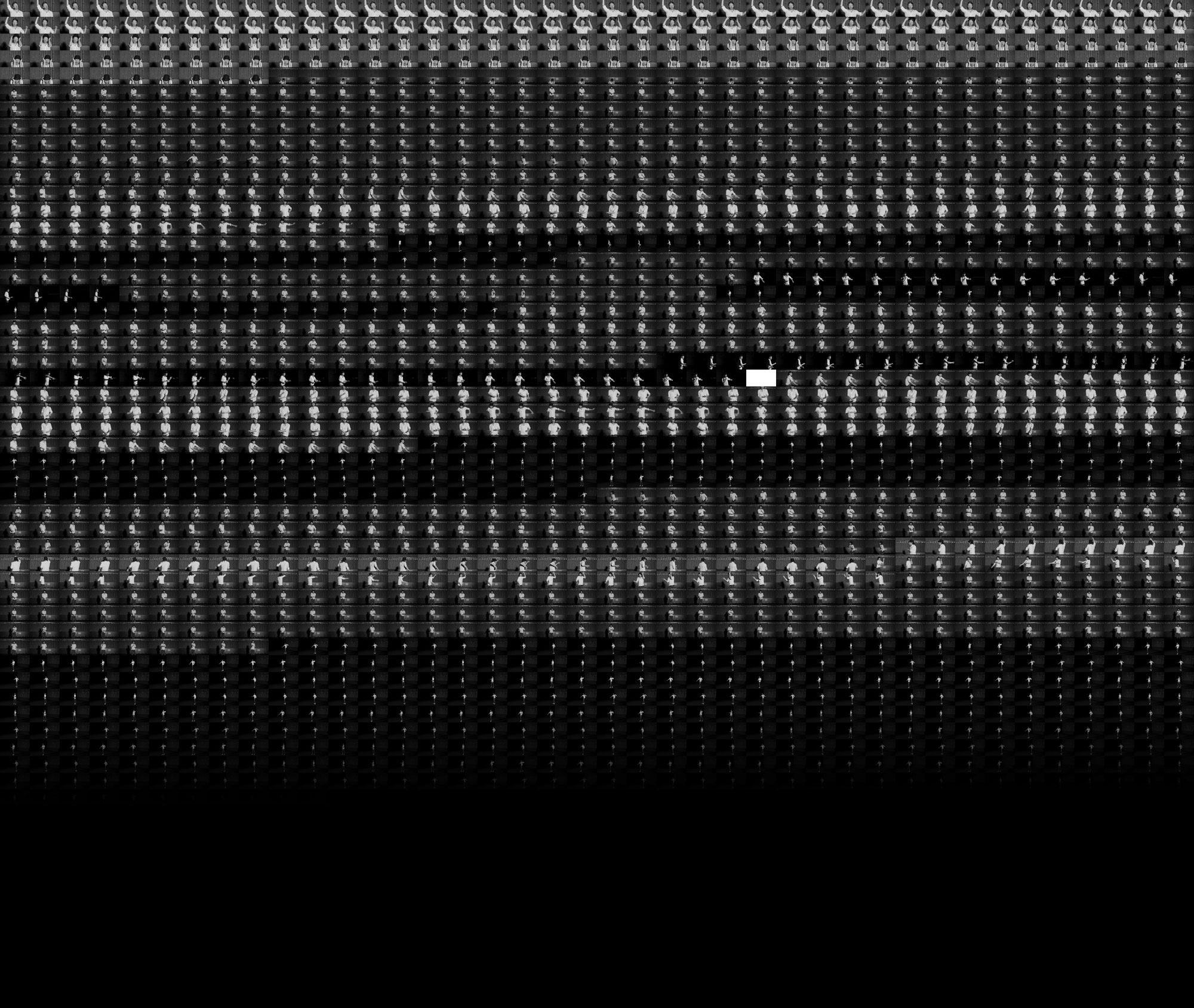
Montage grid of Downfall video, with proper English subtitles.
View 2200px wide version Note that the resolution of the grid montage I make available does not allow for the subtitles to be read.
With the Downfall remixes, the result is similar to the Charleston Remix. In the Charleston, it is only the music that is switched, and for Downfall, only the subtitles are changed; therefore, the only major shift takes place with the formal placement of translations on the screen: sometimes on the middle of the screen, but for the most part at the bottom. For this reason, I’m only showing one montage grid visualization (above).
Visualization of Downfall with original English subtitles (no longer available on YouTube). View 2000px image. The thin horizontal white bars near the bottom of the frame are the subtitles. To former link of this video is: http://www.youtube.com/watch?v=4bmkUlXp5sk&feature=related.
Visualization of “Hitler’s Reaction to the new Kiss album,” a video remix in which Hitler rants about the album’s title “Sonic Boom.” View 2000px image. The subtitles (the thin horizontal white bars) in this case move all over the frame. To view this video visit: http://www.youtube.com/watch?v=nwOLfppXhsk&feature=youtu.be.
Visualization of “Hitler Rejected For Joker In Batman 3.”
View 2000px image
Another shift we can notice with the subtitles is that they may crossover from one shot to the next based on the emphasis of the content that the remixer wants to make. But none of the Charleston and Downfall videos are heavily edited as the Lotus Flower remixes. I will compare at length the three case studies in part four of this series.
This is part 2 of a series of posts in which I introduce three case studies of YouTube video remixes. My first case study is the Charleston Style remixes.
Radiohead uploaded their original official music video on February 16, 2011. The video consists of Thom Yorke, the band’s lead singer, dancing and singing in an empty garage-like space. The footage includes close-ups, mid and long shots of Yorke improvising his dance. When viewing the original video it is evident that Yorke’s quirkiness in part is the reason why the footage was a readymade for a viral meme. The remixes began to appear, just two days after the original was uploaded, on February 18. The range of songs that replaced Radiohead’s original include well known musical classics from Zorba the Greek, pop songs from the Venga Boys, as well top ten hits by Lady Gaga, among others. Below are some of the videos analyzed.
This remix consists of footage taken from the original Radiohead video, which was re-edited to match the song “All the Single Ladies” by Beyonce, uploaded on February 18, 2011.
This video is titled “Thom Yorke Goes Bananas.” In this case, the video footage of Lotus Flower was selectively re-edited to match a samba composition. It was uploaded on February 18, 2011.
This video is titled “Thom Yorke Does the Macarena!” In this case, the video footage of Lotus Flower was selectively re-edited to match the Macarena song and video. It was uploaded on February 18, 2011.
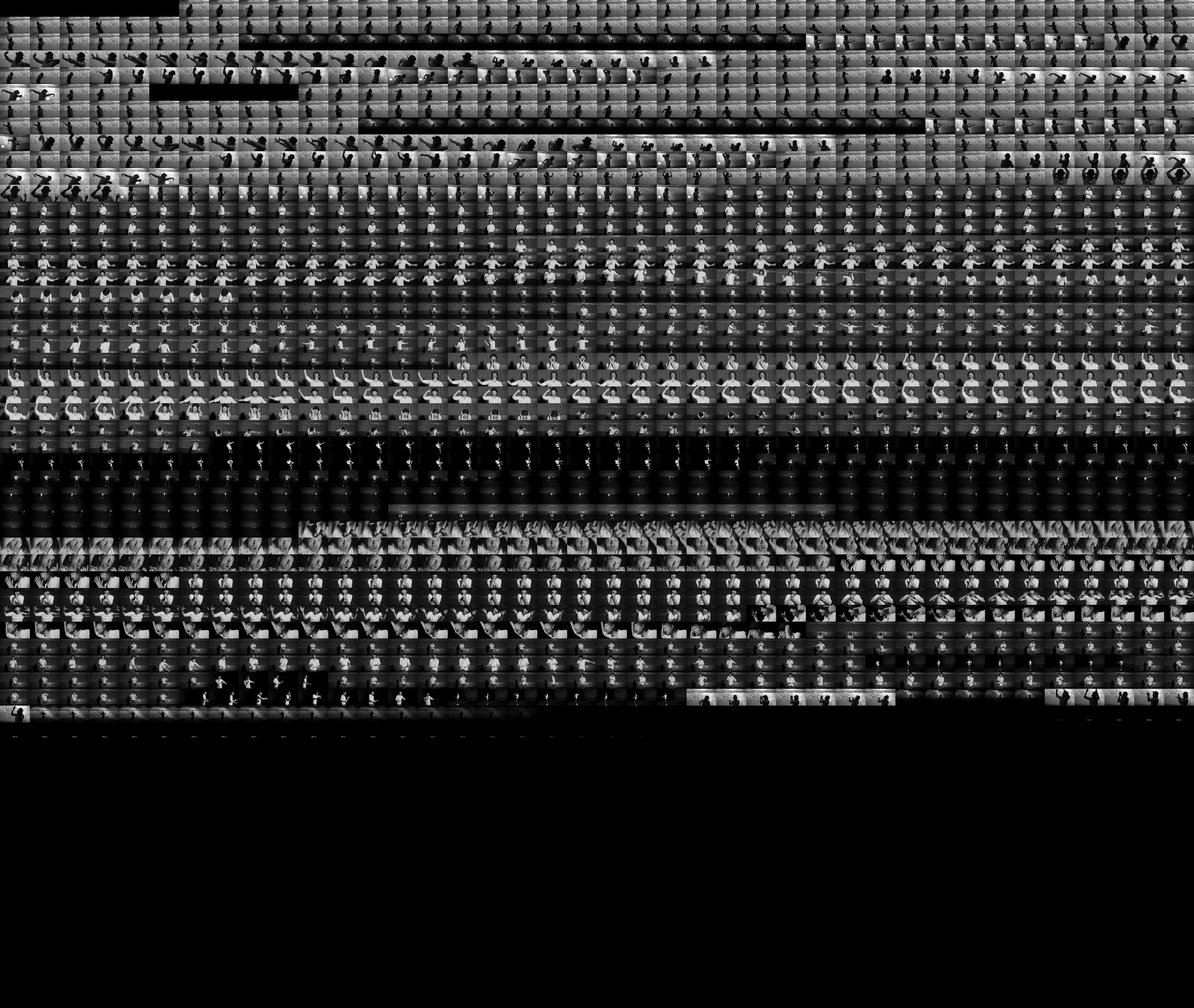
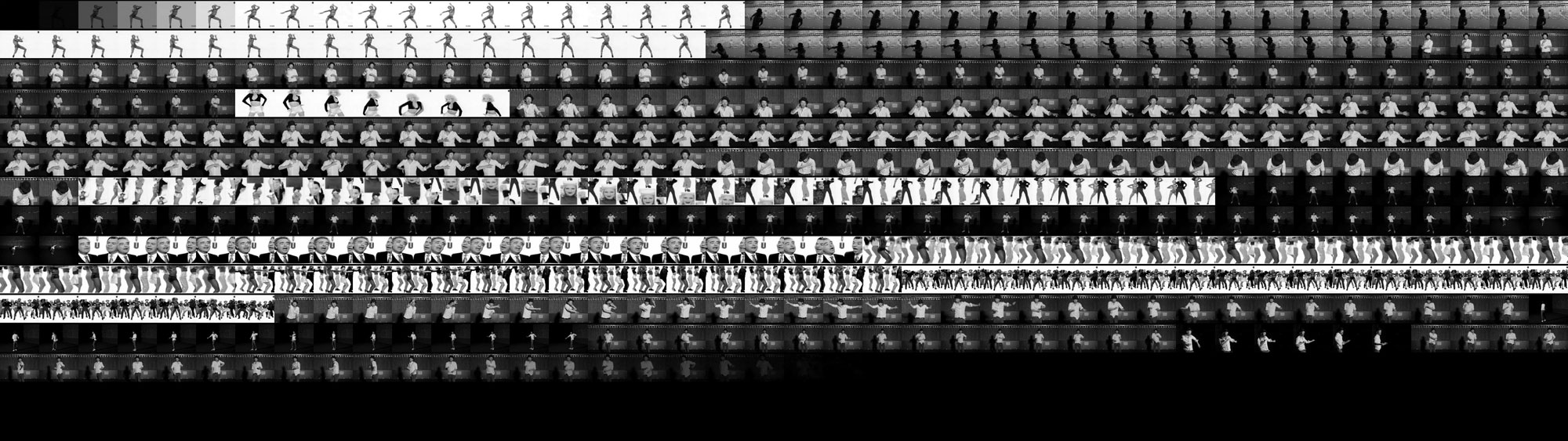
Following the method of analysis of my first case study on the Charleston Style, I first looked at the montage of the videos.
This is the video grid montage of “Thom Yorke Does the Macarena.”
When viewing these grids it becomes evident that the remixers, from the very beginning, took the liberty to edit the footage selectively to match particular songs. This is a different approach in contrast with the Charleston remixes, which, for the most part, leave the video footage intact. The exception is the occasional time adjustment to match the beat of a song.
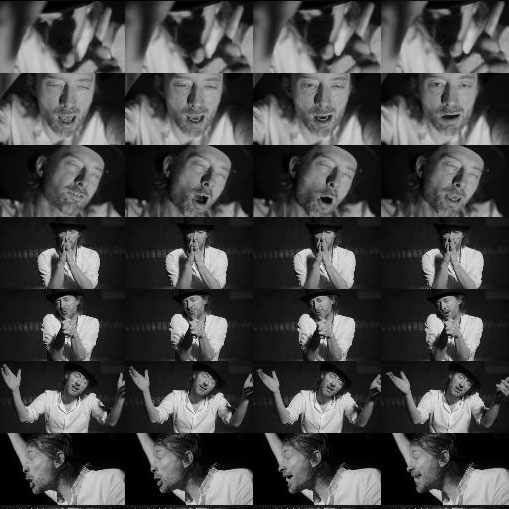
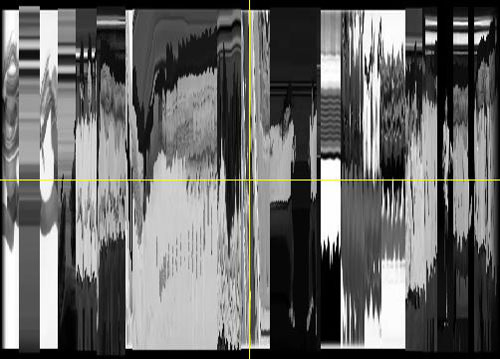
When slicing the video frames, it becomes clear which video sections are remixed. Compare the slices of the original video (above) with the slices of the three other videos, which follow below.
These are slices of “Thom Yorke Does the Macarena.”
The slice visualizations have been adjusted to fit this blog’s design. Many of the remixes are much shorter than the original video by Radiohead, this is because the footage is re-edited to match the length of the songs selected. One of the shortest is the Macarena remix, which is just over a minute.
As mentioned before, this is my second case study. After the introduction of my third case study, I will compare the three memes in order to evaluate the patterns of the remixes.
Note: I met Elisa Kreisinger during a panel presentation at the OVC in 2010. I find her work to be quite interesting for various reasons which are explored in the following interview by Vicki Calahan.
My initial foray as NAMAC blogger can be seen as a parallel text or a continuation of the conversation initiated by Patricia Zimmerman’s fine posting the other day, Film Studies as Social Media 2.0, or the New Media Ecosystems of Virtual Cinephilia. In this instance I want to look specifically at one context within the emergent forms of digital scholarship known as “remix.” I have been fortunate the last two years as a visiting scholar at USC’s Institute for Multimedia Literacy to focus my praxis based undergraduate seminars around this topic with assorted permutations.
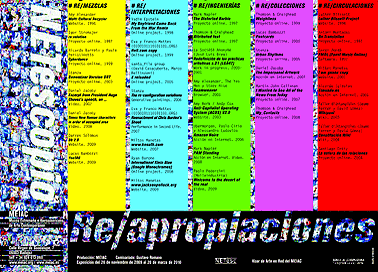
Written for the MEIAC, Badajoz, Spain, March of 2010, for the exhibition Re/appropriations, organized by Gustavo Romano. The exhibition was launched in December 2009. The text is released online with permission.
The exhibition Re/Appropriations, curated by Gustavo Romano, proposes that artists in networked culture find their creative potential in the appropriation, selection, and combination of pre-existing material on a meta-level—that of the re, or more specifically, Remix as a form of discourse. To this effect, Romano recontextualizes the artist as a “redirector of information,” rather than a creator. This premise as the entry point for creative production at the beginning of the twenty-first century leads to a recurring question often posed on the popular awareness of Remix: “Remixing, as an act of combining material has been around for a long time, one could argue since symbolic language was conceived; so, what is so different about the elements of Remix explored during the first decades of the twenty-first century that make them unique from those in the past?”[1]
Escrito para el MEIAC, Badajoz, España, marzo de 2010, para la exposición Re/approriaciones organizada por Gustavo Romano, lanzada en Diciembre del 2009. Publicada en red con permiso.
La exposición Re/apropiaciones, comisariada por Gustavo Romano, propone que los artistas de la cultura en la red encuentran su potencial creativo en la apropiación, la selección y la combinación de material preexistente y lo hacen en un meta-nivel: el del “re”, o, más concretamente, el del remix [remezcla] como forma de discurso. Con este fin, Romano recontextualiza al artista como un “redireccionador de información” más que como un creador. Tomar esta premisa como punto de partida para la producción creativa en los inicios del siglo xxi nos conduce a una pregunta recurrente que se nos plantea con frecuencia acerca de la conciencia popular del remix: “La remezcla, en tanto que acto de combinación de material, lleva existiendo ya mucho tiempo, podría afirmarse que desde que se concibió el lenguaje simbólico; por tanto, ¿qué tienen de peculiar los elementos del remix que se han explorado durante las primeras décadas del siglo xxi que tanto los distingue de aquellos que se dieron en el pasado?”[1] (more…)
Abstract:
This essay examines the complexity of contemporary electronic literary practice. It evaluates how electronic literature borrows from, and also influences, the reception of the textual message in other forms of communication that efficiently combine image, sound and text as binary data, as information that is compiled in any format of choice with the use of the computer. The text aims to assess what it means to write in literary fashion in a time when crossing over from one creative field to another is ubiquitous and transparent in cultural production. To accomplish this, I relate electronic literature to the concept of intertextuality as defined by Fredric Jameson in postmodernism, and assess the complexity of writing not only with words, but also with other forms of communication, particularly video. I also discuss Roland Barthes’s principles of digital and analogical code to recontextualize intertextuality in electronic writing as a practice part of new media. Moreover, I discuss a few examples of electronic literature in relation to mass media logo production, and relate them to the concept of remix. The act of remixing has played an important role in the definition of literature in electronic media. All this leads to a recurring question that is relevant in all arts: how does originality and its relationship to authorship take effect in a time when the death of the author is often cited due to the growing amount of collaboration taking place in networked culture?
Note: The following is an excerpt of a concise summary of the history and theory of Remix:
How have artists critically appropriated the concept of copyright in their works? In this course we will take a closer look at remix culture from the perspectives of text, image and music, and how different artists over considerable time have related to the idea of using already copyrighted materials. We will also investigate some of the different software programs that have, and are, important in the process of creating contemporary remix culture.
Copyright is a set of exclusive rights granted to the author or creator of an original work, including the right to copy, distribute and adapt the work. Copyright does not protect ideas, only their expression. In most jurisdictions copyright arises upon fixation and does not need to be registered. Copyright owners have the exclusive statutory right to exercise control over copying and other exploitation of the works for a specific period of time, after which the work is said to enter the public domain. Uses covered under limitations and exceptions to copyright, such as fair use, do not require permission from the copyright owner. All other uses require permission. Copyright owners can license or permanently transfer or assign their exclusive rights to others.
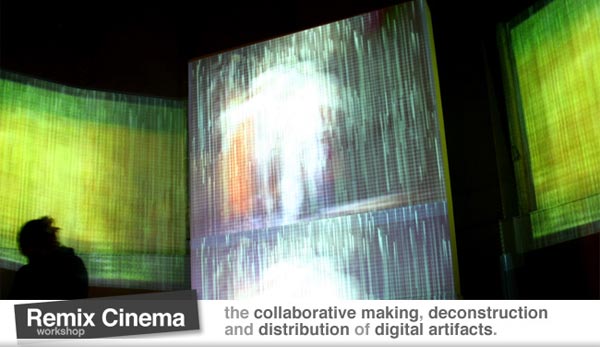
Owen Gallagher has written an excellent summary of Remix Cinema. A conference which took place at St. Anthony College in Oxford. Along with Mette Birk, Owen represented the collective Remix Theory & Praxis, of which I am also a member. Make sure to visit the brand new [re]mix:network.org where you will find Owen’s complete report. An excerpt follows below:
The Remix Cinema Workshop, organised by the Oxford Internet Institute, took place in the beautfiful period setting of St. Anthony’s College in Oxford last weekend. A cohort of remix enthusiasts descended upon the infamous university town to collectively contribute to what turned out to be a very successful and fascinating exploration of remix cinema and the issues surrounding this developing practice.
The keynote speaker was Stefan Sonvilla-Weiss of Aalto University, Helsinki, who edited the 2010 publication, ‘Mash-Up Cultures’ to which our very own Eduardo Navas contributed a chapter. Sonvilla-Weiss delivered a talk entitled ‘From Soft Cinema to Collaborative Movie Making in the Cloud’, influenced heavily by Lev Manovich and with particular reference to Christopher Nolan’s ‘Memento’ illustrating the concept of non-linear narrative and the potential for infinite variability of meaning once the separate elements of a text have been submitted to a database. The main proposal was the notion that if all video content and editing practices were migrated to the cloud, that is from the desktop to the browser window, then questions of authorship and ownership of content would potentially fade into the background.