About | Remix Defined | The Book | Texts | Projects | Travels/Exhibits | Remixes/Lists| Twitter

Archive of the category 'History'

Andy: Meta-dandy, by Eduardo Navas
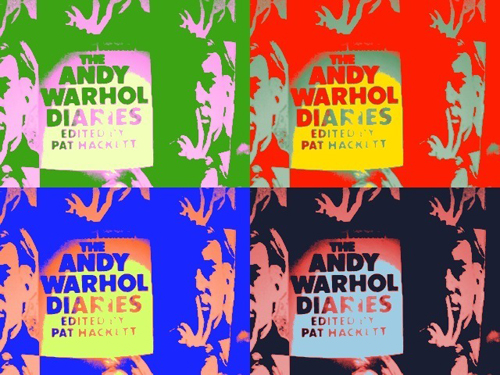
Image of The Andy Warhol Diaries, taken by Eduardo Navas, December 2007

Written on March 18, 2004
Second Draft: April, 2004

Note: Andy: Meta-dandy is part of the online artwork titled Diary of a Star, which consists of selected reblogs of Andy Warhol Diaries. I developed the project between February 28, 2004 and December 31, 2007.  This text has been available online as a PDF file since March 18, 2004. I re-release it on Remix Theory to make it part of my text archive.  For a PDF copy, click here. For more information on Diary of a star in relation to Remix, see my previous entry Completion of Diary of a Star.

Andy: Meta-dandy while theoretically driven is also a piece of creative writing (thus, it provides footnotes and a bibliography).  The reasons why I combined creative and academic writing can best be understood when reading the project’s context page.  I also chose not to revise it–even though I am aware of how I could improve it based on what I have learned since 2004.  Individuals who may have read my previous research will notice that this text is in large part an early exploration of my interest in remix, even though I don’t focus on the term, or use it directly.

The text compares Andy Warhol to Baudelaire’s Flaneur (as dandies) in order to explore the definition of art in modernism and postmodernism.  “Andy: Meta-dandy” explains the philosophy that led to the development of Diary of a Star.

———–

Baudelaire’s Flaneur is the quintessential character of modernity. Being lost in the crowd enjoying anonymity is what the nineteenth century Flaneur is best known for. Andy Warhol may very well be the most famous flaneur of the twentieth century. He was known for taking daily walks in the city streets every morning, with copies of his Interview magazine under his arm, ready to give them to people who recognized him.[1]  Unlike the flaneur, however, Andy loved attention.[2] He always wanted to become a star. He achieved this by immersing himself in a crowd. That such a crowd would be the rich and famous complicates this analogy. Yet, he paradoxically managed to keep a sense of anonymity when he “used the limelight in order to hide in it.”[3] To give credit to the Modern Man of the twentieth century, this was an inevitable transition. Craving attention was and still is one of the greatest desires in modernity, especially as media culture became more established after the 1950s. So Warhol was the new and improved flaneur. Today he is the icon of a man-machine who cranked works out of a factory, which later turned into an office.[4] A flaneur who constantly searched for ways to separate himself from the creative process. And like the new improved man of modernity, he not only embraced media, but mastered it to create some of the most important artworks of his time.

Like the flaneur, we know things about Andy but all based on surface, all based on public interactions and records. Andy in many ways is still a mystery, a persona that becomes a desirable object of appropriation when we find a need to step out of our selves and explore the unknown, to go to places where we dare not go. Today, recalling this persona is most appealing when navigating the World Wide Web. Indeed, the flaneur has been referenced by new media theory to better understand the dynamics of anonymity when exploring the internet.[5]
(more…)

Remix[ing] Re/Appropriations, By Eduardo Navas

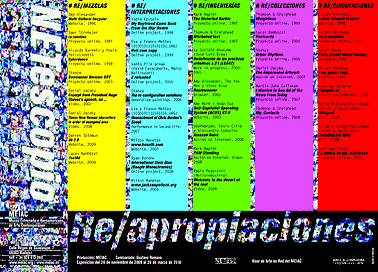
Written for the MEIAC, Badajoz, Spain, March of 2010, for the exhibition Re/appropriations, organized by Gustavo Romano.  The exhibition was launched in December 2009.  The text is released online with permission.

(Versión en Español)

The exhibition Re/Appropriations, curated by Gustavo Romano, proposes that artists in networked culture find their creative potential in the appropriation, selection, and combination of pre-existing material on a meta-level—that of the re, or more specifically, Remix as a form of discourse.  To this effect, Romano recontextualizes the artist as a “redirector of information,” rather than a creator.  This premise as the entry point for creative production at the beginning of the twenty-first century leads to a recurring question often posed on the popular awareness of Remix: “Remixing, as an act of combining material has been around for a long time, one could argue since symbolic language was conceived; so, what is so different about the elements of Remix explored during the first decades of the twenty-first century that make them unique from those in the past?”[1]

(more…)

Remix[ing] Re/apropiaciones, por Eduardo Navas

Escrito para el MEIAC, Badajoz, España, marzo de 2010, para la exposición Re/approriaciones organizada por Gustavo Romano, lanzada en Diciembre del 2009.  Publicada en red con permiso.

(English Version)

La exposición Re/apropiaciones, comisariada por Gustavo Romano, propone que los artistas de la cultura en la red encuentran su potencial creativo en la apropiación, la selección y la combinación de material preexistente y lo hacen en un meta-nivel: el del “re”, o, más concretamente, el del remix [remezcla] como forma de discurso. Con este fin, Romano recontextualiza al artista como un “redireccionador de información” más que como un creador. Tomar esta premisa como punto de partida para la producción creativa en los inicios del siglo xxi nos conduce a una pregunta recurrente que se nos plantea con frecuencia acerca de la conciencia popular del remix: “La remezcla, en tanto que acto de combinación de material, lleva existiendo ya mucho tiempo, podría afirmarse que desde que se concibió el lenguaje simbólico; por tanto, ¿qué tienen de peculiar los elementos del remix que se han explorado durante las primeras décadas del siglo xxi que tanto los distingue de aquellos que se dieron en el pasado?”[1]
(more…)

Electronic Literature and the Mashup of Analog and Digital Code, by Eduardo Navas

Image: Playing Jeff, a mashup from Bunk Magazine and Mad Hatter’s Review special issue.

Note: The following text was written for the peer review journal Dichtung Digital, issue 2010, 40.  To read the complete material, please visit http://www.dichtung-digital.de/en. Direct link: http://www.dichtung-digital.org/2010/navas/navas.htm

Abstract:
This essay examines the complexity of contemporary electronic literary practice. It evaluates how electronic literature borrows from, and also influences, the reception of the textual message in other forms of communication that efficiently combine image, sound and text as binary data, as information that is compiled in any format of choice with the use of the computer. The text aims to assess what it means to write in literary fashion in a time when crossing over from one creative field to another is ubiquitous and transparent in cultural production. To accomplish this, I relate electronic literature to the concept of intertextuality as defined by Fredric Jameson in postmodernism, and assess the complexity of writing not only with words, but also with other forms of communication, particularly video. I also discuss Roland Barthes’s principles of digital and analogical code to recontextualize intertextuality in electronic writing as a practice part of new media. Moreover, I discuss a few examples of electronic literature in relation to mass media logo production, and relate them to the concept of remix. The act of remixing has played an important role in the definition of literature in electronic media. All this leads to a recurring question that is relevant in all arts: how does originality and its relationship to authorship take effect in a time when the death of the author is often cited due to the growing amount of collaboration taking place in networked culture?

To read the full text visit http://dichtung-digital.mewi.unibas.ch/. Direct link: http://dichtung-digital.mewi.unibas.ch/2010/navas/navas.htm

Artistic Expressions and Copyright: The theory and practice of remix culture

Note: The following is an excerpt of a concise summary of the history and theory of Remix:

How have artists critically appropriated the concept of copyright in their works? In this course we will take a closer look at remix culture from the perspectives of text, image and music, and how different artists over considerable time have related to the idea of using already copyrighted materials. We will also investigate some of the different software programs that have, and are, important in the process of creating contemporary remix culture.

Copyright is a set of exclusive rights granted to the author or creator of an original work, including the right to copy, distribute and adapt the work. Copyright does not protect ideas, only their expression. In most jurisdictions copyright arises upon fixation and does not need to be registered. Copyright owners have the exclusive statutory right to exercise control over copying and other exploitation of the works for a specific period of time, after which the work is said to enter the public domain. Uses covered under limitations and exceptions to copyright, such as fair use, do not require permission from the copyright owner. All other uses require permission. Copyright owners can license or permanently transfer or assign their exclusive rights to others.

Read the complete entry at Augmented Reality

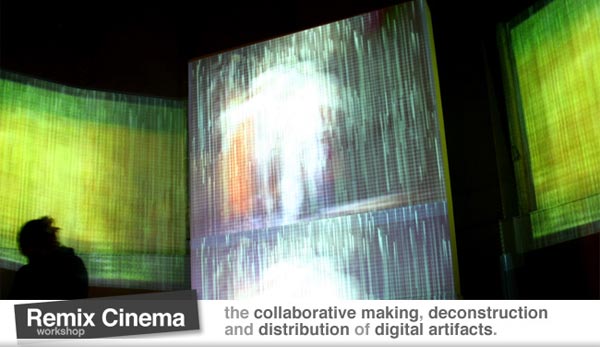
REBLOG: Remix Cinema Workshop, University of Oxford, 24-25 March 2011

Owen Gallagher has written an excellent summary of  Remix Cinema.  A conference which took place at St. Anthony College in Oxford.  Along with Mette Birk, Owen represented the collective Remix Theory & Praxis, of which I am also a member.  Make sure to visit the brand new [re]mix:network.org where you will find Owen’s complete report.  An excerpt follows below:

The Remix Cinema Workshop, organised by the Oxford Internet Institute, took place in the beautfiful period setting of St. Anthony’s College in Oxford last weekend. A cohort of remix enthusiasts descended upon the infamous university town to collectively contribute to what turned out to be a very successful and fascinating exploration of remix cinema and the issues surrounding this developing practice.

The keynote speaker was Stefan Sonvilla-Weiss of Aalto University, Helsinki, who edited the 2010 publication, ‘Mash-Up Cultures’ to which our very own Eduardo Navas contributed a chapter. Sonvilla-Weiss delivered a talk entitled ‘From Soft Cinema to Collaborative Movie Making in the Cloud’, influenced heavily by Lev Manovich and with particular reference to Christopher Nolan’s ‘Memento’ illustrating the concept of non-linear narrative and the potential for infinite variability of meaning once the separate elements of a text have been submitted to a database. The main proposal was the notion that if all video content and editing practices were migrated to the cloud, that is from the desktop to the browser window, then questions of authorship and ownership of content would potentially fade into the background.

Read the complete report at re]mix:network.org

Cultural Analytics: a Busy Week of Publication

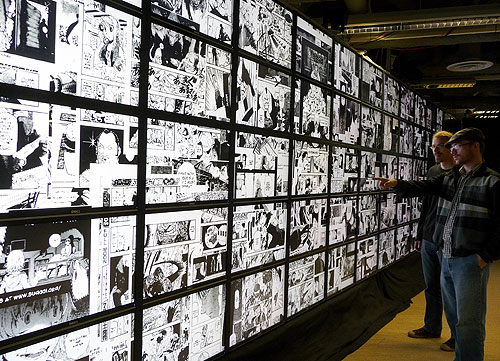
Image: Jeremy Douglass (front) analyzes manga comic pages.

The Software Studies lab has had a busy week.  Three publications are currently available, as listed below.

Article:Jeremy Douglass, William Huber, Lev Manovich. “Understanding scanlation: how to read one million fan-translated manga pages.” Forthcoming in Image and Narrative, Spring 2011. [pdf 3 MB].

An article on Cultural Analytics, titled “Graphing Culture” by James Williford, appears in the March/April 2011 issue of Humanities, the official magazine of the National Endowment for the Humanities (NEH).

And Tara Zepel published her essay “Cultural Analytics at Work: The 2008 U.S. Presidential Online Video Ads” in the edited book Video Vortex Reader II: moving images beyond YouTube – new INC publication.

After Iran’s Twitter Revolution: Egypt, by Eduardo Navas

Note: This text reflects on Egypt’s revolution to reconsider the role of social media, such as Twitter and Facebook, in real life changes.

This text is also available on The Levantine Review and Vodule.com

A peaceful revolution against a regime that had been in power for 29 years sounds impossible until one evaluates the events that led to the fleeing of former President Hosni Mubarak out of Egypt on Friday, February 11. The Egyptian people were able to organize with the use of social media; it was Facebook that rose to the occasion. Needless to say that what happened in Egypt is undoubtedly of historical importance.

About a year ago Wael Ghonim, a thirty-something Google executive decided to create a Facebook group “We Are All Khalid Said,” named after a young man who was killed by the Egyptian police.[1] The Facebook group reached hundreds of thousands, and Ghonim used it to educate people about their rights as citizens. More recently, a youth group known as April 6 was inspired by the events in Tunisia; along with supporters of Mohamed ElBaradei (a nobel prize winner who is active in revitalizing the politics of Egypt), with whom Ghonim also collaborates, they decided to turn the Police Day Protest (which previously was linked to British suppression), scheduled for January 25, into something much bigger. Ghonim announced the event on Facebook, and about 100,000 people signed up.[2] The rest, needless to say, is history–Tahrir Square was filled with thousands of people, and they never left until Mubarak stepped down from office.

(more…)

Remix: The Ethics of Modular Complexity in Sustainability, By Eduardo Navas

COMPLETE TEXT

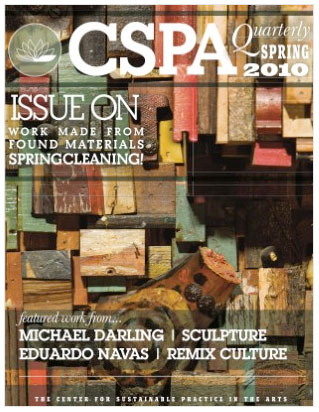
“The Ethics of Modular Complexity in Sustainability” was published in the CSPA Quarterly, Spring 2010 Issue.  My text is available online according to a Creative Commons License adopted by the CSPA Journal. The content may be copied, distributed, and displayed as long as proper credit is given to the CSPA and the individual author(s), and as long as these contents are used by others for noncommercial purposes only.  Any derivative works that result from these contents must also be shared alike.

The journal is the print publication for The Center for Sustainable Practice in the Arts, a non-profit that supports artists and organizations in the process of becoming ecologically and economically sustainable while maintaining artistic excellence.

Editor statement for Spring 2010 issue:

In this issue, we’re working against the stereotypes of the form, and attempting to broaden its term. As always, we’re exploring our chosen theme across disciplines and were delighted to include sculpture, visual art, theater, public art, and media art in the following pages. Instead of asking for work based on waste materials, we asked for work built from objects that already exist.

———-

Abstract: “Remix: The Ethics of Modular Complexity in Sustainability” evaluates sustainability in networked culture.  It considers how the flow of information in terms of immaterial production and its relation to knowledge play a role in a fourth economic layer supported by the growing ubiquity of globalization.  It revisits and expands, yet again, on my interest in Jacques Attali’s concepts of noise and music to propose a critical position fully embedded in pervasive connectivity.

IMPORTANT NOTE: This text was written as a testing ground for my growing interest in the concepts of volume and module, as explored in vodule.com.  Consequently, this text uses the term modular complexity, but does not define it.  I consider this text as part of my process to develop a precise definition of modular complexity in social and cultural terms.  The interests that inform this text are also relevant to my current research on Remix and Cultural Analytics.  Future writings will make clear the interrelation of all these ongoing projects.

This online version contains minor edits made in order to clarify the argument.

———–

At the beginning of the twenty-first century, sustainability can be read with a double meaning: to be self-supportive while socially conscious. This is because specialized fields (and individuals who work in these fields) need to be aware of their interconnectivity if they are to subsist in global culture. Sustainability is relevant in the arts and media according to the interrelation of material and intellectual production, given that such relation supports specialized fields. Sustainability, when linked to social consciousness, modifies how the recycling of material becomes relevant in culture at large. One could promote a philosophy of sustainability, which embodies critical awareness of the politics of intellectual and material property with real consequences in daily life. This is relevant in all areas of culture, even when one may produce strictly in the realm of aesthetics, and other specialized spaces that appear distanced from politics and economy.

The double signification of sustainability also shares principles of recycling with Remix as a form of discourse.  This is because Remix expands across culture from music to ecology: from immaterial pleasure to material responsibility.  The act of remixing has become common due to the rise of information exchange dependent on cut/copy and paste, which is an act of sampling data in all forms.  It enables individuals to apply the attitude of recombining in the realms of aesthetics and material reality, albeit with different results.  To be able to critically understand how such attitude functions in the symbolic and the material is the very challenge of sustainability.

(more…)

Research on Remix and Cultural Analytics, Part 1

Image: Composite image of four YouTube video remixes. From top left to bottom right appear thumbnail montages of Charleston — Original Al & Leon Style!!, Charles Style, Charleston Mirror, and Charleston Mix.  Larger images of the montages with proper explanation are included below as part of this introduction to my initial research on viral videos.

As part of my post doctoral research for The Department of Information Science and Media Studies at the University of Bergen, Norway, I am using cultural analytics techniques to analyze YouTube video remixes.  My research is done in collaboration with the Software Studies Lab at the University of California, San Diego. A big thank you to CRCA at Calit2 for providing a space for daily work during my stays in San Diego.

What follows is a brief introduction of my preliminary interest on video remixes and how I plan to use cultural analytics to evaluate their evolution on YouTube.  My current research consists of various elements, some which I will not introduce at length today, but will only mention to contextualize the use of video grid montage as an analytical tool.

(more…)

Current Projects


    Books


    Remix Theory | is an online resource by Eduardo Navas. To learn more about it read the about page.

    Logo design by Ludmil Trenkov

    http://www.mentalhealthupdate.com/