About | Remix Defined | The Book | Texts | Projects | Travels/Exhibits | Remixes/Lists| Twitter

Archive of the category 'Art'

Particles of Interest: An Interview with *particle group*, by Eduardo Navas
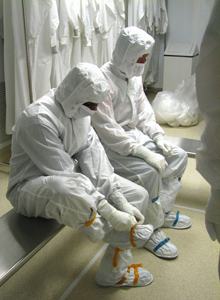
Images and text source: gallery@calit2

Note: The following is an interview published for the exhibition SPECFLIC 2.6 and Particles of Interest: Installations by Adriene Jenik and *particle group* on view from August 6 to October 3, 2008 at gallery@calit2. In this Interview *particle group* shares its critical approach on the ever growing nanoparticles market.

*particle group* is a collective consisting of Principal Investigators Ricardo Dominguez and Diane Ludin, as well as Principal Researchers Nina Waisman (Interactive Sound Installation design)and Amy Sara Carroll, with a number of others flowing in and out.  The collective draws from the hard and social sciences to develop installations that are critically engaged with the politics of science and its market.  Their aim with the installation “Particles of Interest” is to shed light on the lack of regulation of nanoparticles in consumer goods.  In the following interview the *particle group* shares its views on the current state of nanotechnology production, as well as a possible future that we may all be facing, in which nanomachines just might make difficult decisions for us.

[Eduardo Navas]: How does collaboration take place within the *particle group*? You describe members’ roles as Investigators and Researchers. Could you explain how these terms are relevant to each collaborator’s contribution to the project?

[*particle group*]: We mimic the structure of a research and development model for a university laboratory. By laboratory we mean a group of individuals who pursue conceptual investigations determined by a chronology of work that the Investigators have determined. Here, though, it should be noted that already we morph the template as Principal Investigators become Principle Investigators, homonymically signalling our investments in science’s narrative “engines of creation,” the aesthetic/ized practices and/or “naturalized” conceptualisms inherent in research, investigation, discovery and data transfer within scientific communities’ “normalized” articulations of self.

Generally the researchers participate from the beginning stages of materializing/performing/manifesting the work that the collective *particle group* eventually presents in counter/public spheres as varied as the art museum, the mall, and/or the scientific meeting. Researchers work in tandem with Investigators to develop their interpretations of the subject matter under investigation, augmentation, and/or erasure. So each time we are invited (or invite ourselves) to stage an iteration of our research, we meet and discuss via Skype or email what our intentions should be for the “performance.” To date we have had a different crew of researchers for each presentation so inherent in particle group’s particularization and particle-ization is a revolving/open door policy toward creative maelstroming. This project was produced in large part by Calit2, and so it made aesthetic sense to us to approach the project as would-be art(is)cientists and to stage a series of p(our)-us epistemologies (on the testbeds of these strange viroids of art and science) and not to see the gesture of art and science as two bunkers at war — but as possible thought-scapes of concern under the sign of “nano-ethics and nano-constructions.” Each one as blind as the other, each one helping the other over the rocking shoals of Particle Capitalism(s).
(more…)

SPECFLIC 2.6: An Interview with Adriene Jenik, by Eduardo Navas

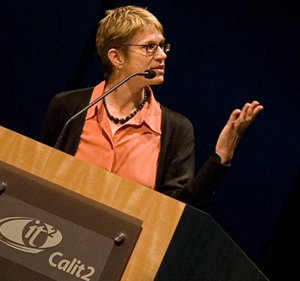
Adriene Jenik lecturing at Calit2

Images and text source: gallery@calit2

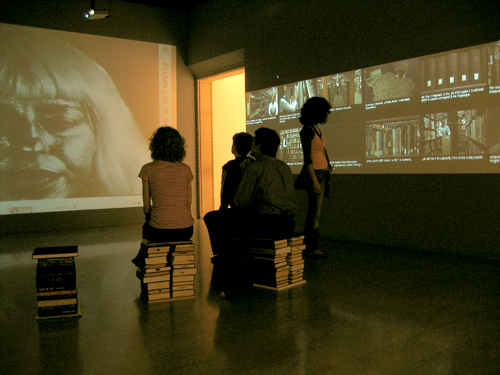
Note: The following is an interview published for the exhibition SPECFLIC 2.6 and Particles of Interest: Installations by Adriene Jenik and *particle group* on view from August 6 to October 3, 2008 at gallery@calit2. In this Interview Jenik shares the creative process behind her ongoing multi-faceted installation SPECFLIC, which points to a future where books have become rare objects.

Adriene Jenik combines literature, cinema and performance to create works under the umbrella of Distributed Social Cinema. For Jenik, this term means that the language of cinema has been moving outside of the conventional movie screens on to different media devices, which today include, the portable computer, GPS locators, as well as cellphones. Earlier in her career, Jenik worked with video and performance, and eventually she produced CD-Roms, such as “Mauve Desert: A CD-ROM Translation” (1992-1997). Jenik’s practice took a particular shift towards network culture when the Internet became a space in which she could bring together her interests in film, literature, and performance. “Desktop Theater: Internet Street Theater” (1997-2002) was a virtual performance which took place in an online space. It was based on Samuel Becket’s play Waiting for Godot. In line with these works, SPECFLIC 2.6 is the result of Jenik’s interest in the relation of networked culture to film, literature and performance. The installation, then, is also another shift in Jenik’s interest in the expanded field of storytelling. In the following interview, Jenik shares the influences and aesthetical concerns that inform SPECFLIC 2.6

[Eduardo Navas]: You describe your ongoing SPECFLIC project, currently in version 2.6, as “Distributed Social Cinema.” Given that your installation takes on so many aspects of contemporary media, could you elaborate on how you arrived at the parameters at play around this concept?

[Adriene Jenik]: SPECFLIC was initially inspired by the recognition that cinema was moving beyond a single fixed image at an expected scale to one of multiple co-existent screens with extreme shifts in scale. I was seeing video on miniature screens, as well as gigantic mega-screens, and seeing these screens move about in space and wondering what types of stories could take advantage of these formal and technological shifts. I’ve long been involved in thinking through layered story structures and at the beginning of SPECFLIC, I could “see” a diagram of the project imprinted on the inside of my eyelids. That original retinal image burn has since been honed and shaped in relation to the needs of the story and the responses of the audience and performers.

The SPECFLIC 2.6 installation takes excerpts from material that was created for SPECFLIC 2.0, and follows on the heels of SPECFLIC 2.5, which was commissioned by Betti-Sue Hertz and presented at the San Diego Museum of Art in Spring of 2008. For SPECFLIC 2.5, I stripped away all of the live, interactive aspects of the piece, and instead, emphasized aspects of the story that might have been more in the background of the live event. This type of “versioning” is something that is in evidence in software creation, but has also become a method for developing an art practice that can expand and embrace new research and technologies. Distributed Social Cinema is a form that takes into account the importance (for me) of the public audience for a film. As cinema-going practice becomes “home entertainment,” I’m interested in what is at stake in cinema as a public meeting space. At the same time, I’m playing with the intimacy of the very small screen, the ways in which having part of a story delivered into someone’s pocket adds a layer of meaning in its form of delivery. The SPECFLIC 2.5 installation was an attempt to consolidate some of these aspects of distributed attention and “voice.”

Granted the opportunity for networked interaction within the gallery@calit2, for SPECFLIC 2.6 I have rethought the installation to develop in concert with audience contributions. So the project is very much evolving in response to what I learn from each previous iteration as well as the opportunities afforded by the space, encounter with the audience, and technological framework.

(more…)

“On Distributed Social Cinema and the Nano Market”, by Eduardo Navas

Adriene Jenik installation at the SDMA

Images and text source: gallery@calit2

Note: This text was written for the exhibition SPECFLIC 2.6 and Particles of Interest: Installations by Adriene Jenik and *particle group*, at gallery@calit2, from August 6 to October 3, 2008. The text outlines how dematerialization is at play ideologically and materially in contemporary life, and how it might be at play in the not so far future.

The installations “SPECFLIC 2.6” by Adriene Jenik, and “Particles of Interest” by *particle group*, on view at the gallery@calit2 from August 6 to October 2, 2008, ask the viewer to consider a not-so-distant future in which we will be intimately connected in networks not only through our computers, but also via nanoparticles in and on our very own bodies. Both projects respond to the pervasive mediation of information that is redefining human understanding of the self, as well as the concept of history, knowledge, and the politics of culture.

Information access to networked archives of books and other forms of publication previously only available in print is becoming the main form of research as well as entertainment. Access to music and video via one’s computer and phone as well as other hybrid devices has come to redefine human experience of media. From the iPhone to the Kindle, visual interfaces are making information access not only efficient in terms of time and money, but also in terms of spectacle. Accessibility usually consists of a combination of animation, video, image and text, informed in large part by the language of film and the literary novel.

(more…)

Ant Farm’s Cadillac Ranch Remixed

The above image is a photoshop composite by Steve Brown for the New York Times. The background was taken from the Getty Images archive. It is an illustration for the article Putting the Dream Car Out on the Pasture, published on July 27, 2008, which explains how people are coping with the high cost of gas prices.

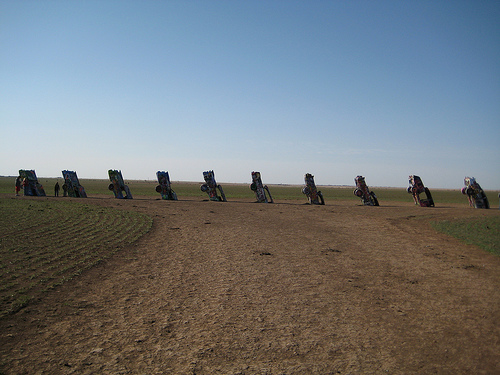
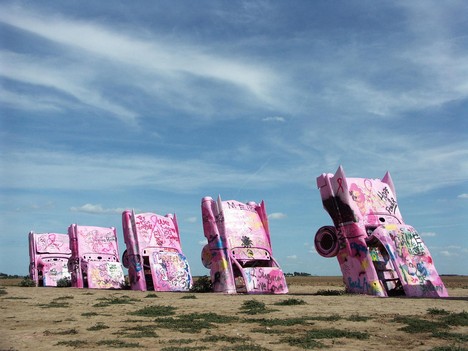
As many people in the arts would know as well as those who love to take road trips, the above image borrows from Ant Farm’s famous land art piece “Cadillac Ranch,” in which Cadillacs were dumped into the ground at Amarillo, Texas. In 1997 it was moved a couple of miles from its original location. It is a disappointment that there is no reference to Ant Farm’s work. Below are some images of Ant Farm’s public art installation, along with comments by the people who took the pictures.

Image from Flickr

Quote: “The Cadillac Ranch just west of Amarillo is a famous Route 66 landmark. Built up in 1974 by said to be eccentric but brilliant millionaire Stanley Marsh 3 and The Ant Farm, this line of old Cadillacs are buried nose first into the ground. The angle of the cars are also reputed to be the same as the ancient pyramids at Cheops. The Cadillacs were moved further west in 1997 from its original location due to growth from nearby Amarillo. The Cadillac Ranch is another of the must see sights off the Mother Road.”
-RoadsidePeek.Com Website

Image and text from Treehugger

Quote: Ant farm was a group of artists and architects that, along with Archigram, was hugely influential among architecture students in the seventies, particularly if you were into mobile architecture, alternative technologies and dovetail joints. Many know about their Cadillac Ranch, which remains an iconic statement about the end of oil as it was in the last oil crisis; few, including Regine at Worldchanging know about their other work. However she does now, after seeing an exhibition of their work at the The Centro Andaluz de Arte Contemporaneo in Seville.

REBLOG: Graphite Sequencer Rocks the Analog World

Text source: Neural.it

Originally posted: July 8, 2008

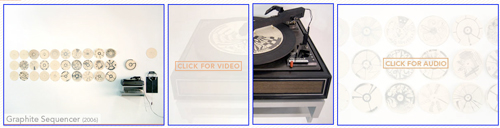
Caleb Coppock’s “Graphite Sequencer” is an analog drum machine of sorts that works through simple electrical conductance. Two wires scrape along the surface of a spinning paper disk with graphite shapes scrawled across them (graphite is a conductive material) so that when they pass over the shapes, they generate tones. The resulting sound is then amplified and played back through the device’s speaker system. Coppock has customized the device so that when the graphite line is thick, allowing more current to pass, the pitch of the resulting tone changes to a lower one. This is in contrast to a thinner line, which creates a very high-pitched tone on contact. Although the resulting sounds are anything but musically appealing, the ability to hand-draw your own beats is a nice and simple way of creating audible results from physical media. The video on the project’s website illustrates how this works although the resulting sounds are a bit difficult to stomach.
Jonah Brucker-Cohen

Munch Remixed by the Wall Street Journal: a brief critical note

Image source: Wall Street Journal

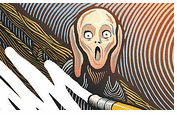
I read a Wall Street Journal article on Sunday July 20, titled “How to Control your Fears in a Fearsome Market.” The article by Jason Zweig was accompanied with the above image by artist Heath Hnegargner. The image is quite small online, but the WSJ’s print edition shows a much larger reproduction.

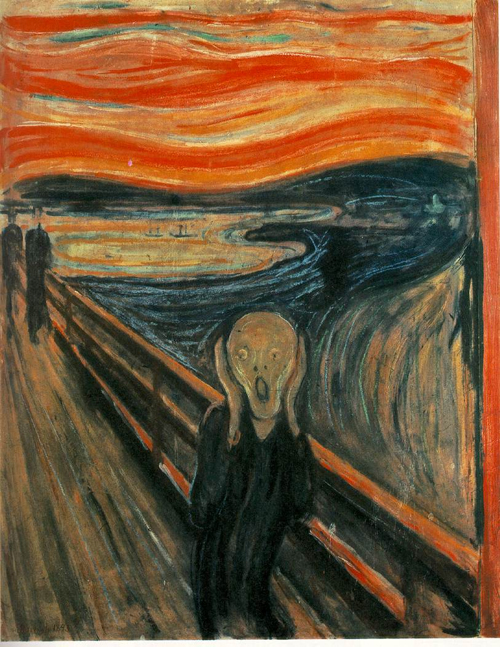
There are a few things that intrigue me about the image. First, there is no reference to Edvard Munch’s original work, The Scream. This could be because Munch’s work may be so ingrained in people’s minds that a citation of the original is no longer necessary.

Second, Hnegargner appropriates Munch’s image in the name of that which many consider the opposite of nature: modernity and its current aftermath in the global economic market. In the image above, the appropriated figure covers his ears in despair not because nature is screaming (as the original image is contextualized based on Munch’s writings), but because the world market is screaming. Such is the power of appropriation. Below is a reproduction of Munch’s painting, from 1893.

Image source: http://www.charleroisd.org/middleschool/images/munch.png

Observatori apuesta por la obra digital más experimental, por R. Bosco / S. Caldana

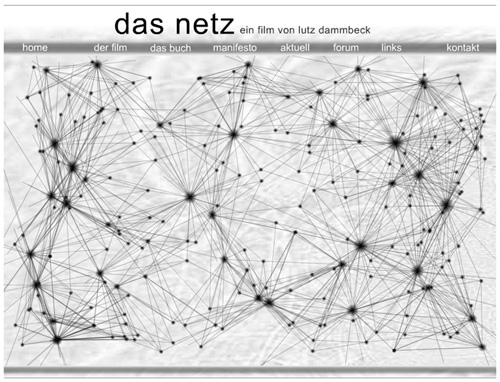
Still of Lutz Dammbeck, THE NET: THE UNABOMBER, LSD AND THE INTERNET, 2003

Text: El Pais, Image: Observatori

Originally published: 6/12/08

(Spanish Only)

Regreso al futuro. El Festival Observatori, que se celebra en Valencia hasta el 29 de junio, vuelve a sus orígenes, centrándose en la vertiente más experimental de arte digital.

La novena edición, titulada After the Net, toma como punto de partida el documental La Red: Unabomber, LSD e Internet, de Lutz Dammbec, para explorar el lado oculto de los avances tecnológicos, la arquitectura de los trabajos en red y las raíces históricas de los sistemas abiertos, que emplea para reactivar los principios fundadores de la ética hacker

Entre las obras que se enfrentan a las dinámicas comunitarias en red destaca Antisocial networking, un almacén de proyectos, coordinado por Geoff Cox, que investiga la naturaleza de las plataformas sociales en Internet. Entre esas propuestas se encuentra Logo_wiki, de Wayne Clemens, donde intenta demostrar cómo militares, empresarios e instituciones gubernamentales son autores de miles de alteraciones de páginas en la enciclopedia libre Wikipedia.
Contradicciones

Las contradicciones del software libre se plasman en Hello process, de Aymeric Mansoux y Marloes de Valk, que revela la paradoja de los sistemas de código abierto, a través de una máquina que ejecuta un software libre con un proceso tan complejo, que le convierte otra vez en un sistema impenetrable.

Entre las instalaciones destaca Chatroom, de Jeff Gompertz y Caen Botto, que se apropia de los videochat del público y los retransmiten manipulando la imagen de los rostros, creando un efecto parecido al de los salones de espejos de las ferias.

La producción española está representada por una retrospectiva de José Antonio Orts, pionero de un trabajo que integra tecnología, objetos, luz y sonido.

La selección de sus obras, que incluye algunas inéditas, arranca con el primer circuito sonoro fotosensible interactivo, que realizó en 1970 con tan sólo 15 años, punto de partida de todo su trabajo posterior, entre ellos instalaciones interactivas y unas esculturas sonoras fotosensibles.

La exposición se completa con la sección openKURATOR. Destacan el minimalista Netart for poor people, de Carlos Katastrofsky, y Con el tiempo contado, una obra digital efímera del español Javier González que lleva la cuenta regresiva de su existencia.

OBSERVATORI: www.observatori.com

My [public] Space: Exhibition Text by Petra Heck

Image by Eduardo Navas, December, 2007

Note: Diary of a Star was part of the exhibition “My [public] Space” in Amsterdam, from May 23 to June 21, 2008. The premise behind the exhibition in part follows the line of thought originally developed for Diary of a Star. Thanks to Petra Heck for including my work in the show.

Diary of a star context: http://navasse.net/star/Context.html

Full text of exhibition follows below. Source: nimk.nl

May 16, 2008

With Twitter, a new application in Web 2.0, all you have to do is push a button to send a message to all the people you have promoted to your social network. The idea is that you indicate where you are, so that you can be ‘followed’ physically or mentally. The question is what need we have for a service like that. Do we really want to make everything public, known “and traceable”.

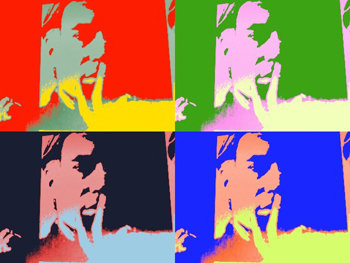
Andy Warhol was doing it already in the 1970s: showing and sharing as many insignificant details as possible. His magazine Interview was full of transcriptions of inane conversations; every telephone call was important enough to tape or write up. The desire ? and the means ? to be visible everywhere at all times was invented by Warhol in the same decade. With the arrival of Web 2.0 the internet makes this possible for everybody, not just for superstars like Edie Sedgwick, who in Warhol’s Screentest films doesn’t do much more than smoke, chatter and sneeze: nothing special. Forty years later there are suddenly millions of people watching television programs like Big Brother, in which people off the street are filmed sleeping, eating and talking about not much in particular.

With the advent of Web 2.0 powerful media are no longer necessary for realizing a relative ?15 minutes of fame?. Bloggers (webloggers) report every detail of their lives in an online diary that anybody can call up and read on their computer. The difference between an online blog and an old-fashioned diary is that online the content is being revealed for an unknown audience. The dividing line between private and public gets blurred. The text can be rather personal, while still functioning in the public domain. Since bloggers are implicitly aware of this, the information can be regarded as being tainted. The dichotomy between public and private that so interested Andy Warhol becomes visible here.*

(more…)

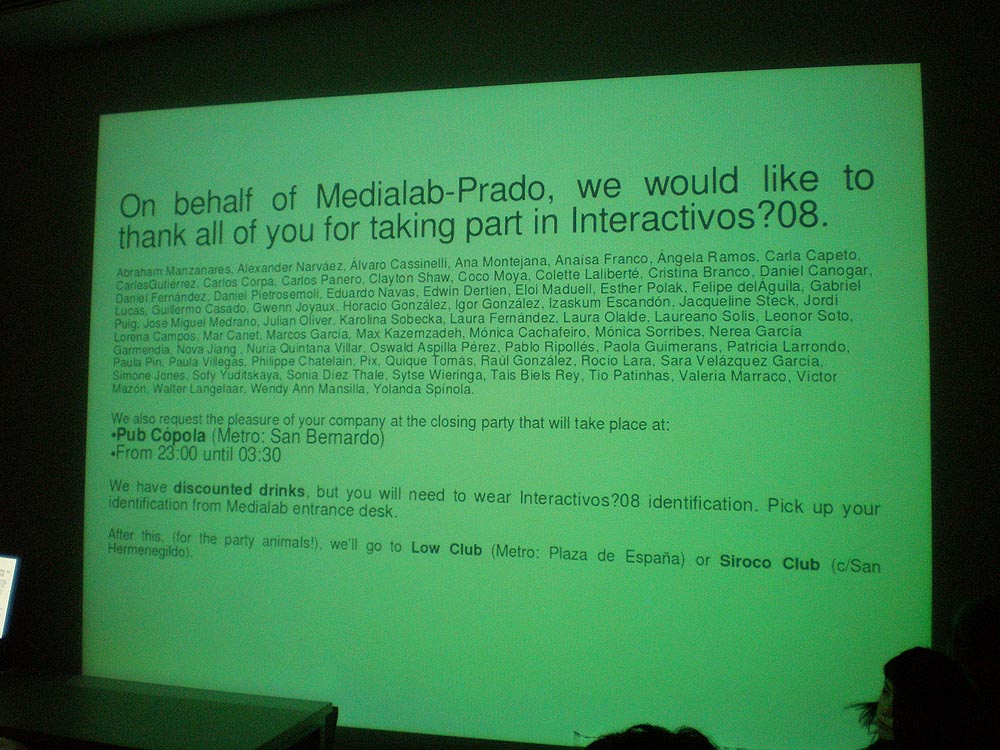
The State of Swift Production: Interactivos?’08 (part 3 of 3), by Eduardo Navas

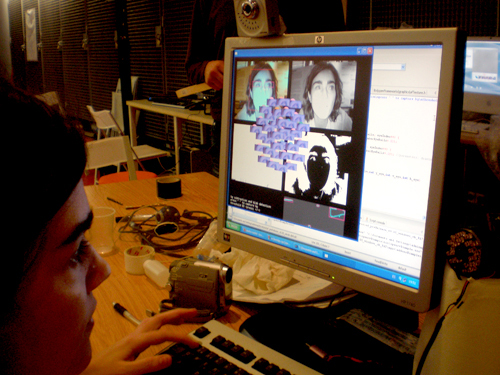
Image: Anaisa Franco, Testing software for “Expanded Eye”

See Part 1: https://remixtheory.net/?p=315
See Part 2: https://remixtheory.net/?p=319

Interactivos?’08-Madrid promoted Vision-play as a point of entry to reflect on how interactivity is redefining aesthetics in art particularly invested in emerging technologies. The Medialab-Prado website presented the two week work intensive series of events as a “workshop [that] aims to use open hardware and open code tools to create prototypes for exploring image technologies and mechanisms of perception.”[1]

To provide a rigorous contextual ground following this premise as a frame of reference for artists and collaborators, the Medialab organized a two day long conference in which artists presented their projects and scholars and writers presented papers focused on the ongoing changes of the image (vision-play) in contemporary art production. On the first day Marta Morales presented “Caída del juego: lo inaparente en la imagen” (Fall of the Game: The Inapparent in the Image), a text in which she explored the void of experience leaning towards the sublime in the work of Giacommeti; she examined his work from drawings to sculptures. I followed with “The Bond of Repetition and Representation,” in which I outlined previously introduced definitions of Remix and their links to the ongoing play between repetition and representation in digital media. Nadine Wanono then discussed her research on Visual Anthropology in “The Camera and The Perspective, as Tool and Metaphor.” In her talk she questioned the supposed objectivity of perspective, both formally and conceptually, when anthropologists study non-western cultures. Wanono’s presentation consisted of selected research she performed in Mali, West Africa, where she spent many years with the Dogon people. And the evening ended with Domingo Sarrey who presented “Cuadrats 40 años después” (Quadrats, 40 Years Later). Sarrey took the evening when he made many Spaniards in the audience aware about art and computer science explorations that took place in Madrid during the sixties. Sarrey was one of the first artists in Madrid to use the computer to develop drawings during that time period. (more…)

The State of Swift Production: Interactivos?’08 (part 2 of 3), by Eduardo Navas

Image: Interactivos?’08 Collaborators, June 14, 2008 (click to view larger image)

See Part 1: https://remixtheory.net/?p=315

The projects for Interactivos?’08 were completed on Saturday June 14, just in time for the exhibition opening scheduled for 6:30 PM. When the project proposals were initially presented during the first two days of the workshops and lectures of May 30 and 31, it was quite understandable if anyone in the audience, and even among the collaborators and artists doubted the completion of the proposals in just two weeks, given their complexity. Fortunately, all projects were up and running.

The key element to meet the deadline was the fact that artists did not work alone, as some people may expect of studio artists, who from time to time might hire or “collaborate” with say a printmaker, or a metalcaster. In Interactivos?’08 collaborators had an incredibly important role to play in, both, decision making as well as actual execution of the works. How much this was so of course varied from project to project, but it is safe to say that there was a certain consensus in the air which was that artists and collaborators live up to the possibility of working together for a common goal, and that they truly contribute in all levels of the creative process, even if some of the work developed did not become part of the final product. Had artists and collaborators not believed this, the selected projects would not have been completed on time, if at all. Upon asking many participants about their role in the overall production of the projects, this sense of contribution was confirmed.

(more…)

Current Projects


    Books


    Remix Theory | is an online resource by Eduardo Navas. To learn more about it read the about page.

    Logo design by Ludmil Trenkov

    http://www.mentalhealthupdate.com/