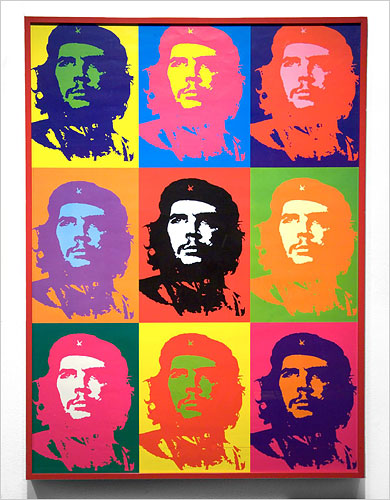
Che Guevara got some attention at the beginning of 2009 with Steven Soderberg’s film Che, starring Benicio del Toro. More recently, Che is the subject of a book titled, Che’s Afterlife, by Michael Casey. The book is reviewed by the New York Times as a detailed account of Che’s famous image taken by Alberto Díaz Gutiérrez, known professionally as Korda. The story goes that Korda took the photograph during a funeral in Cuba. Korda’s creativity was not only in knowing when to take the photograph, which is for what most photographers are praised, but also in knowing how to crop it. To quote directly from the New York Times:
“By radically cropping the shot, snipping out a palm tree and the profile of another man, Korda gave the portrait an ageless quality, divorced from the specifics of time and place.”
This divorce is what Walter Benjamin noted in the first half of the twenty century in his well-known essay “The Work of Art in the Age of Mechanical Reproduction.” An essay that many cultural critics have cited and will probably cite, because Benjamin foresaw many of the elements that today inform media culture in all areas of reproduction. (more…)
Note: The following interview was originally published on Digicult in February 2009. The introduction has been translated from the Italian by Lucrezia Cippitelli. It is here published as originally written. I would like to give a humble thanks to Lucrezia for her introduction, which I think gives me more credit than deserved.
Three years ago I had a long interview with Eduardo Navas about his editorial project, newmediaFIX, the online platform that republishes and redistributes texts and interviews from the most influential international magazines focused on art and media (between them Digicult) and which I collaborated with as editor for almost one year. Recently, I met Eduardo again by e-mail for another interview about his last online project, “Traceblog,” launched on October 2008. ”
The artist, theorist, curator and scholar from the United States works on software and web-resources for blogging. He reflects upon the dynamics of the Internet, the concept of Remix and distribution of concepts and information in culture, since the beginning of his artistic career. He is now one of the most influential voices on network cultures and use/abuse of its tools. As Eduardo asserts in this long chat, referring to “Traceblog” but it could be related with his art practice at large: “I aim to explore the implications of the growing pervasiveness of information flow and its manipulation. From this point of view, I see it in direct relation to my ongoing investment in blogging culture.”
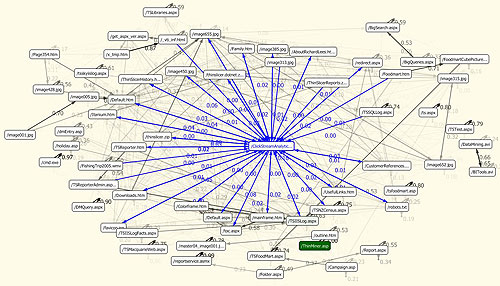
In line with his early net art projects as Goobalization and Diary of a Star, while simultaneously following Eduardo’s theoretical researches on blogging and remix, “Traceblog” is an online artwork that appropriates the free Firefox plug-in (Track me not), created by NYU developers and researchers Daniel C. Howe and Helen Nissenbaum. The plug-in is designed to obfuscate the transparency of the online activities of Internet users. As result, “Traceblog” publishes the pseudo logs of Eduardo’s daily online searches and activities on a web site http://navasse.net/traceblog/. The same website contains links to the explanation of the project, links to the Firefox plug-in and some tools that make users aware on how to hide search trails.
“Traceblog” makes visible how our daily Internet activity is tracked by the browser we use and produces an archive of all our data and information that could be used for commercial and control purposes. A fact is that data mining is totally out of control if we consider all the web 2.0 platforms, that stimulate Internet users’ obsession to expose themselves and constantly be in touch: just consider common tools as Blogger, propriety of a big commercial corporation as Google, just to make an example. We could name a few others such as Facebook, Twitter, Linkedin, and also (although they are not related with browsing), Skype, Msn, the free services for email and so on and so on… We talked with Eduardo about all that and much more.
Cultural Center of Spain invited me to lecture in San Salvador, El Salvador from March 8 to the 13, 2009. During this period I also learned about the contemporary art scene as well as the art history of El Salvador.
I presented my research on Remix at the Cultural Center on March 10, and I lectured on art and new media in the Department of Visual Arts at the University of El Salvador (popularly known as La Nacional) on March 11. I met artists from different generations, some who are becoming more established, and some who are up and coming. I also visited the Museum of Art (Marte) which currently is exhibiting a thorough survey of Art in El Salvador since the 1800’s
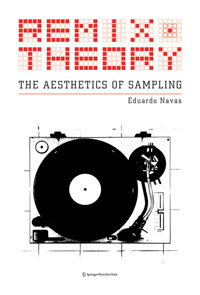
The following text was published in December 2008 in Inter/activos II by Espacio Fundacion Telefonica, Buenos Aires. The publication was produced in support of a new media workshop and theory seminar by the same name which took place in 2006, organized by curator and writer Rodrigo Alonzo. The text revisits my definition of Remix that has already been introduced in prior writings, such as Turbulence: Remixes and Bonus Beats. This definition can also be found in the section Remix Defined. “The Bond of Repetition and Representation” links the theory of Noise by Jacques Attali to my overall argument that Remix has its roots in DJ Culture starting in the seventies. In the conclusion it revisits and extends my analysis of Yann Le Guenec’s project Le Catalogue.
Some things have changed since I first wrote this essay in 2006. I did not expect the print publication to take as long as it did, but now that it has finally been published, as opposed to updating the text, I have chosen to release it online as it was originally written. While some cultural trends may be quite different from 2006, the argument proposed is still relevant. This analysis is part of a much larger and extensive project and will be eventually released in its remixed form in the future.
The term remix, today, is used to describe various cultural elements, from mash-up software applications[1] to projective architecture.[2] No matter what form it takes, the remix is always allegorical, meaning that the object of contemplation depends on recognition of a pre-existing cultural code.[3] The audience is always expected to see within the object a trace of history.
To entertain the importance of Remix in culture at large, we must come to terms with it according to its historical development. This will enable us to understand the dialectics at play within Remix, which at the beginning of the twenty-first century is the ideological foundation for remix culture. As it will become clear in this essay, in order for remix culture to come about, certain dynamics had to be in place, and these were first explored in music, around the contention of representation and repetition. This essay will focus on defining remix in relation to these two terms, and then move on to examine its role in media and art.
The following interview with Sheldon Brown was commissioned by gallery@calit2 for the exhibition “Scalable City”. Exhibition dates: Thursday, Oct. 23, 2008 – Monday, Dec. 15, 2008
Sheldon Brown is an artist who works in new forms of culture that arise out of developments in computing technology. He is Director of the Center for Research in Computing and the Arts (CRCA) at UC San Diego, where he is a Professor of Visual Arts and an academic participant in the California Institute for Telecommunications and Information Technology (Calit2). During his early career, Brown experimented with emerging technologies to develop works that explore the possible meaning of “virtual reality.” His installations were often designed for immersive audience participation. Many of these works have been developed for the gallery, such as “MetaStasis” (1990), an art installation consisting of a room that visitors enter to experience what appears to be, as Brown himself has called it, a “zoetrope of TV images.” Brown took his interest in mediated reality to the public sphere in installations such as “Video Wind Chimes” (1994), which projects broadcast TV images on the street sidewalk – images selected according to how the wind blows. In both of these projects, as well as many others, Brown emphasizes how metaphysical experience is contingent upon our increasing dependency in immersive media of all forms. Brown’s longstanding interest in mediation is further explored in “Scalable City.” In the following interview, the artist reflects on how Scalable City connects his interests in emerging technologies as well as longstanding traditions of art practice.
[Eduardo Navas] Unlike many artists who claim to be interested primarily in expressing their ideas and not being bound to a specific medium, you have chosen to focus on the development of art that is involved with computing technology. Having said this, the computer makes possible metamedia – meaning it simulates other media, and in this sense it allows artists to focus on idea development. It appears, then, that you share the interest of exploring ideas in the tradition of modern art practice with artists who might play down their preference for a particular medium. With this in mind, could you reflect on the shifts that art practice may be taking based on the increasing role of computers in all aspects of our lives? How do you see your art practice in relation to previous practices which may have downplayed their preference for a particular medium?
[Sheldon Brown] It seems you attribute conflicting claims for my relationship to “medium”, but I don’t see computing as a medium in the 20th century sense. Probably even the idea of it as a meta-medium does not capture its character. It may be more useful to think about computing as creating certain cultural conditions, and I’m doing work which utilizes and responds to those conditions. It might then be more like the interest in speed as a condition for the futurists, but I wouldn’t want to make too much of any analogies to previous art movements and their concerns. The impact of computing on culture comes after the modernist, conceptualist and post-modernist engagements, and just as I have called it a meta-medium, I could also call it a meta-ism – it is able to simulate any and all of these previous attitudes. Not that my interests in this begin and end at simulation of previous forms; this is but one of the gestures possible in this condition, but when it performs any of these simulations, they become rapidly engaged in a new dynamic which doesn’t stop at borders of previous operations. (more…)
VERSION:
November 20, 2008.
Please note that this version has not been proofread yet, and it is also missing illustrations.
Length: 82,071 Words (including footnotes).
ABOUT THE VERSIONS:
One of the advantages of online distribution which I can control is that I don’t have to permanently fix the book’s contents. Like contemporary software and web services, the book can change as often as I like, with new “features” and “big fixes” added periodically. I plan to take advantage of these possibilities. From time to time, I will be adding new material and making changes and corrections to the text.
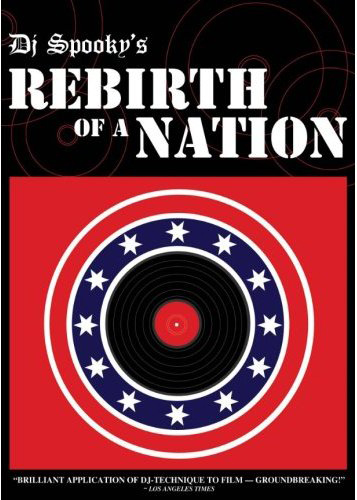
DJ Spooky has performed live Rebirth of a Nation, a remix of D.W. Griffith’s Birth of a Nation in various parts of the world. The multi-faceted media performance deconstructs Griffith’s historically important film to expose the politics of racism during and after 1915, the year when the original film was produced.
DJ Spooky is releasing a DVD version of Rebirth of a Nation on November 4 of 2008. The critically minded would not hesitate to think that the release date is not a coincidence, but rather a constructive move on Spooky’s part to remind people that the upcoming presidential election is historically important. The United States has come a long way since the days when Griffith released Birth of a Nation, and on November 4, the title Rebirth of a Nation will take on a new meaning, for no matter what happens after the fourth, the United states will certainly enter a definitive new stage in its history.
Information about the Film and DJ Spooky’s Biography follow below.
First released in 1915, D. W. Griffith’s Birth of a Nation ignited worldwide controversy with its graphic depictions of racism and white supremacy in the post-Civil War south. Nearly 100 years later, Paul D. MIller- also known as conceptual artist/musician/writer DJ Spooky That Subliminal Kid- creates a daring ‘remix’ of Griffith’s epic to expose the film’s true meaning and relate it to the socio-political conflicts of America today. Originally commissioned as a live multimedia performance, Rebirth of a Nation- now featuring an original score by Miller performed by Kronos buy generic meds online Quartet- is ‘a DJ mix applied to cinema’ that challenges our legacy of revisionist history as it deconstructs one of the most influential and inflammatory movies of all time.
DJ Spooky (Paul D Miller, born 1970, Washington DC) is a composer, multimedia artist and writer. His written work has appeared in The Village Voice, The Source, Artforum and Rapgun amongst other publications. Miller’s work as a media artist has appeared in a wide variety of contexts such as the Whitney Biennial; The Venice Biennial for Architecture (2000); the Ludwig Museum in Cologne, Germany; Kunsthalle, Vienna; The Andy Warhol Museum in Pittsburgh and many other museums and galleries. His work “New York Is Now” has been exhibited in the Africa Pavilion of the 52 Venice Biennial 2007, and the Miami/Art Basel fair of 2007. Miller’s first collection of essays, entitled “Rhythm Science” came out on MIT Press 2004, followed by “Sound Unbound,” an anthology of writings on elctronic music and digital media, published in 2008.
Miller’s deep interest in reggae and dub has resulted in a series of compilations, remixes and collections of material from the vaults of the legendary Jamaican label, Trojan Records. Other releases include Optometry (2002), a jazz project featuring some of the best players in the downtown NYC jazz scene, and Dubtometry (2003) featuring Lee ‘Scratch’ Perry and Mad Professor. Miller’s latest collaborative release, Drums of Death, features Dave Lombardo of Slayer and Chuck D of Public Enemy among others. He also produced material on Yoko Ono’s new album “Yes, I’m a Witch.”
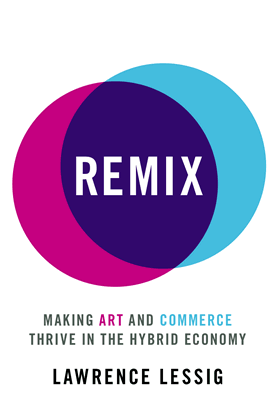
Lessig’s book on Remix was just released. Like his previous books, the emphasis is on the future of intellectual property. Unlike his other books, Lessig appears to focus on the act of “rip, mix and burn” that he often used to discuss different aspects of online culture. In “Remix” this act is the critical framework to discuss the future of creativity.
People heavily invested in the fine arts might find the use of the term “art” misleading, though. Lessig appears to use the term in broad terms to refer to creative acts that are becoming more common due to the spread of Remix principles.
I’m looking forward to this book making the rounds in networked culture. I hope it proves itself to be Lessig’s most popular publication of them all. Sadly, he claims that it will be his last on the issue:
This is (I expect) the last book I’ll write in this field. Dedicated to Lyman Ray Patterson and Jack Valenti, it pushes three ideas — (1) that this war on our kids has got to stop, (2) that we need to celebrate (and support) the rebirth of a remix culture, and (3) that a new form of business (what I call the “hybrid”) will flourish as we better enable this remix creativity.
I wrote this book last year. Many of the themes were described in 18 minutes in my TED talk. I am very eager to have it out.
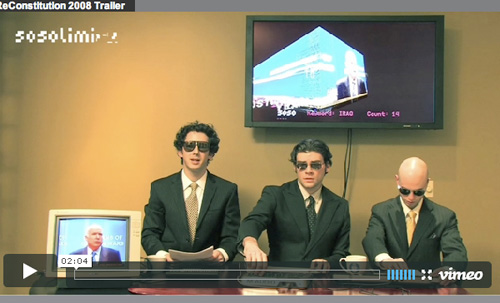
ReConstitution is a live audiovisual remix of the 2008 Presidential debates. There will be three performances in three cities, each coinciding with a live broadcast of the debates.
We’ve designed software that allows us to sample and analyze the video, audio, and closed captioned text of the television broadcast. Through a series of visual and sonic transformations we reconstitute the material, revealing linguistic patterns, exposing content and structures, and fundamentally altering the way in which you watch the debates.
The transformed broadcast is projected onto a movie screen for a seated audience.
Join us in witnessing these historical television broadcasts and in reshaping the medium that has reshaped politics for the last half century.
The legibility of the underlying debate is maintained throughout the performance—we don’t want you to miss a word of it.
Sosolimited is a Cambridge based crew of audiovisual designers and artists. For more information on their work, visit.
Thanks to Greg Smith for directing me to this work.
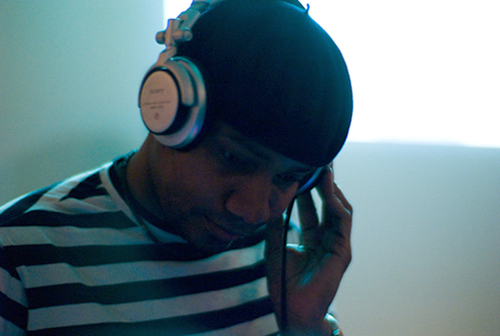
Paul D. Miller, AKA DJ Spooky is a multitasker. He is known for his music productions, as well as his art and film projects. He also has been writing about art and culture for many years. In the last few years, Miller has worked with Trojan Records to develop compilations about Reggae and Dub with a critical yet playful take on the complexities of Jamaica. Most recently, he edited Sound Unbound for MIT Press, a book which comprises a set of texts about the influence of sound in media and culture at large. In the following interview, DJ Spooky, discusses his current projects in a global context, and motivates us to move beyond basic binaries onto a more productive and creative state.
Eduardo Navas: In your most recent Recording Project “Creation Rebel” as well as “DJ Spooky Presents In Fine Style 50,000 Volts of Trojan Records!!!” you write short historical essays about the culture of Reggae, Dub and the Big Sound System. You are also very careful to present your position as a cultural insider, given that you used to visit Jamaica as a kid; and you also state that you were approached by Trojan Records, rather than the other way around, which would otherwise place you, regardless of ethnicity, in a position of “explorer” or Neo-colonial. Based on all this can you explain how you see colonial ideology at play in Jamaica today?
DJ Spooky: The situation Jamaica faces today is part of a global cycle of hyper capitalism – even the Cayman Islands used to be part of Jamaica… anyway, yeah, the whole system is based on production models that privilege the “developed” economies over the “developing” ones. From Mugabe in Zimbabwe to Thabo Mbeki in South Africa, Kim Jong Il in North Korea, or Hugo Chavez in Venezuela, and Ahmadinejad in Iran, people in “developing” economies are faced with rulers just as flawed as anything the U.S. can summon up with people like Bush or Reagan. I tend to think that everything is connected. My Trojan records project is an exploration of the archives of one of my favorite record labels during a time of intense political upheaval. But it’s also about showing how people make music out of their circumstances.