About | Remix Defined | The Book | Texts | Projects | Travels/Exhibits | Remixes/Lists| Twitter

Archive of the category 'Remix Culture'

Loops of Perception: sampling, memory, and the semantic web, by Paul Miller, aka DJ Spooky
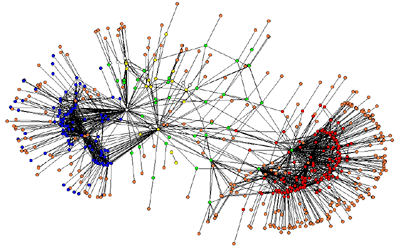
Graph model for IPROnto ontology

Image source: rhizomik.net
Text source: Zone

April/May 2003

“free content fuels innovation”
– Lawrence Lessig, The Future of Ideas

I get asked what I think about sampling a lot, and I’ve always wanted to have a short term to describe the process. Stuff like “collective ownership”, “systems of memory”, and “database logics” never really seem to cut it on the lecture circuit, so I guess you can think of this essay as a soundbite for the sonically-perplexed. This is an essay about memory as a vast playhouse where any sound can be you. Press “play” and this essay says
“here goes”:

(more…)

Quintessence: Art History Shake & Bake, by Sara Diamond

Sherrie Levine, After Edward Weston, 1981

Image source: studiolo.org
Text source: Horizon 8

April/May 2003

Side by side, twining, overlapping, influencing, borrowing from itself and mass culture – so runs the last one hundred years of Western art history. In turn, remix culture borrows from many movements within late and post-modernism: appropriation, collage, dada, graffiti, mail art, manipulated objects, photo montage, pop art, process art, scratch video – the beat goes on. The 20th Century avant garde understood the image as a representation, not a thing in itself. They sought to undermine its aura and authenticity, and open up its meaning, through shifting its context and interpretation.

Dada and Collage
Appropriation practices in 20th Century art start with modernism’s fascination with industrial revolution, with essence and progress. The term “collage” derives from the French coller (to glue), and first appears in the work of Picasso – specifically, Still Life with Chair Caning (1912), wherein he used actual chair cane as well as paint. Collage continued through the Dada movement, spilling into surrealism. Inspired by peeling layers of Parisian street posters, LÈo Malet invented dÈcollage: the removal of images from an existing surface. Collage appears in the work of Braque and Picasso, whose work was in turn iterative of early advertisements. Remix is a form of collage.

(more…)

Open Source at 90 MPH, by Bruno Giussani


Image source: theoscarproject.org
Text source: Business Week
December 8, 2006

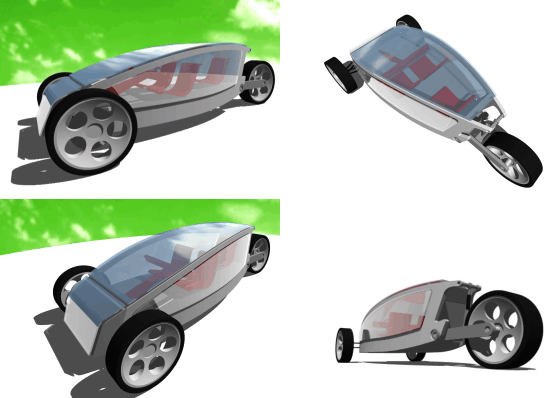
Inspired by Linux, the OScar project aims to build a car by tapping the knowledge of a volunteer team. It won’t be an easy ride, but their journey is important

The computer operating system Linux and the Web browser Firefox are generally considered the two biggest successes of the movement to develop open-source programs—software anyone can modify, transform, and redistribute back into the community. While there are thousands of other examples, Linux and Firefox have managed to mount serious competition to established commercial products, and have therefore come to represent this specific, collective mode of creation.

But Linux and Firefox are made of bits. They are immaterial. Bits can be shared and sent around easily, so that distant people can work on them concurrently; bugs can be corrected almost instantly; new versions containing updates, improvements, or fixes can be released virtually for free.

(more…)

A Critical Reflection on Four a minima:: Texts for the Exhibition NOW 2006, by Eduardo Navas

Image source: a minima PDF, feature on Marta Menezes’s DNA altered Butterflies. Available at newmediaFIX

This text was written to be part of a curatorial participation by a minima:: magazine in the exhibition NOW 2006, which took place at the CCCB.

Read Spanish Version

For a minima’s participation in Now, I have chosen four texts invested in the crossover of art, science and technology. The texts are “Nature?” by Marta de Menezes, “Observation, Interference and Evolutionary Relationships. (An overview of the Phumox project) – Phumox? What’s that?” by Andy Gracie, “Convergent Realities: art, technology consciousness from the planetary perspective” by Roy Ascott, “Artport” and “Not Just Art—from Media Art to Artware” by Christiane Paul. The first two texts, written by artists/researchers, could be read as honest attempts to cross over art, science and technology; the last two texts, written by theorists, can be read as reflections on such practices. The four texts are sensitive to contextualization and critical commentary, which are expected of art practice today, as well as the urge to do research for the sake of understanding the world and develop technology to do it, which is expected of science and technology.

(more…)

Una reflexión critica sobre cuatro textos de la revista a minima:: para la exhibición NOW 2006, por Eduardo Navas

Image source: a minima PDF, feature on Marta Menezes’s DNA altered Butterflies. Available at newmediaFIX

Este texto fue escrito para la participación curatorial de la revista a minima:: en la exhibición NOW 2006, la cual se llevó a cabo en el CCCB durante Noviembre del 2006,.
Lea la versión en inglés

Para la participación de a minima en Now, he escogido cuatro textos que se enfocan en el cruce cultural entre arte, ciencia y tecnología. Los textos son “Nature?” por Marta de Menezes, “Observation, Interference and Evolutionary Relationships. (An overview of the Phumox project) – Phumox? What’s that?” por Andy Gracie, “Convergent Realities: art, technology consciousness from the planetary perspective” por Roy Ascott, “Artport” y “Not Just Art—from Media Art to Artware” por Christiane Paul. Los primeros dos textos, escritos por artistas/investigadores activos en el arte, podrian ser considerados atentos en cruzar entre el arte, ciencia y tecnología; mientras que los dos últimos, escritos por teóricos, podrian ser reflecciones sobre tales practicas. Los cuatro textos son sensitivos a la contextualización y comentario crítico, los cuales son esperados de la practica del arte hoy, junto con el impulso de desarrollar investigaciones por la necesidad de comprender el mundo y desarrollar la tecnología para hacerlo, lo cual es esperado de la ciencia y la tecnología.

(more…)

New Media Develops Rapidly, Report and Interview by Jeffrey Brown

Source: The News Hour
January 1, 2007

New media products and programming developed rapidly in the past year. Jeffrey Brown takes a look at the largest media stories of 2006, including the rise of YouTube and the ongoing struggles in the newspaper business.

JEFFREY BROWN: Yes, the big stars of what we can call old media were in the spotlight in 2006, notably when Charles Gibson and Katie Couric traded mornings for evenings.

But another old media mainstay, Time magazine, passed over the anchors and other newsmakers, and instead selected as its person of the year, “You.” That’s you, the viewer, reader, listener, and more and more creator of news content.

(more…)

Culture and Code by Regine Debatty

Source: We Make Money Not Art
December 30, 2006

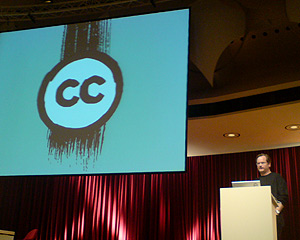
A short recap of Creative Commons-founder Lawrence Lessig‘s evangelization talk (or rather motivation session for the converted) at 23C3 in Berlin about the differences between culture and code.

The fundamental change is the fact that code had been used to create things like printer-drivers and such. But – since a few years, code, or rather the tools that had been coded have become a main element in the creation of culture as we use and witness it today. Especially the whole mashup-culture is heavily relying on the techniques and the mindset of digital creation and open access to other’s works for sampling from and building upon, etc. Popular examples are the anime music-clip subculture like the Muppet Hunter, the Jesus Christ the Musical-clip or lots of pieces that borrow from news networks’ footage to make their own suggestive edits.

(more…)

Copy-paste (net.)art by Regine Debatty

Source: We Make Money not Art
Reblogged at Rhizome.org
December 20, 2006

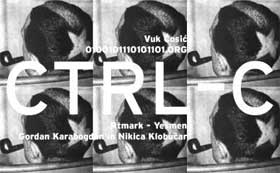
Last May, i blogged about Plagiarismo, an exhibition that tried to demonstrate that the appropriation and re-formulation of other artists’ ideas is an essential component of culture.

Vuk Cosic – who’s having a solo exhibition at the Skuc Gallery in Ljubljana- wrote me then that he was putting together a show called CTRL-C on a similar subject. The show has just opened at the galerija Simulaker in Slovenia. Here’s the gist:

(more…)

A Chill Pill

Taking a break on my research until the beginning of 2007. This announcement will be up until then. Enjoy the end of the year festivities.

Eduardo Navas

Remix is Active Consumption not Production (when media becomes culture, part 2) by Danah Boyd


Image source: blogimg.goo.ne.jp
Text source: Apophenia

October 08, 2005

After great comments and good conversations, i want to take a second stab at explaining the shift i was asking for wrt copyright and remix. My argument is that we stop thinking of remix as production, but as active consumption. Remix happens as a bi-product of consumption. What we’re remixing is culture and the active consumption of culture is part of identity development and living as a social creature in society.

Think about clothing consumption. Few people buy all of the items on the mannequin. You buy different pieces and mix and mash them. You might even decide to alter them by adding patches, by dying them, by cutting them up. You make the clothing yours. And then you share your consumption with the world by parading on the streets. In this way, you make the clothing tell your story. (tx Kevin Bjorke)

(more…)

Current Projects


    Books


    Remix Theory | is an online resource by Eduardo Navas. To learn more about it read the about page.

    Logo design by Ludmil Trenkov

    http://www.mentalhealthupdate.com/