About | Remix Defined | The Book | Texts | Projects | Travels/Exhibits | Remixes/Lists| Twitter

Archive of the category 'Remix Culture'

The Three Basic Forms of Remix: a Point of Entry, by Eduardo Navas

Image source: Turbulence.org
Layout by Ludmil Trenkov
Duchamp source: Art History Birmington
Levine source: Artnet

(This text has been recently added to the section titled Remix Defined to expand my general definition of Remix.)

The following summary is a copy and paste collage (a type of literary remix) of my lectures and preliminary writings since 2005. My definition of Remix was first introduced in one of my most recent texts: Turbulence: Remixes + Bonus Beats, commissioned by Turbulence.org. Many of the ideas I entertain in the text for Turbulence were first discussed in various presentations during the Summer of 2006. (See the list of places here plus an earlier version of my definition of Remix). Below, the section titled “remixes” takes parts from the section by the same name in the Turbulence text, and the section titled “remix defined” consists of excerpts of my definitions which have been revised for an upcoming text soon to be released in English and Spanish by Telefonica in Buenos Aires, Argentina. The full text will be released online once it is officially published.
(more…)

DUB CITY: Systemwide & BSI Records Lead the Charge of Portland’s Abstract Reggae Boom, by Charles Mudede

Image and text source: The Stranger

Despite its large Mexican and Asian communities, and a black neighborhood that’s more distinctive than the black community in Seattle, Portland seems isolated and singular. Isolated because its architecture, laws, and civic infrastructure are unique, as if the municipal and design trends radiating from the big centers of the world failed to reach this remote outpost, and in this splendid isolation Portland established its own ideals. Singular because its cultural products seem of one mind, one lifestyle, one world (white, middle-class), and not like, say, hiphop, whose parts were fused in boroughs that contained various ethnic groups (African American, Jamaican, Puerto Rican, Jewish).

Portland, however, is not completely isolated as an artistic community, being intricately connected with cities like Seattle, Vancouver, BC, and San Francisco, and it isn’t confined solely to the production of postmodern novels or rock music. In fact, Portland is one of the North American capitals (in terms of production and distribution) of dub music, an abstract form of reggae that originated on the streets of Kingston, Jamaica. The reason for Portland’s dub capital status is the presence of Systemwide, the house band for a thriving dub label called Bucolic Sound Investigations (BSI).

A SHORT HISTORY OF DUB

If you already know what dub is, then I recommend you skip this part and resume the feature in the next section, titled “Portland’s System.”

There is a famous story of a Rastaman and a hippie dancing at a reggae concert. The hippie dances wildly, flapping his arms and moving frantically. The hippie’s expressive dancing irritates the chilled-out Rastaman, who, when accidentally struck by the hippie’s hand, finally tells him to stand still and dance. This is precisely what one must do when listening to reggae: stand still and dance. Reggae is less dance music and more soul music. It’s the soul, not the body, that dances when one listens to Bunny Wailer or the Roots Radics or the Itals. Reggae is so preoccupied with the soul (its condition, its qualities, its shivers and shades) that a whole subcategory of the music is devoted to reproducing soul worlds or geist dimensions. That subcategory is dub.

Read the entire article at The Stranger

Architecture and interaction design, via adaptation and hackability, Posted by Dan Hill at City of Sound (reblog)

Image and text source: City of Sound

May 23, 2006

Dan Saffer recently asked me to contribute some thoughts on adaptation, hackability and architecture to his forthcoming book Designing for Interaction (New Riders, 2006), alongside 10 other ‘interviewees’ such as Marc Rettig, Larry Tesler, Hugh Dubberly, Brenda Laurel etc. Dan’s been posting their various responses up at the official book site (see also UXMatters) yet he kindly agreed to let me post my full answers below (the book will feature an excerpt).

The questions he posed were: Can products be made hackable, or are all products hackable? What types of things can be designed into products to make them more hackable? What are the qualities of adaptive designs? You’ve spoken on putting “creative power in the hands of non-designers.” How do interaction designers go about doing that? What can interaction designers learn about adaptability from architecture?

Given this, Dan had inadvertently provided me with the impetus to get down a decent summary to a few years’ worth of thinking around this subject. So what follows directly addresses one of the stated purposes behind this blog: to see what we can draw from the culture and practice of architecture and design into this new arena of interaction design – and some of the issues in doing so. (An unstated purpose of the blog – of providing me with an indexed notebook – is also fulfilled!) Here goes:

Can products be made hackable, or are all products hackable?

(more…)

WHAT COMES AFTER REMIX? by Lev Manovich


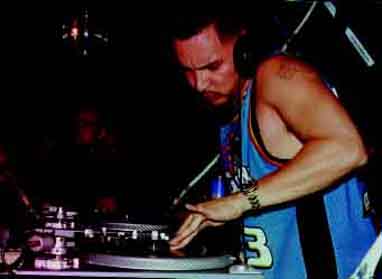
Mixmaster Mike- photo by Chris Taylor

Image source: Virtual DJ

Text source: Manovich.net 

winter 2007

It is a truism today that we live in a “remix culture.” Today, many of cultural and lifestyle arenas – music, fashion, design, art, web applications, user created media, food – are governed by remixes, fusions, collages, or mash-ups. If post-modernism defined 1980s, remix definitely dominates 2000s, and it will probably continue to rule the next decade as well. (For an expanding resource on remix culture, visit remixtheory.net by Eduardo Navas.) Here are just a few examples of how remix continues to expand. In his 2004/2005-winter collection John Galliano (a fashion designer for the house of Dior) mixed vagabond look, Yemenite traditions, East-European motifs, and other sources that he collects during his extensive travels around the world. DJ Spooky created a feature-length remix of D.W. Griffith’s 1912 “Birth of a Nation” which he appropriately named “Rebirth of a Nation.” In April 2006 Annenberg Center at University of Southern California ran a two-day conference on “Networked Politics” which had sessions and presentations about a variety of remix cultures on the Web: political remix videos, anime music videos, machinima, alternative news, infrastructure hacks.[1] In addition to these cultures that remix media content, we also have a growing number of software applications that remix data – so called software “mash-ups.” Wikipedia defines a mash-up as “a website or application that combines content from more than one source into an integrated experience.”[2] At the moment of this writing (February 4, 2007), the web site www.programmableweb.com listed the total of 1511 mash-ups, and it estimated that the average of 3 new mash-ups Web applications are being published every day.[3]

(more…)

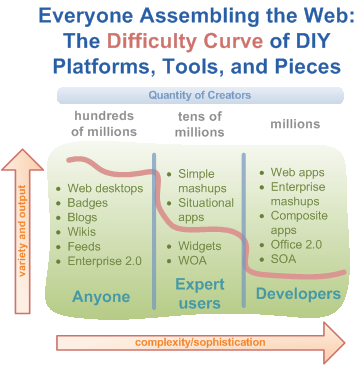
Tracking the DIY phenomenon Part 2: Mass customization, mashups, and recombinant Web apps, by Dion Hinchcliffe

Images and text source: ZDnet

February 25th, 2007

In my  last post, I took a look at the recent proliferation of Web widgets, which are modular content and services that are making it easier for anyone to help themselves to the vast pool of high value functionality and information that resides on the Web today.  Companies are actively “widgetizing” their online offerings so that it can actively be repurposed into other sites and online products.  And as we discussed in the last post, it’s believed that letting users innovate with your online offerings by letting embedding them in their own Web sites, blogs, and applications can greatly broaden distribution and reach, leverage rapid viral propagation over the Internet, and fully exploit the raw creativity that theoretically lies in great quantities on the edge of our networks.

DIY on the Web is looking to be a major trend; Newsweek recently speculated that 2007 will be the Year of the Widget.

Looked at this way, letting thousands and even millions of users build Web sites and apps out of your Web parts and then monetizing it with advertising, usage fees, or subscriptions sounds great in the abstract.  But one of the big outstanding questions is if widgitizing is mostly useful for gaining fast user adoption and market share, and not for building the fundamentals of a viable, long-term business online.  While this last question is still very much an open one, part of the answer will come from the way that the consumption side of DIY develops.  The question is this: Are environments emerging that will enable rich and sophisticated DIY scenarios that are usable by most people?

(more…)

Technology Helped Virginia Tech Students Connect After Tragedy, by Jeffrey Brown


Image source: Youtube
Text source: The News Hour

Originally Aired: April 18, 2007

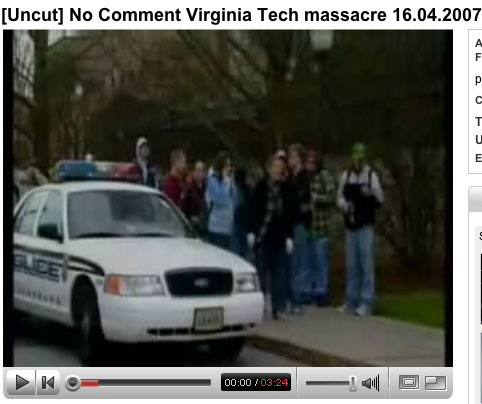
JEFFREY BROWN: As events in Blacksburg, Va., unfolded Monday, the world saw this: video shot with a cell phone, taken by Virginia Tech student Jamal Albarghouti. The footage, run repeatedly on CNN, allowed the audience to hear the gunshots from Norris Hall, where 31 people, including the gunman, died.

CNN anchors then interviewed Albarghouti, referring to him as “our I-reporter,” part of a project encouraging viewers to submit what’s known as citizen journalism.

JAMAL ALBARGHOUTI, Virginia Tech Student and Reporter: I knew this was something way more serious. It was then when I decided to use my camera.

JEFFREY BROWN: In recent big stories from the 2004 tsunami, to the 2005 London subway bombings, TV news organizations have relied more and more on contributions from nonprofessional eyewitnesses.

In Blacksburg, ABC broadcast these cell phone images taken inside Norris Hall. Martin Clancy is senior producer for ABC News Digital.

MARTIN CLANCY, ABC News Digital: Well, reporting has gone beyond shoe leather and phone calls. This is a much more efficient way to reach a lot of people, to gather a lot of information. Granted, it’s a lot more work to verify it, to bring it up to broadcast or publishing standards.

But this is a really much more efficient way to gather information and to get input and to discover perspectives you didn’t even know existed. I think there’s no end to this. We used to play with getting e-mails from viewers. What started as a trickle of e-mails has become a flood. What is now a trickle of video is going to become, I predict, a flood of video.

‘Everybody is a storyteller’

(more…)

‘Birth’: The remix. DJ Spooky’s spin on’Birth of a Nation, By SHAUN BRADY


Miller: “… [‘Nation’ is] one of the cornerstones of American cinema.”

Text and Image source: Philadelphia Daily News

Apr. 11, 2007
THE FAMILIAR image of the DJ hunched over a pair of turntables doesn’t quite describe the innovative approach of Paul Miller, aka DJ Spooky, That Subliminal Kid.Where other DJs remix songs, adding beats and blending melodies, Miller remixes culture in his style-blending music and as a writer, producer, critic, philosopher and multimedia artist.

On Friday at Rutgers-Camden, he’ll present his multimedia performance “Rebirth of a Nation,” bringing the art of the remix to one of history’s greatest and most controversial films, “Birth of a Nation.”

“Cut, splice, scratch – it’s all about editing,” explained Miller about transferring his DJ techniques to a visual medium. “When you see someone spin records, they’re taking bits and pieces of any performance – classical, hip-hop, etc. In the era of software, it’s all about compositional strategy.”

Read the entire article at Philadelphia Daily News

Penguin Remixed, by Robyn Good (reblog)

Image and text source: masternewmedia.org

This is an absolutely great cultural marketing initiative, spreading valuable passages from some of the best classical writings in remixes and mashups completely created by users. Penguin Books has in fact made available a good number of audio recordings containing the voices of some popular actors reading through classical passages. Users can freely download the recordings and remix them with music and sounds in any way they like.

The results are nothing short of astonishing.

In my personal view this has got to be one of the best ways to get exposure to the classics for today’s youth. Not only. It is my personal conviction and experience that by listening to the spoken word when associated to repetitive and not dominant music patterns the human brain can memorize and remember those words much more effectively.

Don’t think so? Give it a try:

http://www.penguinremixed.co.uk/site/

Radio Show: The Creative Remix, by Benjamen Walker. If remixing is an art form why are the lawyers running the conversation?


Image source: Wikipedia

Text source: Creative Commons Radio
The Creative Remix, with host Benjamen Walker, is an hour-long “lawyer free” examination of the art, culture, and history of the remix. The hour kicks off with a musical analysis of DJ Dangermouse’s infamous remix of the Beatles and Jay-Z. Then we go back in time to check out the ancient Roman art of the poetry mash-up, or the Cento. Then we rewind to the 18th century to check out the birth of copyright and how it effected writers like Alexander Pope; and the early 20th century when the visual artist Marcel Duchamp used the remix to reinvent everything. We also take a field trip to the Mass Mocca museum of modern art to check out the exhibit “Yankee Remix.” Walker brings along a few grad students and a pair of curmudgeonly New England antique collectors to investigate different attitudes towards remixing.

(more…)

History of the remix, reblog from TXU: The Real Talk on the Streets

Image and text source: http://www.bbc.co.uk/1xtra/tx/
documentaries/remix.shtml

Date of publication, uncertain

1Xtra’s ‘Remix Kid’ Seani B uncovers the origins of remixing…
How has the art has changed over the years?

First developed by Jamaican reggae producers in the 1960s to create dub music, remixing was picked up by hip hop pioneers and disco DJs to develop new styles.

P Diddy is one the most famous remixers of all time – if that title is in your sights, listen up for Seani’s tips on how to put together your own remix track.
Who’s the remixer of the remixers? How has remixing blurred the boundaries between different musical genres in the UK?

(more…)

Current Projects


    Books


    Remix Theory | is an online resource by Eduardo Navas. To learn more about it read the about page.

    Logo design by Ludmil Trenkov

    http://www.mentalhealthupdate.com/