About | Remix Defined | The Book | Texts | Projects | Travels/Exhibits | Remixes/Lists| Twitter

Archive of the category 'Remix Culture'

‘Copyright criminals’ look to remix the noise–legally, by Daniel Terdiman
Image source: Copyright Criminals

Text source: Cnet

When Paul Miller, aka DJ Spooky, says he thinks musicians should be able to remix samples of others’ clips into new works, he puts his money where his mouth is.

Miller is part of a group of musicians including Public Enemy’s Chuck D; Parliament Funkadelic’s George Clinton; and the band De La Soul who are allowing the public to mash up audio snippets from interviews they’ve given into submissions for a new remixing competition.

The Copyright Criminals Remix Contest, which is sponsored by the nonprofit copyright licensing organization Creative Commons, is all about promoting remixing culture and encouraging artists like Miller to make their work legally and affordably available for other musicians to manipulate.

Creative Commons has built a licensing system that allows content creators to decide which usage rights to their work to grant others. In every case, the licenses require attribution to the creator. Some allow users to manipulate licensed work for any non-commercial purpose, while others don’t. The ultimate point is to faciliate copyrights that are flexible on which rights users get.

Read the entire article at Cnet
Step Away From the Sampler, by Peter Kirn

Image and text source: Key Board Mag

January 2005

Court rules all digital sampling illegal and the record industry objects — but you still have options

Get this: According to a fall 2004 ruling by the 6th Circuit U.S. Court of Appeals, any use of a digital sample of a recording without a license is a violation of copyright, regardless of size or significance. In its decision in Bridgeport Music et al. vs. Dimension Films, the court said simply, “Get a license or do not sample. We do not see this as stifling creativity in any way.”

“As far as sampling of recordings, they didn’t make it gray; they made it a line in the sand,” says Jay Cooper, a leading entertainment arts lawyer and a former president of the National Academy of Recording Arts and Sciences (NARAS). Previously, courts had applied the question of size and significance to copyright infringement claims, but the new ruling changes that for sampling. Cooper says, “I think they went a little far afield from what the law has been in the past. Basically, the law has generally been there has to be more than a minimal use . . . this case basically said that you could take one note and that could be copyright infringement. They really did say that.”

(more…)

The Latency of the Moving Image in New Media, by Eduardo Navas

Image and text source: Telic Arts Exchange

Written for an exhibition with the same title curated by Eduardo Navas at Telic Arts Exchange, Chinatown, Los Angeles, CA. May 25 – June 16, 2007

Text released: May 25, 2007

What separates new media from previous media is, in part, waiting periods that define public and private experience; whether the download of a file from the Internet is taking longer than expected, an e-mail message has not been sent from one server to another for some unknown reason, or a large file is being rendered in video software like Final Cut Pro for output as a viewable movie, new media is largely dependent on constant moments of waiting, often referenced as latency.

Latency is used with three significations in mind. First, is the technological latency that takes place in new media culture due to the nature of the computer: the machine has to always check in loops what it must do, to then execute commands, eventually leading to the completion of a task. This is the case when someone uses Photoshop, Microsoft Word, or any other commercial application; or streams image and sound across the Internet. This constant checking in loops at hardware and software levels opens the space for latency’s second signification, which extends in social space when the user consciously waits for a response that begins and ends with the computer. Latency becomes naturalized when a person incorporates computer interaction as part of his/her everyday activities.

(more…)

Deleuze/Guattari: Remix Culture, Paul D. Miller Interviews Carlo Simula

Image source: Dusty Groove

Text source: Nettime.org and Djspooky.com

November 20, 2005
The following is an interview with Carlo Simula for his book
MILLESUONI. OMAGGIO A DELEUZE E GUATTARI (Cronopio Edizioni)

Contributions will include Guy-Marc Hinant (Sub Rosa), Philippe Franck (transcultures, le maubege), Bernhard Lang, Tim Murphy, Achim Szepanski – and many others. I think it’s an update on some issues that have been percolating.

Smell the brew.
Paul,
Tunis, Tunisia 11/20/05

1) You’ve often referred in your interviews to how much contemporary philosophy has influenced your work. Foucault said “Un jour, peut-être, le siècle sera deleuzien”, how much and in which way Deleuze and Guattari influenced you? And what you feel is interesting in their work?

The idea of the “remix” is pretty trendy these days – as usual people tend to “script” over the multi-cultural links: the economics of “re-purposing,” “outsourcing” and above all, of living in an “experience economy” – these are things that fuel African American culture, and it’s active dissemination in all of the diaspora of Afro-Modernity. My take on Deleuze and Guattari is to apply a “logic of the particular” to the concept of contemporary art. Basically it’s to say that software has undermined all of the categories of previous production models, and in turn, molded the “computational models” of how “cultural capital,” as Pierre Bourdieu coined it, mirrors various kinds of production models in a world where “sampling” (mathematical and musical), has become the global language of urban youth culture. Eduoard Glissant, the Afro-Caribbean philosopher/linguist liked to call this “creolization” – I like to call it “the remix.” Philosophy is basically a reflective activity. It always requires a surface to bounce off of. We don’t exist in a cultural vacuum.

(more…)

Free Tool Offers ‘Easy’ Codin, by Jonathan Fildes


Scratch’s creator Mitchel Resnick building a character

Image and text source: BBC

May 14, 2007

A free programming tool that allows anyone to create their own animated stories, video games and interactive artworks has been developed.

Primarily aimed at children, Scratch does not require prior knowledge of complex computer languages.

Instead, it uses a simple graphical interface that allows programs to be assembled like building blocks.

The digital toolkit, developed in the US at MIT’s Media Lab, allows people to blend images, sound and video.

“Computer programming has been traditionally seen as something that is beyond most people – it’s only for a special group with technical expertise and experience,” said Professor Mitchel Resnick, one of the researchers at the Lifelong Kindergarten group at MIT.
(more…)

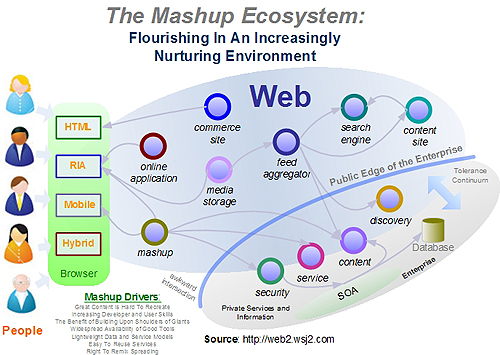
The Web 2.0 Mashup Ecosystem Ramps Up, by Dion Hinchcliffe


Image and text source: Soa Web Services

4 February 2006

2.63 new mashups a day.  That’s what John Musser’s terrific new Mashup Feed site says is current the creation rate.  If that rate flattens out today, which isn’t likely, that’s over 960 new mashups every year.  Mashups, composite web applications partially constructed from the services and content from other web sites, are taking off with an amazing speed.  Yet they are a relatively new phenomenon in terms of being this widespread and pervasive.  All this even though mashups, like blogs and wikis, were actually possible from the creation date of the first forms-capable browser.  So why the sudden widespread interest?

(more…)

1 + 1 + 1 = 1: The new math of mashups, by Sasha Frere-Jones

Image source: Gullbuy

Text source: The New Yorker

January 10, 2005

In July of 2003, Jeremy Brown, a.k.a. DJ Reset, took apart a song. Using digital software, Brown isolated instrumental elements of “Debra,” a song by Beck from his 1999 album “Midnite Vultures.” Brown, who is thirty-three and has studied with Max Roach, adjusted the tempo of “Debra” and added live drums and human beat-box noises that he recorded at his small but tidy house in Long Island City. Then he sifted through countless a-cappella vocals archived on several hard drives. Some a-cappellas are on commercially released singles, specifically intended for d.j. use, while others appear on the Internet, having been leaked by people working in the studio where the song was recorded, or sometimes even by the artist.

After auditioning almost a thousand vocals, Brown found that an a-cappella of “Frontin’,” a collaboration between the rapper Jay-Z and the producer Pharrell Williams, was approximately in the same key as “Debra.” The two songs are not close in style—“Debra” is a tongue-in-cheek take on seventies soul music, while “Frontin’ ” is hard and shimmering computer music—but the vocalists are doing something similar. Brown exploited this commonality, and used his software to put the two singers exactly in tune.

Read the entire article at The New Yorker

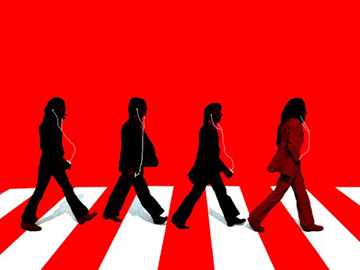
Time for an Apple/Google Mash-up, by Arik Hesseldahl


Abbey Road ipod mash up

Image source: xlr8r.com
Text source: Business Week
AUGUST 31, 2006

Byte of the Apple

The two titans are drawing closer together. If they would just combine their offerings, they’d pose a real threat to Microsoft

I have an admittedly odd affinity for remembering TV advertisements I saw as a very young child. Sometimes those memories pop up when I least expect them.

Today I’ve been thinking of a spot that those of a certain age will remember well: Two guys walking, one eating chocolate, the other, inexplicably eating peanut butter out of a jar. They bump, and the chocolate drops into the jar. The rest, of course, has become marketing history, summed up by the jingle for Reese’s Peanut Butter Cups: “Two great tastes that taste great together.”

Funny, the ad comes to mind in the wake of an announcement that Google (GOOG) CEO Eric Schmidt is joining the board at Apple Computer (AAPL). It’s the latest indication these two Silicon Valley stalwarts are getting closer all the time. And the possibilities for cooperation between the two are legion.

Read the entire article at Business Week

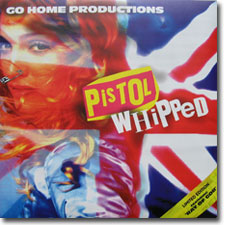
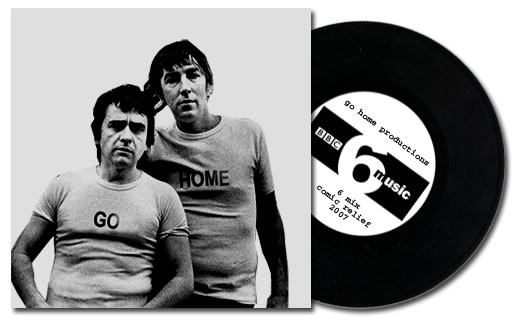
Mash-Up: Artistic Musical Creations or Blasphemy? Interview of Mark Vidler of Go Home Productions, by Ronnie

Image source: gohomeproductions.co.uk

Text source: earcandy_mag.tripod.com

December 17, 2004

Intro:
Some call it artistic musical creations, while others cry that it is blasphemy! It is all the rage in the U.K. and it has even gone mainstream, with MTV U.K. celebrating it on “MTV-Mash”. This new craze is called “mash-ups” and it involves taking the vocal from one song and joining it to the instrumental track of another. For instance, take a “mash-up” like “Paperback Believer”, which uses the musical track of the Monkees “I’m a Believer” with the vocals from The Beatles “Paperback Writer”.

Probably the best-known of the recent mash-up’s is the notorious “Grey Album” by Dangermouse, which mixed Jay-Z’s “Black Album” with The Beatles “White Album”. In February, when the record label EMI overreacted and blocked distribution of “The Grey Album” it pretty much created an instant hit.

And earlier this year, David Bowie had a contest in which he asked fans to create a new song using computer music software to blend or “mash up” two existing tracks – with the winner winning a car!

(more…)

2007 Cassette Jockey World Championships (Competition call worth noting)

Image source: http://www.civilunrest.biz/

Text source: http://makerfaire.com/cj/

Originally learned about it at Rhizome.org

Note: This announcement is so good as as an idea recalling the good ol’days, that it’s worth keeping around for nostalgia’s sake. (But I admit I keep it here for the sake of my ongoing archive.) I can’t think of a DJ from the 80’s who didn’t start out mixing tunes with a tape-player. I did, and it improved my skills on the ones and twos once I could afford to buy them. I do know of another CJ Championship organized by Beige: 2004 BEIGE Cassette Jockey World Championship. Below is the announcement:

2007 Cassette Jockey World Championships

*** CALL FOR COMPETITORS ***

CALLING ALL: Cassette Jockies… Retro-Tech Lovers… Magnetic Media Monsters… Circuit Benders… Multi-Media DJs… Walkman Hot-Rodders… we want you at the:

2007 CASSETTE JOCKEY WORLD CHAMPIONSHIPS

at the Make Magazine Maker Faire!

http://makerfaire.com/cj/

In 2003 at a festival in Chicago, a group of retro-tech geniuses organized The Cassette Jockey World Championships. Like the popular DJ (Disk Jockey) competitions with record-toting DJs showing off their turntable skills, the CJ Championships showcases skills and styles in the venerable world of cassettes. Since CJs were encouraged to hot-rod their own equipment, eviscerated boomboxes, disembodied tape heads, and overclocked Walkmans were the weapons of choice… anything that used the standard cassette as its ammo.

(more…)

Current Projects


    Books


    Remix Theory | is an online resource by Eduardo Navas. To learn more about it read the about page.

    Logo design by Ludmil Trenkov

    http://www.mentalhealthupdate.com/