About | Remix Defined | The Book | Texts | Projects | Travels/Exhibits | Remixes/Lists| Twitter

Archive of the category 'Remix Culture'

Entrevista a Eduardo Navas // artista, historiador y crítico especializado en nuevos medios, por: yto.cl
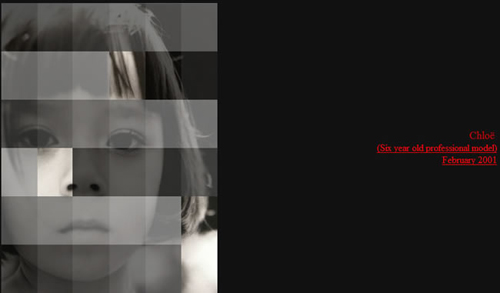
Online Project:
Chloë
(Six year old professional model)

February 2001

Note: This interview was originally published by Yto (Isabel Aranda) in the Magazine Escaner Cultural, August 2007, based in Santiago de Chile. It is currently only available in Spanish.

Image source: navasse.net/cloeyStart/

Text source: revista.escaner.cl/node/279

Eduardo Navas es artista, historiador y crítico especializado en nuevos medios; su obra y teorías han sido presentadas en varios lugares en Estados Unidos, Latino América y Europa. Ha sido jurado para ” Turbulence.org” en 2004, también fue jurado para las comisiones de “Rhizome.org” de 2006-07, en Nueva York.

Navas es fundador y editor contribuyente de “Net Art Review” (2003-2005), y co-fundador de “newmediaFIX” (desde 2005). Actualmente, Navas es docente de práctica de multimedia en la Universidad del Estado en San Diego (SDSU), y es candidato al doctorado en letras en el Departamento de Historia de Arte y Medios de Comunicación, Teoría y Crítica, en el programa de Bellas Artes en la Universidad de San Diego California (UCSD).

Cuéntame un poco sobre tu infancia, por favor…

Nací en 1969 en El Salvador, Centro América, y emigré a Los Estados Unidos en 1980, en donde he crecido como ciudadano naturalizado.

¿Cuándo descubriste que tu camino era el arte?

Siempre lo supe. Mis modelos fueron mis hermanos Max y Ricardo, quienes dibujaban mucho. Ellos coleccionaban paquines (historietas cómicas en forma de revista). Maximiliano, mi hermano mayor, había tenido un curso por correo para aprender a dibujar caricaturas. El nunca lo terminó, pero guardó todas las lecciones, las cuales yo terminé usando. Yo practicaba a dibujar los ejemplos en cada lección y después con los años comencé a copiar dibujos cómicos, más que todos de paquines de súper héroes. Mis favoritos eran del Hombre Araña, y los Cuatro Fantásticos. Pero en El Salvador más que todo se encontraban paquines de Superman y otros personajes de la compañía DC Comics. Así que cuando encontraba un paquin del Hombre Araña, publicado por Marvel, era prácticamente de oro para mí. Al llegar a los Estado Unidos me volví loco comprando paquines del Hombre Araña, Los Cuatro Fantásticos, entre otros. Era como un sueño poder ir a una tienda especializada de paquines y ver tantos de ellos ahí. Pero llegó un momento en el cual pude dibujar con facilidad y me pregunté que más se podría hacer con el arte, una vez que uno llega a dibujar más o menos bien. Creo que fue ahí donde mi interés en la práctica crítica comenzó.

(more…)

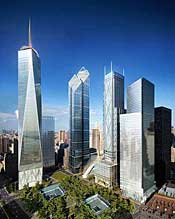
Ground Zero – Five Years Later


Image: SPI, dbox

Image and text source: Architectural Record

Note: This is a great resource offering several articles about design proposals for Ground Zero in NYC. Click on the above link to access all articles. It was published sometime in 2006.

Today, New Yorkers awoke to déjà vu. This crisp September morning, with fiercely white sunshine piercing a cloudless sky, was almost exactly like the day that greeted New Yorkers on September 11, 2001. While the similarity is uncanny, the platitudes are correct that the world is forever changed.

Words fail to fully communicate the experience of the terrorist attacks, and their transformative effect on society, politics, and the economy. Can the architecture that will replace and memorialize the Twin Towers fill the gaps?

We are getting closer to an answer. Despite the many conflicts about which commentators had forewarned us early on, Ground Zero’s rebirth inches toward reality. In the few weeks leading up to this fifth anniversary, news of progress has appeared with increasing frequency. Power switched hands, designs were revealed, steel was shipped. Ground Zero promises to be home to works by the generation’s most famous architects. That fact alone guarantees neither universal praise nor timelessness. But its completion will open a new chapter in which the public demands innovation and excellence throughout the built landscape, not just in rebuilding what’s lost.
ward reality. In the few weeks leading up to this fifth anniversary, news of progress has appeared with increasing frequency. Power switched hands, designs were revealed, steel was shipped. Ground Zero promises to be home to works by the generation’s most famous architects. That fact alone guarantees neither universal praise nor timelessness. But its completion will open a new chapter in which the public demands innovation and excellence throughout the built landscape, not just in rebuilding what’s lost.

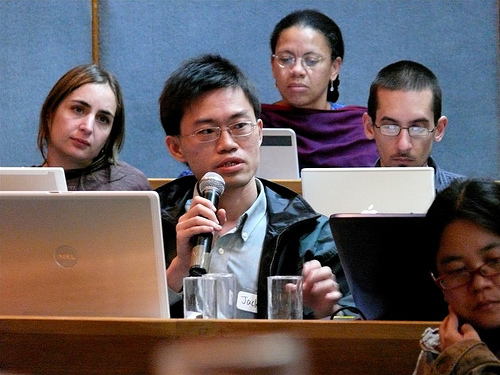
Learning By Remixing, by Mark Glaser

Image source: rconversation.blogs.com

Text source: PBS Media Shift

According to a 2005 study conducted by the Pew Internet & American Life Project, 57 percent of American teens who use the internet could be considered media creators. For the purpose of the study, a media creator was defined as someone who “created a blog or webpage, posted original artwork, photography, stories or videos online or remixed online content into their own new creations.” Most American teens online have done two or more of these activities. 33 percent of teens share what they create online with others. 19 percent create new works by remixing content they appropriated from another source.

America’s children are become media-makers: they are blogging, designing their own websites, podcasting, modding games, making digital movies, creating soundfiles, constructing digital images, and writing fan fiction, to cite just a few examples. As they do so, they are discovering what previous generations of artists knew: art doesn’t emerge whole cloth from individual imaginations. Rather, art emerges through the artist’s engagement with previous cultural materials. Artists build on, take inspiration from, appropriate and transform other artist’s work: they do so by tapping into a cultural tradition or deploying the conventions of a particular genre. Beginning artists undergo an apprenticeship phase during which they try on for size the styles and techniques of other more established artists. And even well established artists work with images and themes that already have some currency within the culture. Of course, this isn’t generally the way we talk about creativity in schools, where the tendency is still to focus on individual artists who rise upon or stand outside any aesthetic tradition.

Read the entire feature at  PBS Media Shift

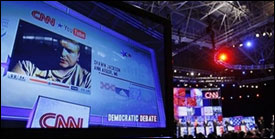
Democrats Face Voter Questions in New Format

Text and image source: The News Hour

Note: We are definitely entering a new stage of mass opinion.  The fact that Youtube is playing a role in the next U.S. elections demonstrates the ease incorporation of web 2.0 in mainstream culture: the individual can apparently express opinions and be heard like never before, but how effective is this, really?  The analysts interviewed in the feature below express the outcome to be more or less business as usual as most candidates got to promote their own agendas, while immersing in new media culture.   

Democratic presidential hopefuls fielded questions directly from the voters Monday in a debate sponsored by CNN and the video sharing Web site YouTube. A reporter and political analyst discuss the candidates’ answers and new debate format.

GWEN IFILL: It was yet another candidates’ forum, but last night, the questions came from Internet-savvy Democrats.

REMY MUNASIFI, McLean, Virginia: My taxes put some kids through college, I can’t afford to send myself. Now, tell me, if you were elected president, what would you do to help?

GWEN IFILL: YouTube, the wildly successful Internet video-sharing service, joined with CNN to host the debate at the Citadel in Charleston, South Carolina. CNN screened 3,000 submissions. The ones that aired ranged from serious and emotional…

Read the entire feature at  The News Hour

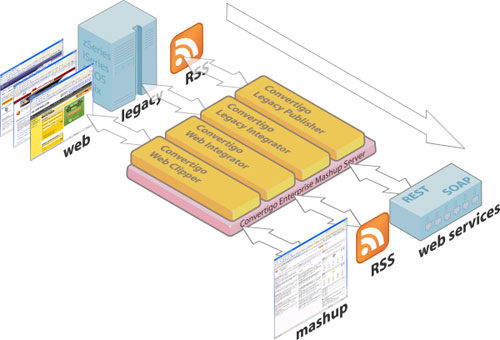
IBM Executive Declares Web 2.0 Technology to Drive New Business Applications

Note: Archived for historical purposes.

Image source: http://www.twinsoft.fr/intl/fr/
cariocaweb/convertigo-ems-enterprise-mashup-server.htm

Text source: IBM

New “IBM Enterprise Mashup” Technology Allows for Creation of Five Minute Custom Applications

NEW YORK, NY – 15 Jun 2006: NY PHP Conference — In a keynote speech to leading technology executives, Rod Smith, IBM’s vice president of emerging Internet technologies, declared that the technologies underpinning blogs, wikis and innovative sites like Google Maps and Wikipedia on the Web will transform the way productivity applications are developed — in some cases in as little as five minutes — using the ever-expanding palette of Web 2.0 components available for free on the Internet.

According to Smith, the rapid adoption of Web 2.0 technologies is encouraging clients to experiment by marrying the growing combinations of online Web services with existing data and information from inside their business, enabling the creation of new applications that bring the experience and utility of popular next-generation Internet applications to business users.

(more…)

“Why Yes it’s a Remix”: A response by KnowProSE to Remixtheory’s comment on Breakdancing, Beatbox, deejayin to Cannon D

The following is a response to my brief posting about KnowProSE’s entry on a Cultural Remix. I have no comment at the moment, but KnowProSE’s response is worth considering. I’m sure to write something about it in the near future. For now I leave you with KnowProSE’s comment (which starts with a Quote from Remixtheory):

RemixTheory commented, based on this entry:

“This particular video is contextualized as a “Remix.” I’m not sure I would agree completely, because it is more of a performative hybrid of different styles–rather than a sampling of material. Regardless I do find the comments by KnowProSE worth quoting below.”

Well, I was speaking of the cultural remix – not a technical remix. It incorporates, as RemixTheory says, a hybrid of styles. So I watched the video again – it is a cool video – and I kind of have to disagree on the technical remix standpoint. The DJ isn’t scratching with empty records, but that’s hokey. However – the English is probably sampled — ‘Yeah… there there there it is…”.

Still, I meant it as a cultural remix, and a tribute to the ability to mix cultures effectively. It is not far removed from what Lawrence Lessig wrote of (and hopefully still writes of!), and it is also not far removed from protecting people from a patent process which is a little nuts.

Text source: http://www.knowprose.com/node/17671

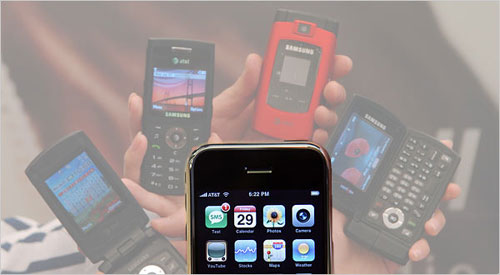
Rival Manufacturers Chasing the iPhone, By Martin Fackler

Image and text source: NY Times

July 2, 2007

SEOUL, South Korea, June 29 — While Americans have been blitzed with news about the iPhone’s debut, many in South Korea’s and Japan’s technology industries initially greeted Apple’s flashy new handset with yawns.

Pantech’s design center in Seoul, South Korea. An executive at the company says that riding on Apple’s coattails may turn out to be the best business strategy.

Cellphones in these technology-saturated countries can already play digital songs and video games and receive satellite television. But now that analysts and industry executives are getting their first good look at the iPhone, many here are concerned that Asian manufacturers may have underestimated the Apple threat.

Read the entire article at NY Times

Apple Waves Its Wand at the Phone, By David Pogue

Image and text source NY Times

January 11, 2007

Remember the fairy godmother in “Cinderella”? She’d wave her wand and turn some homely and utilitarian object, like a pumpkin or a mouse, into something glamorous and amazing, like a carriage or fully accessorized coachman.

Evidently, she lives in some back room at Apple.

Every time Steve Jobs spies some hopelessly ugly, complex machine that cries out for the Apple touch — computers, say, or music players — he lets her out.

At the annual Macworld Expo in San Francisco, Mr. Jobs demonstrated the latest result of godmother wand-waving. He granted the wishes of millions of Apple followers and rumormongers by turning the ordinary cellphone into … the iPhone.

Read the entire article at NY Times

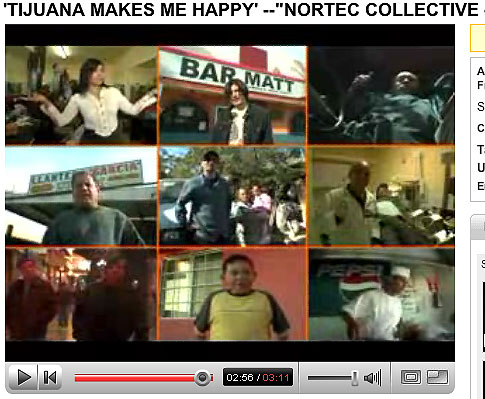
Imagining modernity, revising tradition: Nor-tec music in Tijuana and other borders, by Alejandro L. Madrid

Image source: Youtube

Text source: Look Smart: Find Articles

December 2005

Based on extensive fieldwork in Tijuana, San Diego, Los Angeles, and Mexico City, this article explores the intersections of identity, modernity, desire, and marginality in the production, distribution, and transnational consumption of Nor-tec music. Tijuana musicians developed Nor-tec by combining sounds sampled from traditional music of the north of Mexico (conjunto norteno and banda) with compositional techniques borrowed from techno music. The resulting style reflects the current re-elaboration of tradition in relation to imaginary articulations of modernity that takes place in Tijuana’s youth border culture.

Read the entire text at Look Smart: Find Articles

Announcing the Launch of Vague Terrain 07: Sample Culture

Image source: Vague Terrain

Note: The following is an announcement of Vague Terrain’s latest issue, in which I’m very happy to be a contributor. Make sure to also peruse their previous releases on Minimalism, Locative Media and Generative Art among others.

Announcement:

The latest edition of the Toronto based digital arts quarterly vagueterrain.net is now live. The issue, vague terrain 07: sample culture is a provocative exploration of contemporary sampling of sound, image and information. This body of work examines the remix as a critical practice while addressing broader issues of ownership and intellectual property.

Vague terrain 07: sample culture contains work from: brad collard, christian marc schmidt, defasten, des cailloux et du carbone, [dNASAb], eduardo navas, eskaei, freida abtan, jakob thiesen, jennifer a. machiorlatti, jeremy rotsztain, noah pred, ortiz, rebekah farrugia, and an interview with ezekiel honig conducted by evan saskin.

For more information please see http://www.vagueterrain.net

Current Projects


    Books


    Remix Theory | is an online resource by Eduardo Navas. To learn more about it read the about page.

    Logo design by Ludmil Trenkov

    http://www.mentalhealthupdate.com/