About | Remix Defined | The Book | Texts | Projects | Travels/Exhibits | Remixes/Lists| Twitter

Archive of the category 'Remix Culture'

Web 2.0: What Is A Mash Up? Marshall Kirkpatrick Video Interview, by Robin Good


Photo credit: (cc) Beth Kanter

Image and text source: Robin Good

Originally published on October 17, 2006

Web 2.0 has unleashed an era of online participation, personalization and interoperability set to change the way we network, do business and interact with the media that engulf us.

One of the most exciting developments in recent times is that of the Mash Up. The term Mash-Up can seem initially confusing, especially as it has more than one meaning. As Wikipedia points out a Mash Up can refer to:

  1. A Musical Mash Up that works on the basis of cutting often mismatched samples together to create new and interesting hybrids in dgital music. One of most famous musical Mash Ups of recent times is the now banned DJ Danger Mouse album ‘The Grey Album’ – created from the fusion of The Beatles White Album and Jay-Z’s Black Album.
  2. A Video Mash Up in which video and audio from different sources is cut together into a new Mashed Up union. One of the best video Mash Ups of recent times has to be the Bush/Blair Gay Bar video.
  3. A Mash-Up “Web Application hybrid“, which seamlessly combines tools or data from one or more online sources into a new, integrated whole. Examples of this latter type of Mash Up, the focus of our Marshall Kirkpatrick interview, can be found in abundance at Programmable Web.


(more…)

Press Play on Tape – Loading Ready Run, by Duke

Image source: Gamebase 64 

Text source: Press Play on Tape

Published on February 27, 2002

Earlier we have already reviewed a series of albums remixing old-timer Commodore-64 tunes, called Back In Time 2 and 3. Since then a few other similar initiatives have appeared, probably the best of them is the new CD from the Danish Press Play On Tape band with their debut album Loading Ready Run, which I’ll talk about now. Even the name of the band itself causes nostalgic feelings in many (since those who had tapes remember that after the LOAD command was issued the computer gave this instruction: press play on tape). After this came “Loading” (which is present in the title), then Ready, and finally we started the program with Run.

We have seen remixes that were created with the classic band setup (the BIT series wasn’t exactly like this), but this new album is probably the best of them. The band has 6 members: 2 guitar players, one guy on the synth, one base player and a drummer (although he doesn’t play on acoustic, rather on electronic drums, but the difference can be noticed only by audiophiles).

(more…)

20 Great Music Applications For Facebook, by Stan Schroeder

Image and text: Mashable

Remember the time when we announced Facebook as a platform? Well, a lot has changed since then: thousands of great applications for Facebook have appeared, and having a “naked” Facebook profile is just not that cool these days. This time, we’ve assembled a list of 20 great music-related apps for Facebook that you simply must try out.

My Music – here’s one for all you iTunes users: this handy little app enables you to access your entire iTunes library directly from Facebook.

Pandora – tune into Pandora from Facebook and find your new favorite songs and artists.

Last.FM Music – the official Last.FM Facebook app lets you turn your music into playlists and compare musical tastes with friends. Read more about it here.

Last.FM Charts – import up to 5 charts from Last.FM into your Facebook profile.

iLike – somewhat of a competitor to Last.FM, iLike lets you see which concerts your friends are going to as well as add music and videos to your Facebook profile.

MixLister – create a personal theme song; import and create playlists and share them with everyone.

BandTracker – track your favorite bands and their shows and check out who your friends are tracking.

Music Videos – add favorite music videos to your profile. Simple and effective.

Yahoo! Music Videos – another way to import music videos to your profile, this time from Yahoo!’s vast collection.

Upcoming – track all the events you plan on attending. Great for tracking live shows.

What I’m Listening To – a must-have app that shows the world what song you’re currently listening to; powered by Last.FM’s audioscrobbler application.

Currenty Listening – similar to What I’m Listening To, this app shows the artist name and cover art of whatever song is currently playing on your computer.

My Last Songs Played – display the last songs played in iTunes or any other media player.

Remixing Mr. Rogers, by Eduardo Navas

Image source: Youtube

I recently ran into some interesting remixes of Mr. Rogers and a young breakdancer in Youtube. The original excerpt in which Mr. Rogers interacts with a young African American boy already has sexual and class tensions, which could be ignored by the average viewer. But these tensions are brought forth in a one minute remix titled, “Mr Roger’s Breakdance Remix” in which Mr. Rogers states repeatedly “Hey Jermaine”, “Breakdancing with your friend…” and “I really like the way you do that…”

And then there’s another remix titled, “Mr. Rogers Was a B-Boy MOFO ! (feat NWA)” which is subtle in its intervension: it leaves the entire video clip intact, except for the moment when the young boy performs. In this remix, the original musical composition, which is non-intrusive, middle of the road, and exudes enough funk for the young boy’s moves to feel authentically off the street, is replaced by one of NWA’s track “F__k the Police” from back in the day–cursing from beginning to end. And like the previous remix, this one also makes obvious the cultural tensions at play between the two individuals. Mr. Rogers’s pleasant stride feels a bit forced, and when the music is over, he appears a bit out of touch with the boy’s performance.

These are multiple readings that any Mr. Rogers fan may want to retaliate against or at least play down, but one only has to look at the original clip carefully to sense the tension that the two remixes have brought forth for critical reflection. And this does not necessarily mean that there is something “wrong” with Mr. Rogers’s behavior, or with his interest in featuring a young breakdancer in his popular show. It just means that the remixes are able effectively to make obvious the social codes that both Mr. Rogers and the boy carry based on their ethnicity, class and gender, that are already at play in culture and they both, as well as us (the viewers), should be aware of.

Washingtonpost.com Teams Up with Readers for Remix, by Tara Calishain

Image: Washington Post Remix

Text source: Information Today
Posted On December 12, 2005

Note: This text summarizes the expectations of an online project by the Washington Post, which is no longer active. The project is worth keeping in mind as a stepping stone and experiment to develop interesting tools for Web 2.0

The Washington Post Co. has launched a new site called Post Remix, described as “the Post’s official mashup center.” Available at http://blogs.washingtonpost.com/post_remix, Post Remix spotlights reader creativity with both washingtonpost.com RSS feeds and other streams of content The Post is making available. The site launched around mid-November, and that’s been plenty of time for interesting content to appear on it. A blog format provides an overview of reader-submitted projects, ordered by date. Among the spotlighted applications are a site that offers Amazon.com book suggestions based on washingtonpost.com content, automated text-to-speech podcasts of Post stories, and a “Tag Cloud” overview of washingtonpost.com content. All these applications use RSS feeds of washingtonpost.com content.

(more…)

Columbus Leadership


Charles Leadbeater in Action at Providence New Commons

Image by Christopher Reyes

Image and text source: CEOs for Cities

Originally posted on 5-24-07

We are being hosted by CEOs for Cities member Doug Kridler at The Columbus Foundation this afternoon. Thirty locals from business, health care, nonprofits, government, and philanthropy have gathered to work through Charlie’s ideas using their own experiences.

Charlie has gone right to the point: How do you orchestrate contributions by large numbers of people to solve problems? Is it possible to attack the opportunities and challenges the way Google or
eBay would attack them?

Think of an egg. For any issue area, there is a small core of that egg that represents the institution, such as police, schools, hospitals, performing arts centers. But the rest of that egg is outside the institution – learning, safety, health, culture. While the institution is fixed cost and hierarchical with budgets and
buildings, the rest of the egg is fuzzy and distributed and complex.

(more…)

Some Notes on Nine Inch Nails’ Invitation to Create Mashups

Image source: yearzero.nin.com

Note: Below are a couple of comments on Nine Inch Nails’ current project, which consists of inviting fans and music enthusiasts to mashup one of NIN’s new songs “Survivalism” to their hearts’ content. This project is welcomed and reminiscent of the pioneering project A Bush of Ghosts by Brian Eno and David Bowie. Also see: http://bushofghosts.wmg.com

———-

“Nine Inch Nails Invites Mashups,” by Jonathan at Ampheteme.org

Text source: Amphetameme.org

Published on 3-26-07

Trent Reznor’s inviting you to mash-it-up. He invites you to go absolutely nuts with his latest creation, the tracks that come together to make the song “Survivalism”. Feel free to interpret the tracks any way you wish he says, and add your own. And he’s asking you (because of his partnership with Apple I presume) to use Garageband. I don’t mind. Garageband 3’s one pretty damn cool piece of work. At any rate, I’m a big NIN fan and I’m happy to see him once again inviting remix interpretation. Pick up all the details at yearzero.nin.com.

———-

“A mashup on Garageband takes music experiences to a new level,” by Stephen Abbott

Text source: projectopus.com/

Published on 3-26-07
Trent Reznor of Nine Inch Nails is pushing the boundaries of a music experience to new levels. According to an article in Digital Music News, Reznor is making a single from the upcoming album, Year Zero, available for “remix interpretation”. The interesting twist to this is that it is being done in a sort of collaboration with the latest release of Garageband 3, part of Apple’s iLife suite.

Garageband users can adjust a number of tracks that make up “Survivalism,” and add their own elements as well. Once created, the tracks can be shared, ripped and distributed at will. According to an Apple representative, other songs from the album are also on the way.

The ability to share and distribute the personal remixes is huge. Perhaps ability is the wrong word – the encouragement to distribute these remixes is incredible. The artist is giving open permission to use his work. There could be literally thousands of interesting and unique interpretations of NIN’s musical talent. Of course, there are going to be many more versions that suck, but those will fade away soon enough.

(more…)

Ghetto Ambient, by Greg Smith

Image and text source: Serial Consign

I’ve been a longtime fan of musician and artist Sebastian Meissner who releases beautiful and often unsettling ambient music under the moniker Klimek on Kompakt. I began a dialog with Sebastian when I tipped him off that I had used a Klimek track to score my Kamera Obscura project, and as we chatted back and forth I realized he was the creative force behind a number of other projects that have showed up on my radar over the years.

Sebastian is also behind or was involved in: Bizz Circuits, Autopoieses (with Ekkehard Ehlers) and Random Inc. In addition to the Klimek material that I find so mesmerizing, the Random Inc. record Walking In Jerusalem was one of my favourite albums of 2002, and Autopoieses’s locked-groove laden La Vie À Noir Transposed didn’t leave my crate for two years when I was still playing records.

(more…)

Regressive and Reflexive Mashups in Sampling Culture, by Eduardo Navas


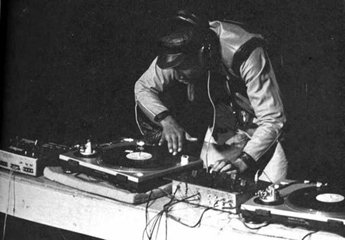
Grandmaster Flash on the Wheels of Steel some time in the early days of hip hop.

Image source: greatestcities.com

Update as of 8/13/10.  The revised version of this text is now available online as Remix Theory post 444.

Update as of 4/29/10: This text has been revised for the book publication Mashup Cultures. In the revised print version, I introduce a series of new terms along with a diagram.  The 2007 draft is shared below in the tradition of online sharing.  The final argument while it has not necessarily changed is more precise in the revised print version, which I encourage those interested to read.

This text was published on June 25, 2007 in Vague Terrain Journal as a contribution to the issue titled Sample Culture.

Today, sampling is practiced in new media culture when any software users including creative industry professionals as well as average consumers apply cut/copy & paste in diverse software applications; for professionals this could mean 3-D modeling software like Maya (used to develop animations in films like Spiderman or Lord of the Rings );[1] and for average persons it could mean Microsoft Word, often used to write texts like this one. Cut/copy & paste is a vital new media feature in the development of Remix. In Web 2.0 applications cut/copy & paste is a necessary element to develop mashups; yet the cultural model of mashups is not limited to software, but spans across media. Mashups actually have roots in sampling principles that were first initiated in music culture around the seventies with the growing popularity of music remixes in disco and hip hop culture; and even though mashups are founded on principles initially explored in music they are not always remixes if we think of remixes as allegories. This is important to entertain because, at first, Remix appears to extend repetition of forms in media, in repressive fashion; but the argument in this paper is that when mashups move beyond basic remix principles a constructive rupture develops that shows possibilities for new forms of cultural production that question standard commercial practice.

(more…)

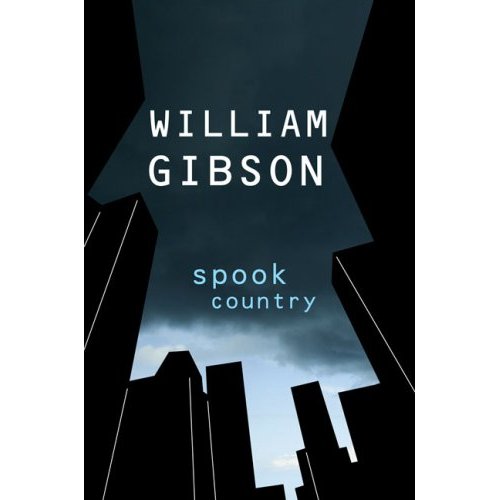
Spook Country: Some notes on William Gibson’s new novel, Spook Country, by Steven Shaviro

Image source: Amazon.com

Text source: The Pinocchio Theory

Note: A comment on this review was previously posted at Nettime.org by DJ Spooky.

“The door opened like some disturbing hybrid of bank vault and Armani evening purse, perfectly balanced bombproof solidity meeting sheer cosmetic slickness.” William Gibson’s prose is cool and precise: minimal, low-affect, attuned to surfaces rather than depths. It’s overwrought, filled to bursting with similes and allusions; yet somehow it still manages to feel as if it had been executed skeletally, entirely without flourishes. There’s a sense of density built up in layers, but packaged inside a bland and featureless box; this writing is like a nondescript cargo container (one of the book’s main images) filled with everything from expensive brand names, hi-tech geekery, and the detritus of popular culture to micro-perceptions of psychological shifts that take place just beneath the threshold of conscious attention.

At times, the effect of this prose is one of deadpan absurdity, as when townhouses in the Georgetown neighborhood of Washington, D.C. are described as radiating “the sense that Martha Stewart and Ralph Lauren would have been hard at work on interiors, together at last, sheathing inherently superior surfaces under hand-rubbed coats of golden beeswax.” At other times, it’s surreally dislocating, as when one of the protagonists is startled by the actions of her companion, so that “for an instant she imagined him as a character in some graphically simplified animation.” At still other times, it’s slyly mordant, as when one character is described as looking “like someone who’d be invited quail-shooting with the vice president, though too careful to get himself shot.”

(more…)

Current Projects


    Books


    Remix Theory | is an online resource by Eduardo Navas. To learn more about it read the about page.

    Logo design by Ludmil Trenkov

    http://www.mentalhealthupdate.com/