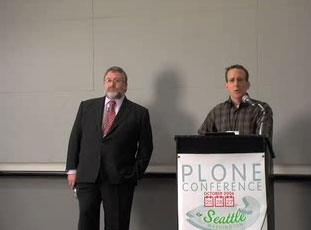
Eben Moglen’s keynote address, titled “Software and Community in the Early 21st Century” presented at Plone Conference 2006 on October 25, 2006 in Seattle, WA.
In this inspiring lecture, Professor Moglen weaves together the industrial revolution, the knowledge economy, the free software movement, the One Laptop Per Child project and the long struggle for human dignity and equality.
Eben Moglen is Chairman of the Software Freedom Law Center, Professor of Law and Legal History at Columbia University Law School, and General Counsel of the Free Software Foundation.
MP3 and Ogg (audio only) versions of this talk are also available. Click on the FTP or HTTP “all files” links at left.
Robert Scoble spent the last week giving his new Amazon Kindle ebook reader a test drive, reading a couple of books and declaring the progeny of Jeff Bezos a failure. He thinks the usability and user interface suck and it lack features such as a touch screen, social networking and the capability to send electronic goods to others. He wants version 3.0 of the device.
David Pogue of the New York Times is far kinder to the Kindle.
So if the Kindle isn’t a home run, it’s at least an exciting triple. It gets the important things right: the reading experience, the ruggedness, the super-simple software setup. And that wireless instant download — wow.
Even though most people will prefer the feel, the cost and the simplicity of a paper book, the Kindle is by far the most successful stab yet at taking reading material into the digital age.
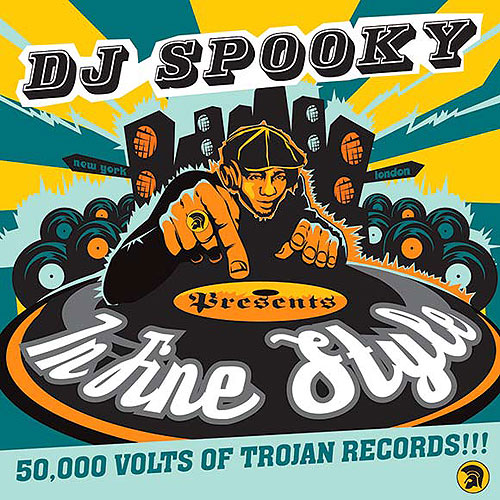
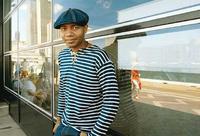
Paul D. Miller, also known as DJ Spooky, That Subliminal Kid, has been producing beat-heavy electronic music for more than a decade. From his early solo trip-hop efforts to his more recent collaborations with jazz giants, Spooky has always approached music from multiple angles at once. He has the chops of a musician, the genre-blending ear of a disc jockey and the conceptual vision of a performance artist.
It was therefore no surprise when Trojan Records, a reggae label entering its 40th year, asked DJ Spooky to put together a mix showcasing tracks from its massive archives. When assembling >In Fine Style: DJ Spooky Presents 50,000 Volts of Trojan Records, one of several mixes commissioned to mark the Trojan birthday, Miller found countless parallels between the Jamaican reggae scene of the 1960s and ’70s and the digital mashup ecosystem of today. (See Upgrading Jamaica’s Cultural Shareware: Trojan Records at 40.)
Social networking Web sites such as MySpace and Facebook have started to allow advertisers to access users’ profiles and target the ads they deliver to that user accordingly. A media and technology writer examines the potential impact this marketing may have on individual user privacy.
GWEN IFILL: Judy Woodruff has our Media Unit look at the balance between online information’s financial potential and individual privacy.
JUDY WOODRUFF: It’s where millions of young people list their favorite hobbies, movies, friends and trends, and now all that information from the two largest social networking sites, Facebook and MySpace, with a combined total of more than 160 million users, will be made increasingly available to advertisers.
Facebook announced today that it will allow companies to show ads to its users, both when they are on and off the site, based on personal information they list online.
Yesterday, MySpace unveiled a self-service advertising tool allowing groups like small businesses, musicians and politicians to post an ad and choose who sees it. They also increased a number of categories that track user preferences by more than tenfold, in order for businesses to better target their products to the much-sought-after 18 to 25-year-old demographic.
Drum and bass music (drum n bass, DnB) is an electronic music style. Drum and bass, originally an offshoot of the United Kingdom breakbeat hardcore and rave scene, came into existence when people mixed reggae basslines with sped-up hip hop breakbeats and influences from techno . Pioneers such as raggamuffin DJ General Levy and other DJs quickly became the stars of Drum and bass, then still called jungle . Producers such as Goldie and 4 Hero transformed the current art and turned drum and bass in more instrumental direction, spawning sub-genres like techstep and moving the genre closer to techno. Some of the more popular and defining artists include Shy FX, Ed Rush & Optical, LTJ Bukem, Goldie, and Roni Size.
Jungle music, ORIGINS:
Based almost entirely in England, Drum’n’Bass (then called ‘jungle’ ) emerged in the early ’90s. It is one of the most rhythmically complex of all forms of dance music, relying on extremely fast polyrhythms and breakbeats . Usually, it’s entirely instrumental — consisting of nothing but fast drum machines and deep bass.
As its name implies, jungle does have more overt reggae, dub, and R&B influences than most hardcore — and that is why some critics claimed that the music was the sound of black techno musicians and DJs reclaiming it from the white musicians and DJs who dominated the hardcore scene. Nevertheless, jungle never slows down to develop a groove — it just speeds along. Like most dance music genres, jungle is primarily a ‘twelve inch’ genre designed for a small, dedicated audience, although the crossover success of Goldie and his 1995 debut Timeless suggested a broader appeal.
Dozens of respected artists started fusing breakbeats with influences lifted from jazz , film music, ambient, and trip-hop. — allmusic.com
[This article originally appeared in The Village Voice Summer 1993 “Rock & Roll Quarterly” insert.]
Oooh oooh Techno city
Hope you enjoy your stay
Welcome to Techno city
You will never want to go away
–Cybotron, “Techno City” (1984)
“The ‘soul’ of the machines has always been a part of our music. Trance always belongs to repetition, and everybody is looking for trance in life… in sex, in the emotional, in pleasure, in anything… so, the machines produce an absolutely perfec t trance.”
–Ralf Hütter, 1991, quoted in Kraftwerk: Man Machine and Music, Pascal Bussy
“It’s like a cry for survival,” a panicked male voice calls out. The beat pauses, but the dancers do not. Then Orbital throw us back into the maelstrom: into a blasting Terry Riley sample, into the relentless machine rhythm, into a total environment of light and sound. We forget about the fact that we’re tired, that the person in front of us is invading our space with his flailing arms. Then, suddenly, we’re there: locked into the trance, the higher energy. It does happen, just like everybody always says: along with thousands of others, we lift off.
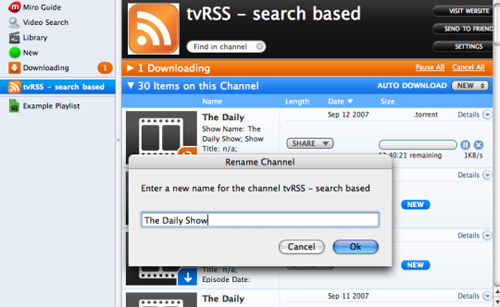
NBC’s recent withdraw from the iTunes store leaves the millions of users of Apple iPods without a legitimate way to purchase and watch NBC’s content. Could this be the push that brings easy-to-use ‘piracy’ to the masses? This article discusses the issues, and then provides step-by-step instructions to setup a computer to automatically download any of hundreds of TV shows as soon as they are broadcast and put online.
With Apple’s recent lovers’s spat with NBC making the headlines, it seems like a good opportunity to examine the state of the online TV downloads, be they paid or ‘pirated’. The end result of the dispute between the companies is that NBC’s shows, which currently count for approximately one third of iTunes’ TV show sales will no longer be available for sale at Apple’s iTunes store. Customers wishing to purchase NBC’s shows will now need to go through Amazon’s Unbox service. While Unbox supports users of Windows and TiVo, Mac users, as well as those millions of iPod users are left out in the cold. Linux geeks, and those customers who have purchased divx/avi capable portable music players are also excluded, but this small subset of the market were equally ignored by Apple. (more…)
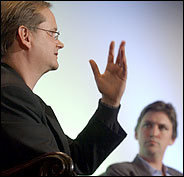
Lawrence Lessig, left, a law professor, spoke at “Who Owns Culture?,” a talk moderated by Steven Johnson, an editor at Wired magazine.
Image and text source: NY Times
Published: April 9, 2005
he tickets for the event Thursday sold out in five minutes on the Internet, and on the evening itself the lines stretched down the block. The reverent young fans might as well have been holding cellphones aloft as totems of their fealty.
Then again, this was the New York Public Library, a place of very high ceilings and even higher cultural aspirations, so the rock concert vibe created some dissonance. Inside, things became clearer as two high priests of very different tribes came together to address the question of “Who Owns Culture?” – a discussion of digital file-sharing sponsored by Wired magazine, part of a library series called “Live From the NYPL.”
Originally published on February 4, 2005
Socially and culturally aware, this DJ is the harbinger of change, writes Ashley Crawford.
He travels to Trinidad and Istanbul, Paris and Jakarta, Moscow and New Orleans. He hangs out with Yoko Ono, Merce Cunningham, Sonic Youth and Wu-Tang Clan. He tosses off cultural references from James Joyce to Gertrude Stein, Jean Baudrillard to Mikhail Bakhtin, and he writes for a range of journals and magazines from Artforum to The Village Voice.
He is in Australia to promote his new book, Rhythm Science (published by the prestigious MIT Press) – a meditation on the “flow of patterns in sound and culture”, and he has just screened Rebirth of a Nation, his re-mix of D. W. Griffith’s 1915 film classic, Birth of a Nation, at the Sydney Festival.