VERSION:
November 20, 2008.
Please note that this version has not been proofread yet, and it is also missing illustrations.
Length: 82,071 Words (including footnotes).
ABOUT THE VERSIONS:
One of the advantages of online distribution which I can control is that I don’t have to permanently fix the book’s contents. Like contemporary software and web services, the book can change as often as I like, with new “features” and “big fixes” added periodically. I plan to take advantage of these possibilities. From time to time, I will be adding new material and making changes and corrections to the text.
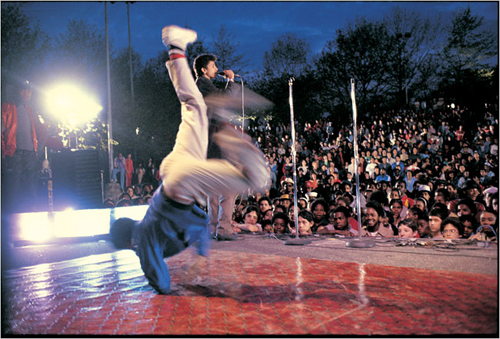
In the 25 years since “Wild Style” was first shown, in Times Square, more than a few viewers were convinced that the movie was a documentary. Granted, its stars were real-life graffiti artists like Lee Quiñones, hip-hop groups like the Cold Crush Brothers and break dancers like the Rock Steady Crew. But the story — such as it was — was less a reflection of real life than a hope for the future.
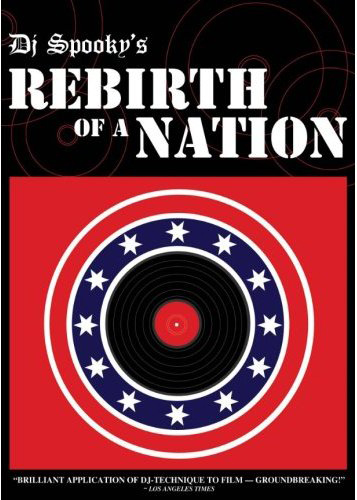
DJ Spooky has performed live Rebirth of a Nation, a remix of D.W. Griffith’s Birth of a Nation in various parts of the world. The multi-faceted media performance deconstructs Griffith’s historically important film to expose the politics of racism during and after 1915, the year when the original film was produced.
DJ Spooky is releasing a DVD version of Rebirth of a Nation on November 4 of 2008. The critically minded would not hesitate to think that the release date is not a coincidence, but rather a constructive move on Spooky’s part to remind people that the upcoming presidential election is historically important. The United States has come a long way since the days when Griffith released Birth of a Nation, and on November 4, the title Rebirth of a Nation will take on a new meaning, for no matter what happens after the fourth, the United states will certainly enter a definitive new stage in its history.
Information about the Film and DJ Spooky’s Biography follow below.
First released in 1915, D. W. Griffith’s Birth of a Nation ignited worldwide controversy with its graphic depictions of racism and white supremacy in the post-Civil War south. Nearly 100 years later, Paul D. MIller- also known as conceptual artist/musician/writer DJ Spooky That Subliminal Kid- creates a daring ‘remix’ of Griffith’s epic to expose the film’s true meaning and relate it to the socio-political conflicts of America today. Originally commissioned as a live multimedia performance, Rebirth of a Nation- now featuring an original score by Miller performed by Kronos buy generic meds online Quartet- is ‘a DJ mix applied to cinema’ that challenges our legacy of revisionist history as it deconstructs one of the most influential and inflammatory movies of all time.
DJ Spooky (Paul D Miller, born 1970, Washington DC) is a composer, multimedia artist and writer. His written work has appeared in The Village Voice, The Source, Artforum and Rapgun amongst other publications. Miller’s work as a media artist has appeared in a wide variety of contexts such as the Whitney Biennial; The Venice Biennial for Architecture (2000); the Ludwig Museum in Cologne, Germany; Kunsthalle, Vienna; The Andy Warhol Museum in Pittsburgh and many other museums and galleries. His work “New York Is Now” has been exhibited in the Africa Pavilion of the 52 Venice Biennial 2007, and the Miami/Art Basel fair of 2007. Miller’s first collection of essays, entitled “Rhythm Science” came out on MIT Press 2004, followed by “Sound Unbound,” an anthology of writings on elctronic music and digital media, published in 2008.
Miller’s deep interest in reggae and dub has resulted in a series of compilations, remixes and collections of material from the vaults of the legendary Jamaican label, Trojan Records. Other releases include Optometry (2002), a jazz project featuring some of the best players in the downtown NYC jazz scene, and Dubtometry (2003) featuring Lee ‘Scratch’ Perry and Mad Professor. Miller’s latest collaborative release, Drums of Death, features Dave Lombardo of Slayer and Chuck D of Public Enemy among others. He also produced material on Yoko Ono’s new album “Yes, I’m a Witch.”
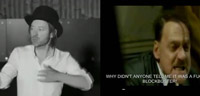
The video is clever and funny, with a critical edge. It opens with Obama and Ellen Degeneres dancing to Rick Astley’s “Never Gonna Give You Up.” When Rick Astley begins to sing, clips of Obama from a number of his rallies are carefully edited to show the presidential candidate singing along with Rick Astley.
This video has developed a discourse of its own, as it was mashed up in a video response in which Senator McCain is shown during the Republican Convention presenting to the Republican audience the very same clip of Obama dancing and singing: http://www.youtube.com/watch?v=_TiQCJXpbKg
This second mashup appears quite believable and one can argue is even more successful but only because the “Obama Roll” mashup is quite effective to begin with. If not sure why the term “Roll” is included as part of the title, check out the brief definition of rickrolling on Wikipedia: http://en.wikipedia.org/wiki/Rickroll
Lessig’s book on Remix was just released. Like his previous books, the emphasis is on the future of intellectual property. Unlike his other books, Lessig appears to focus on the act of “rip, mix and burn” that he often used to discuss different aspects of online culture. In “Remix” this act is the critical framework to discuss the future of creativity.
People heavily invested in the fine arts might find the use of the term “art” misleading, though. Lessig appears to use the term in broad terms to refer to creative acts that are becoming more common due to the spread of Remix principles.
I’m looking forward to this book making the rounds in networked culture. I hope it proves itself to be Lessig’s most popular publication of them all. Sadly, he claims that it will be his last on the issue:
This is (I expect) the last book I’ll write in this field. Dedicated to Lyman Ray Patterson and Jack Valenti, it pushes three ideas — (1) that this war on our kids has got to stop, (2) that we need to celebrate (and support) the rebirth of a remix culture, and (3) that a new form of business (what I call the “hybrid”) will flourish as we better enable this remix creativity.
I wrote this book last year. Many of the themes were described in 18 minutes in my TED talk. I am very eager to have it out.
Note: This text was originally published on Vague Terrain, Digital Dub Issue, August 08. It is reposted here with minor edits, and an additional quote by Bunne Lee, to clarify the history of dub in Jamaica.
Abstract: This text outlines the foundation of dub as a musical movement that found its way from Jamaica to other parts of the world, in particular NY and Bristol. Upon looking at history, it can be argued that dub and other musical genres that it has influenced have constantly thrived on the threshold of culture, feeding the center. In support of this argument the essay links the influence of dub to the theories of Homi Bhabha and Hardt & Negri. Dub is also linked to Remix as a discourse of global production.
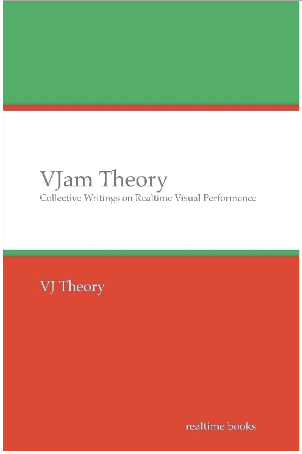
VJam Theory (collective writings on realtime visual performance) presents the major concerns of practitioners and theorists of realtime media under the categories of performance, performer and interactors, audiences and participators. The volume is experimental in its attempt to produce a collective theoretical text with a focus on a new criticality based on practitioner/artist theory in which artist/practitioners utilise theoretical models to debate their practices. For more information visit www.vjtheory.net
Paul D. Miller, AKA DJ Spooky is a multitasker. He is known for his music productions, as well as his art and film projects. He also has been writing about art and culture for many years. In the last few years, Miller has worked with Trojan Records to develop compilations about Reggae and Dub with a critical yet playful take on the complexities of Jamaica. Most recently, he edited Sound Unbound for MIT Press, a book which comprises a set of texts about the influence of sound in media and culture at large. In the following interview, DJ Spooky, discusses his current projects in a global context, and motivates us to move beyond basic binaries onto a more productive and creative state.
Eduardo Navas: In your most recent Recording Project “Creation Rebel” as well as “DJ Spooky Presents In Fine Style 50,000 Volts of Trojan Records!!!” you write short historical essays about the culture of Reggae, Dub and the Big Sound System. You are also very careful to present your position as a cultural insider, given that you used to visit Jamaica as a kid; and you also state that you were approached by Trojan Records, rather than the other way around, which would otherwise place you, regardless of ethnicity, in a position of “explorer” or Neo-colonial. Based on all this can you explain how you see colonial ideology at play in Jamaica today?
DJ Spooky: The situation Jamaica faces today is part of a global cycle of hyper capitalism – even the Cayman Islands used to be part of Jamaica… anyway, yeah, the whole system is based on production models that privilege the “developed” economies over the “developing” ones. From Mugabe in Zimbabwe to Thabo Mbeki in South Africa, Kim Jong Il in North Korea, or Hugo Chavez in Venezuela, and Ahmadinejad in Iran, people in “developing” economies are faced with rulers just as flawed as anything the U.S. can summon up with people like Bush or Reagan. I tend to think that everything is connected. My Trojan records project is an exploration of the archives of one of my favorite record labels during a time of intense political upheaval. But it’s also about showing how people make music out of their circumstances.
The above image is a photoshop composite by Steve Brown for the New York Times. The background was taken from the Getty Images archive. It is an illustration for the article Putting the Dream Car Out on the Pasture, published on July 27, 2008, which explains how people are coping with the high cost of gas prices.
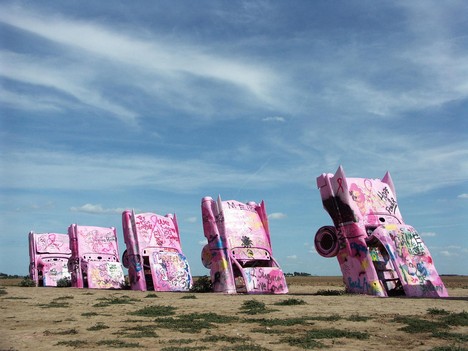
As many people in the arts would know as well as those who love to take road trips, the above image borrows from Ant Farm’s famous land art piece “Cadillac Ranch,” in which Cadillacs were dumped into the ground at Amarillo, Texas. In 1997 it was moved a couple of miles from its original location. It is a disappointment that there is no reference to Ant Farm’s work. Below are some images of Ant Farm’s public art installation, along with comments by the people who took the pictures.
Quote: “The Cadillac Ranch just west of Amarillo is a famous Route 66 landmark. Built up in 1974 by said to be eccentric but brilliant millionaire Stanley Marsh 3 and The Ant Farm, this line of old Cadillacs are buried nose first into the ground. The angle of the cars are also reputed to be the same as the ancient pyramids at Cheops. The Cadillacs were moved further west in 1997 from its original location due to growth from nearby Amarillo. The Cadillac Ranch is another of the must see sights off the Mother Road.”
-RoadsidePeek.Com Website
Quote: Ant farm was a group of artists and architects that, along with Archigram, was hugely influential among architecture students in the seventies, particularly if you were into mobile architecture, alternative technologies and dovetail joints. Many know about their Cadillac Ranch, which remains an iconic statement about the end of oil as it was in the last oil crisis; few, including Regine at Worldchanging know about their other work. However she does now, after seeing an exhibition of their work at the The Centro Andaluz de Arte Contemporaneo in Seville.
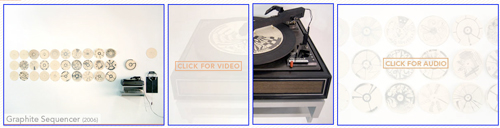
Caleb Coppock’s “Graphite Sequencer” is an analog drum machine of sorts that works through simple electrical conductance. Two wires scrape along the surface of a spinning paper disk with graphite shapes scrawled across them (graphite is a conductive material) so that when they pass over the shapes, they generate tones. The resulting sound is then amplified and played back through the device’s speaker system. Coppock has customized the device so that when the graphite line is thick, allowing more current to pass, the pitch of the resulting tone changes to a lower one. This is in contrast to a thinner line, which creates a very high-pitched tone on contact. Although the resulting sounds are anything but musically appealing, the ability to hand-draw your own beats is a nice and simple way of creating audible results from physical media. The video on the project’s website illustrates how this works although the resulting sounds are a bit difficult to stomach.
Jonah Brucker-Cohen