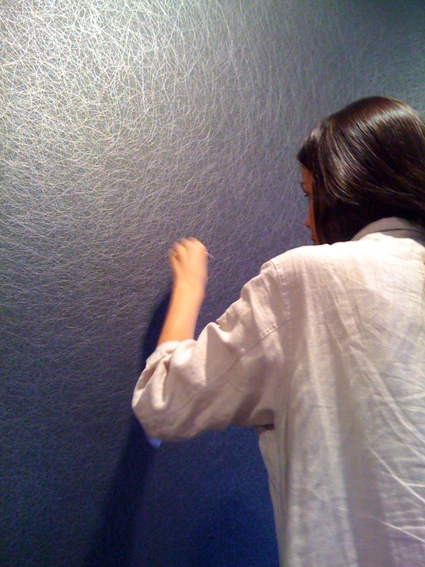
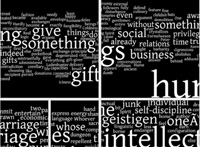
”Wall Drawing #715”, February 1993
On a black wall, pencil scribbles to maximum density. Pencil.
Courtesy Estate of Sol LeWitt
First installation: Addison Gallery of American Art, Phillips Academy, Andover, MA
First drawn by: S. Abugov, S. Cathcart, A. Dittmer, F. Dittmer, L. Fan, C. Hejtmanek, S. Hellmuth, D.
Johnson, A. Moger, A. Myers, J. Noble, G. Reynolds, A. Ross, A. Sansotta, J. Wrobel. (Varnished by
John Hogan)
Image courtesy of Magasin 3
On November 5, as Correspondent in Residence for the Swedish Traveling Exhibitions, I visited Magasin 3, located in Frihamnen (freeport), Stockholm. Curator Tessa Praun took the time to discuss with me the history of the Konsthall (art space) which opened in 1987, and has since then developed an extensive collection of contemporary art.
In the tradition of appropriation, Magasin 3 takes its name after the building’s original function as a sea port storage facility. The space is hard to find, and one must make a definite commitment to visit it. I was no exception. I first took the subway then a bus to the end of the line, then walked and (as is probably common for first time visitors) got a bit lost, but finally found the space.
The Konsthall has a low-key facade, and retains the look of an industrial space. Its name is no different than the other storage facilities in the area (there are magasin 1, 2, 4, 5, and more); because of this, it is unlikely that a casual passerby will enter the premises. This exclusivity gives Magasin 3 an elegance defined with minimal aesthetics. Appropriately enough, at the time of my visit, the konsthall featured minimal drawing installations by Sol LeWitt, curated by Elisabeth Millqvist. The Sol LeWitt exhibition opened on October 2nd 2009 and will close June 6, 2010. In what follows, I discuss LeWitt’s work as well as two video installations by british based Israeli artist Smadar Dreyfus, curated by Tessa Praun. (more…)
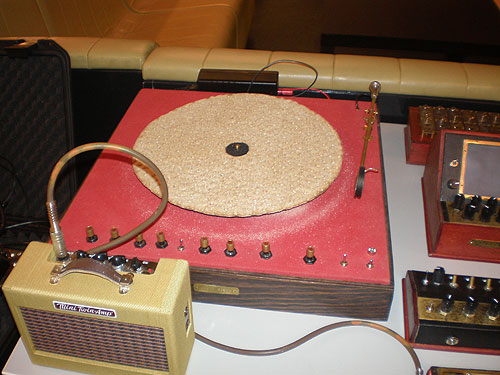
Image: ‘Crisp Bread Turntable’ by Yoshi Akai. Video available below.
As part of my residency at the Swedish Traveling Exhibitions, on October 29 I visited the Interactive Institute, quite a unique research center located in the city of Stockholm. Its model is unlike any other I have encountered. While the institute has close ties to the arts and the tradition of exhibitions as forms of communication and education, it also focuses on the development of projects that crossover to the commercial sector. There are actually a few spin-off companies that were started as research collaborations in the Interactive Institute. But to do justice to their mission, it is best that I quote how they present themselves publicly, from their about page:
The Interactive Institute is a Swedish experimental IT-research institute that combines expertise in art, design and technology to conduct world leading applied research and innovation. We develop new research areas, art concepts, products and services, and provide strategic advice to corporations, the cultural sector and public organisations. Our research results are communicated and exhibited worldwide and brought out to society through commissioned work, license agreements and spin-off companies.
I cite them directly because I find this type of research model to be an increasingly common hybrid: rigorous academic research meets commercial interests. Yet, the Interactive Institute, seems unique because its creative drive appears to be well balanced, given that it is in the middle of a major corporate technology research sector in Stockholm, located in the neighborhood of Kista. One thing that became certain is that their model is directly informed in part by the always changing aesthetics of networked communication. In their case, this tendency is found in the concept of “Interactivity;” such premise is part of their name.
The following text was originally published during the month of August, 2009 as part of Drain‘s Cold issue. The journal is a refereed online journal published bi-annually. The text is republished in full on Remix Theory with permission. Drain’s copyright agreement allows for 25% of the essay to be reblogged or reposted on other sites with proper citation and linkage to the journal at http://www.drainmag.com/. I ask that their agreement be respected by the online community.
In 1964 Marshal McLuhan published his essay “Media Hot and Cold,” in one of his most influential books, Understanding Media.[1] The essay considers the concepts of hot and cold as metaphors to define how people before and during the sixties related to the ongoing development of media, not only in Canada and the United States but also throughout the world.[2] Since the sixties, the terms hot and cold have become constant points of reference in media studies. However, these principles, as defined by McLuhan, have changed since he first introduced them. What follows is a reflection on such changes during the development of media in 2009.
McLuhan is quick to note that media is defined according to context. His essay begins with a citation of “The Rise of the Waltz” by Curt Sachsk, which he uses to explain the social construction behind hot and cold media. He argues that the Waltz during the eighteenth century was considered hot, and that this fact might be overlooked by people who lived in the century of Jazz (McLuhan’s own time period). Even though McLuhan does not follow up on this observation, his implicit statement is that how hot and cold are perceived in the twentieth century is different from the eighteenth. Because of this implication, his essay is best read historically. This interpretation makes the reader aware of how considering a particular medium as hot or cold is a social act, informed by the politics of culture. McLuhan’s first example demonstrates that, while media may become hot or cold, or be hot at one time and cold at another, according to context, the terms, themselves, are not questioned, but rather taken as monolithic points of reference. To make sense of this point, McLuhan’s concepts must be defined.
A performative confrontation between hardware and software. Nick Collins vs. Nick Collins: hardware vs. Software, Old School vs. New School. One of the hightlights of the concert series organized as part of “Bifurcaciones Sonoras” (Aural Bifurcations) for Transitio MX 03.
I was able to attend most concerts that took place nightly at Fonoteca, during Transitio MX, except for the last night of Thursday the 8th. While there were many highlights, one that I found worth sharing on my blog is the performance of Nick vs. Nic. A playful sound hacking performance by Nick Collins (USA) vs. Nick Collins (England). The younger Collins (English) improvised in code, while the more seasoned Collins proved why he is one of the pioneers in circuit bending. The sound was appropriately distributed and mixed on left and right sides of the stage, allowing the audience to evaluate how software and hardware hacking can be complementary, thus creating a performative mashup: a meeting between the old school and the new school of experimental sound could not be better.
Here are some videos from the selection “Bifurcaciones Sonoras” (Aural Bifurcations), curated by Arcángel Constantini and Rodrigo Sigal for Transitio_MX 03.
Interactive Installation by Gerardo García de la Garza (Mexico), No Materia, 2009. Sound is produced according to the distance between the visitor and the object.
Peter Vogel (Germany), Circular Structure, 1979
It was quite an experience to finally view interactive works that are historically important. Vogel developed the objects displayed in the two videos in the late seventies. Questions on our relation to the object of art were a subject of intense debate during this period. The work is now a relevant work that demonstrates the clear link between art practice during the mid-second half of the twentieth century, and the early part of the twenty-first.
Peter Vogel (Germany), Self-Stimulating Closed Loop, 1979.
In January of 2009 I wrote two brief entries, “On Content and Form: 2009 Forecast” and “Further Reflections on Content and Form in 2009,” which evaluated the difficulty that developers are encountering with the constant change of delivery devices. Since then, there appears to be more interest in having constant access to information than on the devices themselves. I also noted the possibility that consumers may develop fetishes for hybrid devices like the iPhone.
Yet, as we move on to the second half of 2009, the actual subject of analysis is becoming more apparent: the screen. It is the aesthetics of the screen, a vessel of simulation, of make believe, of simulacra proper that is turning out to be the recurring device in all media. From the early days of film on to television, and currently the computer and its supplementary devices, including GPS systems, text readers such as the kindle, portable DVD players, and of course the iPhone, the screen has played a defining role in the ongoing expansion of global communication.
The screen’s never-ending evolution, then, is what needs to be considered carefully in order to understand how media is changing with the growth of network culture. The challenge in this acknowledgment is that our familiar window for entertainment and communication, while always a comfortable rectangular format of malleable dimensions, has no actual stable material form; it keeps shifting at an ever increasing speed; and because of media’s dependency on the screen, developers need to change their approach to product development. This also means that content providers need to rethink their relation to media delivery, whether this be print, or online. (more…)
Detail of Szkieve’s circuit bending performance at Montevideo, Uruguay, July 28, 2006.
Image source: http://www.hushush.com
Note: This text was specifically written as a contribution to ReFunct 09‘s Symposium taking place at ISEA 09.
One might wonder what is the concrete definition of “circuit bending.” In a way, the name does not completely connect with the actual activity of appropriating sound from pre-existing sources, ranging from electronic toys to hacked radios, or even half-broken generators. When I first heard the term, I thought it referred to strict manipulation of electronic signals. This possible definition hints at a certain purity in sound with specific electronic technology; yet, in 2009 circuit bending is quite the opposite, even if in the beginning it may have had a leaning towards hacking electronic gadgets of all types. At the moment, it is a hybrid practice that appropriates any type of sound, freshly recorded or pre-recorded; re-recorded or significantly manipulated; even erased or retraced–or captured live from the environment in which a performance is taking place to be bent immediately, on the fly.
My most memorable performance of circuit bending took place in Uruguay, on July 28, 2006. I attended a soundtoys event organized by Brian Mackern, one of the first net-artists from the southern cone, active since at least the mid-nineties. Mackern more recently has become a major supporter of sound performances of all types. The performance took place at the French Alliance of Montevideo, where I saw Mackern and a number of other sound artists perform on customized software interfaces. A couple of performers used Max MSP and Jitter, while Mackern presented a series of visual platforms built in Flash that remixed well-known movie clips from Hitchcock and Tarkovsky.
I saw a connection with the aesthetic of sound manipulation often found in circuit bending in these performances; yet, it was the performance of Szkieve (Dimitri della Faille), a Belgian-Canadian Sociologist that left a lingering impression on me. He is obsessed with collecting toys that produce noise in any shape or form with the purpose to use them in circuit bending performances. In fact, that afternoon, before the performance, I was invited by both Mackern and Szkieve to join them on a walk in downtown Montevideo. At the time I knew that Szkieve performed with toys, but did not know exactly how he developed his sets.
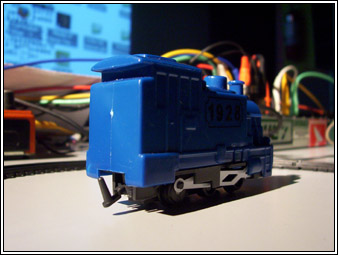
That evening Szkieve used a green plastic fish toy which he had bought from a street vendor during our walk. He pulled and released a string from the fish, which then emitted an expected fish-like sound that Szkieve slowly distorted into an echoish abstract noise, somewhat reminiscent of dub. Szkieve then combined the loop with the distorted sample of a toy train that moved on a circular track. The pitch of the train’s motion was drastically lowered several notes, turning it into a cacophonous massive bass sound that directly contradicted the petiteness of the actual train. Szkieve also mixed loops from various electronic devices through a mixer. If the audience had not experienced the visual development of the performance, the sound could easily have been mistaken for just another experimental electronic mix, carefully developed in a music studio–rather than from toys found at any corner store.
Szkieve’s performance is a good example of how the key to creativity is not so much the ability to produce sound from scratch, or have an advanced skill in performance, but actually to be able to conceptualize the potential of material that may already have a function, or holds particular cultural value. In this sense, circuit bending is a unique link between individuals who believe that all production should be developed and manipulated from scratch, and individuals who are primarily invested in acts of sampling and recombining material, as commonly understood in Remix. Circuit bending exposes how in the end it is not important if something is performed live or looped, or is a mix of the two, but rather whether or not what is performed challenges the audience’s perception of the source material. This is true not just for sound and noise performers, but artists in all fields.
I must admit that I often view circuit bending primarily as a performance based medium. My case in point is Szkieve’s performance, in which the sound may not be as interesting on its own but in conjunction with its visual development.
However, Circuit bending is becoming more diverse. In 2009 it is closely linked to physical computing and all types of art installations. What is promising about circuit bending is that it can be a medium, as well as a tool: it can include software and hardware, or exclude either one, as long as its only requisite is met: that perception be bent. Most importantly, like Remix, circuit bending can also be an aesthetic, to be cited in literary terms:
The snare of a wet red elastic nylon wire licking the bass-line of grey wooden-nails bound with the blind screams of a last name never to be famous and always worth mentioning; the beat of gracefully scratched hair longer than the history of the will, pushing the finger that struggles to penetrate its own castration; the speed of trust on the Internet, showing off its color as it begins to understand its dependence on truth…
The series of workshops and symposium at ReFunct 09, taking place at ISEA, in Ireland, are likely to push circuit bending’s definition, perhaps to the point that people like myself will no longer desire a live performance, but simply aspire to think beyond representation as we know it.
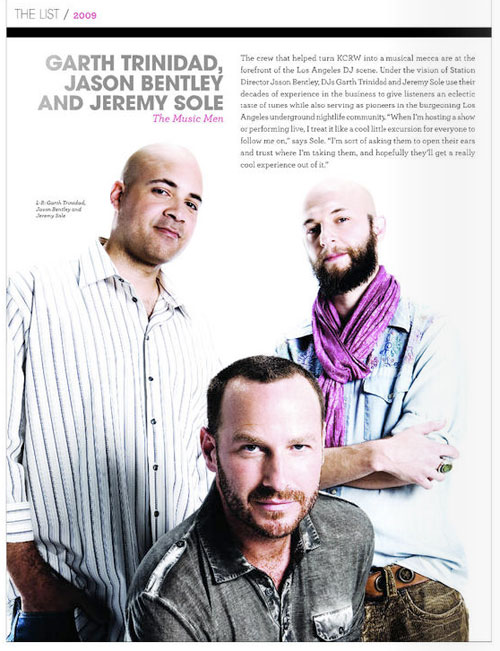
I’m currently in Los Angeles. Just picked up a copy of 944, a magazine about fashion, entertainment and lifestyle. The August issue features “the nightlife.” Like most lifestyle magazines these days, it consists of short snippets about trendsetters or “pioneers.” One cannot help but notice a quote stating that DJ’s can make as much as 35,000 for a three hour set. The magazine truly hypes up the life on the ones and twos.
Regardless of such statements, as I grew up in Los Angeles, I was quite happy to see that 944 acknowledged real talent. Above are some of the DJ’s that have shaped my views on music beyond the mainstream. Trinidad’s Chocolate City may well be a historical gem of a radio show, which any music historian specialized in radio would have to note; he has a vast knowledge of R & B and Soul and has taken great care to bring back B-sides that even serious record diggers have missed. The same for Jason Bentley, who was around even before Garth with his radio show, Metropolis. Bentley was one of the first DJ’s to mix electronic music live on the radio.
The pervasiveness of the screen in mobile media is pushing convergence development in two particular ways worth noting. The first, how image and text are increasingly treated the same by users, is actually a stepping stone to the second, which is how the convergence (combination) of all media is designed not only to provide the greatest access to as much information as possible, but also to negotiate which material is likely to be noticed first.
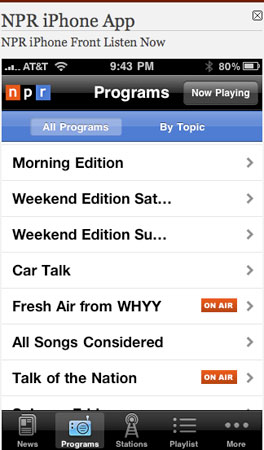
In relation to this, NPR recently released an iPhone widget that enables users to download a podcast or listen to live streaming. This particular widget is designed to complement multitasking, as NPR’s Digital SVP & GM Kinsey Wilson explains to Paid Content:
The small television in the kitchen comes to mind when reading Wilson’s explanation: people for the most part listen to the news while getting ready to leave for work in the early morning, or in the evening while preparing dinner. From time to time, when something of interest comes up, people are likely to look up and pay attention to the screen. In this case, the television is used as a radio with visual options. However, as it is obvious, the Television was not initially designed for this function.
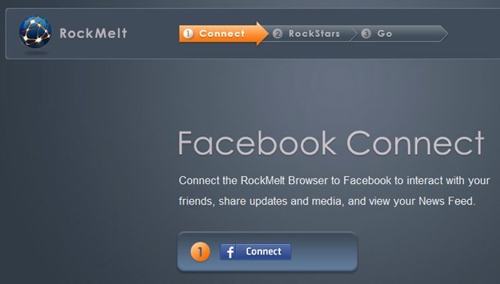
Netscape founder Marc Andreessen is backing a new browser dedicated to browsing Facebook, called RockMelt, according to rumors we’ve heard from reputable sources. A semi-independent desktop client for Facebook? Doesn’t seem far fetched at all.
The software isn’t publicly available or being discussed yet, but we’ve gotten our hands on an early build and had a look at the front door after download. Robert John Churchill, who was the principal engineer for Netscape Navigator, is the principle engineer for RockMelt as well.