I recently found a video of Lessig discussing his position on Free Culture at the 23C3 in Berlin in December 2006. In this video Lessig refers to Remix Culture/Free Culture as Read/Write Culture. This video shows his thinking process in the development of his latest term. Some of his propositions found in his three major books are revisited briefly. One good thing about Lessig is that he does not repeat his book examples; instead, he uses more recent material and discusses the history of radio, BMI vs. ASCAP. Lessig’s last book, Code 2.0, was published in 2006, so this video serves as a decent update about his position, given that he lectured at the end of the same year. Worth spending 1:15 on google video.
Note: I saw this on CBS last night and thought it was worth keeping in the archive for possible future reference for several reasons. First, the myth that “the young will lead” in the computer age is promoted eloquently; Facebook’s CEO is only 23 years old. Also, the frenzy that made the WWW so popular before the dot.com bubble burst of 2000 is kept alive with eloquent distance, while excitedly stating that Facebook is perhaps the next “Google”; and to accentuate this point they show Mark Zuckerberg in a large shared office space echoing the early days of the internet boom, particularly in San Francisco; his office is in Palo Alto, not too far from the former dot.com haven. But the most interesting part is to see Zuckerberg struggling to create actual revenue and hitting a wall that other online entities have encountered in the past when they try to make hard cash out of community based sites. Wikia and Shopwiki are two obvious examples. Perhaps Zuckerberg’s most interesting remark is when he explains why Beacon, which was not well received by the Facebook community, did not work. He actually does not know why. And when asked about the role of ads in Facebook, he resorts to a common argument that any business owner uses when asked about the pressure of making money: “I mean there have to be ads either way because we have to make money,” Zuckerberg says. “I mean, we have 400 employees and you know, I mean, we have to support all that and make a profit.”
(CBS) Are you on Facebook yet? The site is up to 60 million users so far, with a projection of 200 million by the end of the year.
If you’re not on Facebook, here’s how it works: you set up a profile page with details about yourself and then decide who gets to see it. Friends use their pages to share personal news, exchange photos, team up on political causes, or just play long-distance Scrabble. It can be a useful tool or an addictive waste of time. Either way, Facebook is having a dramatic impact on the World Wide Web and it’s estimated to be worth $15 billion.
As Lesley Stahl reports, sitting atop this growing company and directing an Internet revolution is a young, geeky computer programmer who created the site only four years ago.
The face of Facebook is Mark Zuckerberg, the mogul who’s guiding its extraordinary growth. What everyone wants to know is: Is he old enough to be running a company some people say is the biggest thing since Google?
“I’m 23 right now,” Zuckerberg tells Stahl when asked how old he is.
“And you’re running this huge company,” Stahl remarks.
“It’s not that big,” Zuckerberg says.
During her visit to Facebook’s headquarters, Zuckerberg helped Stahl set up her own Facebook page, with a profile of her likes and dislikes. They added her friends and family, and within a few minutes, she got a friend request.
“Here’s a guy I haven’t talked to in two years and I’m so thrilled to hear from him,” Stahl remarks.
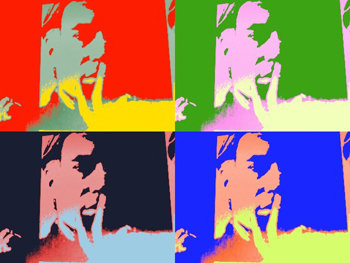
I’ve completed Diary of a Star, a blog project that appropriates the Warhol Diaries. Even though I did not initially contextualize this project as a remix, it certainly is one. Here’s an excerpt of my definition of Remix as a cultural practice:
The remix will always rely on the authority of the original song. When this activity is extended to culture at large, the remix is in the end a re-mix—that is a rearrangement of something already recognizable; it functions at a second level: a meta-level. This implies that the originality of the remix is non-existent, therefore it must acknowledge its source of validation self-reflexively. In brief, the remix when extended as a cultural practice is a second mix of something pre-existent; the material that is mixed at least for a second time must be recognized otherwise it could be misunderstood as something new, and it would become plagiarism. Without a history, the remix cannot be Remix.
Similar to sampling in music remixes, I selected diary entries from Warhol’s Diaries. The way they are recontextualized as a blog allows for the online user to recognize the aura of Warhol, as well as the autonomy of the work as an allegorical piece of art. To accentuate this autonomy, the comments I made are separated from Warhol’s entries, thus the user can come to terms with allegory as a naturalized strategy of the everyday.
Read more about my definitions in this site’s section Remix Defined.
Below is an excerpt of the initial ideas behind the blog:
I use selections of the Andy Warhol Diaries in the form of a blog to comment on diary entries, the private and public, the idea of a celebrity and her life as a public persona, and the activity of web-surfing as part of a new social space. The way the project works is I select an entry from Warhol’s diary and type it verbatim on the blog to the right called “diary.” I create links of people and places that Warhol mentions. I then comment on the people and/or the entry itself on the blog to the left called “meta diary.” What I write always depends on how I relate to Warhol’s entry as well as what I learn while surfing the links his entry provided. The entries correspond by date. I will often take more than half a day to post my own entry, so chances are that when the reader visits this website the “meta-diary” will be a day behind.
I recently saw No Country for Old Men, which I highly recommend, and when looking for reviews and critical analysis, I ran into No Country for Old Men/Creeper Remix in Ebaum’s World. The remix video takes the sound from one of the movie’s trailers and combines it with footage from Scooby Doo. The author/remixer, whose name does not appear in the post, explains that s/he found a resemblance between Scooby Doo’s Creeper and Javier Bardem’s character, Anton Chigurh.
No Country for Old Men/Creeper Remix exposes the importance of sound in film-making (or any other time based project), something which most viewers don’t think about once they become immersed in a film. For a remix such as this one to be successful, the viewers need to already be familiar with the film’s soundtrack; they need to recognize almost naturally Chigurh’s voice, just like they are also expected to know about Scooby Doo–at least in terms of popular culture. Scooby Doo’s footage, on the other hand, becomes supplemental, or subverted by the sound. Even if viewers don’t know about the Scooby Doo TV show and its characters, they are likely to see the Creeper’s resemblance to Bardem’s character–which is largely marked by the haircut. In this way the conventional roles of image and sound are reversed: the sound becomes the main point of reference, while the image supports the message carried by the sound. Filmmakers obviously know that there is a fine balance between image and sound to tell a good story, so this gesture is designed for popular consumption. In the end, that’s were most remixes are expected to find their audience.
I recently ran into some interesting remixes of Mr. Rogers and a young breakdancer in Youtube. The original excerpt in which Mr. Rogers interacts with a young African American boy already has sexual and class tensions, which could be ignored by the average viewer. But these tensions are brought forth in a one minute remix titled, “Mr Roger’s Breakdance Remix” in which Mr. Rogers states repeatedly “Hey Jermaine”, “Breakdancing with your friend…” and “I really like the way you do that…”
And then there’s another remix titled, “Mr. Rogers Was a B-Boy MOFO ! (feat NWA)” which is subtle in its intervension: it leaves the entire video clip intact, except for the moment when the young boy performs. In this remix, the original musical composition, which is non-intrusive, middle of the road, and exudes enough funk for the young boy’s moves to feel authentically off the street, is replaced by one of NWA’s track “F__k the Police” from back in the day–cursing from beginning to end. And like the previous remix, this one also makes obvious the cultural tensions at play between the two individuals. Mr. Rogers’s pleasant stride feels a bit forced, and when the music is over, he appears a bit out of touch with the boy’s performance.
These are multiple readings that any Mr. Rogers fan may want to retaliate against or at least play down, but one only has to look at the original clip carefully to sense the tension that the two remixes have brought forth for critical reflection. And this does not necessarily mean that there is something “wrong” with Mr. Rogers’s behavior, or with his interest in featuring a young breakdancer in his popular show. It just means that the remixes are able effectively to make obvious the social codes that both Mr. Rogers and the boy carry based on their ethnicity, class and gender, that are already at play in culture and they both, as well as us (the viewers), should be aware of.
In Le Catalogue, Yann Le Guenec has developed a public database of documentary images (an archive) of art projects which he created between 1990-1996. Every time an image is viewed, a horizontal line and a vertical line forming a cross are added; the image is then stored for access by another user. The more the images are accessed, the more they are abstracted or — if one is thinking of art conservation — destroyed.
Here, the archive is similar to analog vinyl records losing their fidelity, being slightly deteriorated every time the needle passes through the groove. Unlike a record player, however, which is fabricated with the aim to provide the least damage possible while offering an aesthetic experience for the user, Le Catalogue actually makes the most of destruction in order to create a unique image for the present user. The image is unique because each time the same file is accessed, two more lines will be added.
In this way, Le Catalogue reinterprets the idea of destruction as progress, bringing on the new. One can look forward to destruction as a type of online collaboration; the archived information is not preserved but rather reinterpreted as information constantly shifting. History is here dependent on linear traces that expose the instability of interpretation; much like tree rings, traces are left behind by the process, leaving us with an allegorical database presenting destruction as an inevitable part of life.