On Friday January 29, I participated in The Long Table, an open discussion session part of Refest in which about 8 individuals were invited to discuss the state of remix in 2013. The video of the discussion is embedded above. The Long Table was co-curated by Tom Tenney. The event took place at La Mama streamed live and archived online by Culturehub. I had the pleasure to participate in this event along with Adriano Clemente, David Commander, Fabian Saucedo, Jennifer Weber, and DJ Spooky, among others. The discussion began with the copyright dispute over the song “Girls” between GoldieBlox and The Beastie Boys. It moved from there to other aspects of remix. Refest took place at La Mama from November 29 – December 1, and also featured a performance by DJ Spooky which took place on November 30. The video of the performance is embedded below. Many thanks to Tom Tenney for inviting me to participate, a special thanks to the entire staff at La Mama and Culturehub, who do an amazing job at producing high quality events.
The catalog for the exhibition Three Junctures of Remix, which took place from January 17 to March 15, 2013 is now available for download as a PDF. I would like to thank the entire gallery staff and committee members for making the exhibition possible, especially Trish Stone, Jordan Crandall, Hector Bracho, Doug Ramsey, and Scott Blair. I especially thank the artists Arcangel Constantini, Mark Amerika & Chad Mossholder, Giselle Beiguelman, and Elisa Kreisinger, who participated in the exhibition, and were generous in providing interviews now published in the catalog.
Above: “portishead – documentaire – 1998 (welcome to portishead)”, included in the resource selections below.
List of online resources and music selection for week 5 of Hip-Hop to Dubstep, taught during the summer of 2013 at The New School’s Media Studies, Department of Communication. I will be releasing brief notes based on my class lectures in the near future. If interested in looking at the actual class webpage with all the weekly selections at once, feel free to peruse this link: http://navasse.net/NS/NCOM3039A/. My notes will not be available on the class webpage, only on each corresponding entry here on Remix Theory. Please note that links may become broken. If and when this happens, the best thing to do is to search for the source by name. And do let me know if anything is broken and I will look into it.
Coldcut – “Say Kids What time is it?” (1987) http://www.youtube.com/watch?v=gOlI-pi3Zug Coldcut – “Beats and Pieces” (1987) http://www.youtube.com/watch?v=DyIQ2Nzcx_E (Coldcut remixed Eric B & Rakim’s “Paid in Full” thanks to the recognition of the two tracks above. See week 4 for links that explain more about “Paid in full.”)
Coldcut was heavily influenced by the aesthetics of cut & paste as performed on the turntables by Grandmaster Flash on his well-known “Grandmaster
Flash’s Adventures on the Wheels of Steel” (1981) http://www.youtube.com/watch?v=gXNzMVLqIHg
Worth considering how Massive Attack’s cover gets remixed to fit the dialogue of a film (pay attention to how the verses get rearranged to complement the film): http://www.youtube.com/watch?v=lU4EnYbCHJM
Above: “Pump Up the Volume – Part 1, The History of House Music”, included in the resource selections below.
List of online resources and music selection for week 4 of Hip-Hop to Dubstep, taught during the summer of 2013 at The New School’s Media Studies, Department of Communication. I will be releasing brief notes based on my class lectures in the near future. If interested in looking at the actual class webpage with all the weekly selections at once, feel free to peruse this link: http://navasse.net/NS/NCOM3039A/. My notes will not be available on the class webpage, only on each corresponding entry here on Remix Theory. Please note that links may become broken. If and when this happens, the best thing to do is to search for the source by name. And do let me know if anything is broken and I will look into it.
The Salsoul Orchestra. “Ooh, I Love It (Love Break)”. 12″ Original Remix Shep Pettibone. (1982) http://www.youtube.com/watch?v=HkDmbJegNpw Short version (break mix): http://www.youtube.com/watch?v=ynSP04nUThk (Note that in the above mixes you can already hear the drum arrangement that Frankie Bones would come to perfect with drum machines.)
On The House – “Move Your Body” (1986) http://www.youtube.com/watch?v=enyh56-Q_Cs (First record to use a piano in house music. Became a house anthem because it uses the word “house” in the lyrics)
Jungle Brothers – “I’ll House You” (1989) http://www.youtube.com/watch?v=AFGhQSiGHWM (The above crosses over to what came to be called “hip-house.” Some house purists did not like rap combined with house. Often times only the dub or instrumental versions of this record was remixed on the dancefloor.) One of various intrumental versions that were released:
“Richie Rich Instrumental” http://www.youtube.com/watch?v=K0k1qLGVjsM
Inner City – “The Good Life” (1988) http://www.youtube.com/watch?v=iUwfOOdg4eE Inner City – “Big Fun” (1988) http://www.youtube.com/watch?v=omfiVkkJ1OU Inner City is a crossover act, and is not necessarily considered a techno group, even though Kevin Saunderson is one of the three founders of Techno in Detroit. The songs by Inner City were also mixed with Freestyle and some Electro-Funk, depending on the club.
Joey Beltram – “Energy Flash” (1990) http://www.youtube.com/watch?v=ALsHox5sYCk Considered a pivotal track in defining the sound of techno particulary in Europe. It is one of the compositions that also opened the door for the aesthetics of trance. Beltram considered his composition to be part of house music, but it eventually became labeled as techno in Europe for selling purposes.
Above: The Amen Break documentary by Nate Harrison, included in the resource selections below.
List of online resources and music selection for week 3 of Hip-Hop to Dubstep, taught during the summer of 2013 at The New School’s Media Studies, Department of Communication. I will be releasing brief notes based on my class lectures in the near future. If interested in looking at the actual class webpage with all the weekly selections at once, feel free to peruse this link: http://navasse.net/NS/NCOM3039A/. My notes will not be available on the class webpage, only on each corresponding entry here on Remix Theory. Please note that links may become broken. If and when this happens, the best thing to do is to search for the source by name. And do let me know if anything is broken and I will look into it.
Newcleus was clearly influenced by the sound coming out of Germany. “Push the Button makes this quite evident.” Also note that while Newcleus were very much experimenting with electro-funk, they also would rap, as you will notice one of their most successful songs is included under the rap section below.
Kid Frost – La Raza (1990) http://www.youtube.com/watch?v=bZ8AS300WH4
(See disco section for the original song “Viva Tirado” by El Chicano to hear the source of melody and percussion samples)
Above: Skatalites Authentic, included in music selections below.
List of online resources and music selection for week 2 of Hip-Hop to Dubstep, taught during the summer of 2013 at The New School’s Media Studies, Department of Communication. I will be releasing brief notes based on my class lectures in the near future. If interested in looking at the actual class webpage with all the weekly selections at once, feel free to peruse this link: http://navasse.net/NS/NCOM3039A/. My notes will not be available on the class webpage, only on each corresponding entry here on Remix Theory. Please note that links may become broken. If and when this happens, the best thing to do is to search for the source by name. And do let me know if anything is broken and I will look into it.
Links used to contextualize why everything is not a remix, but why the concept of remixing has become popular to discuss recycling of material in forms beyond music:
Above: “Rehab” by the Jolly Boys, Mento cover of Amy WineHouse’s composition (listed below as part of music selection)
This summer I am teaching an onlline class on the history of remix in music since the 1960s for The New School’s Media Studies, Department of Communication. I will be making available the music selections for each week in a total of 7 entries. I will be releasing brief notes based on my lectures in the near future, for now I am sharing the online resources and music selection. The first week’s list of resources is below, following the description of the class. If interested in looking at the actual class webpage with all the weekly selections at once, feel free to peruse it: http://navasse.net/NS/NCOM3039A/ . My notes will not be available on the class webpage, only on each corresponding entry here on Remix Theory. Please note that links may become broken. If and when this happens, the best thing to do is to search for the source by name. And do let me know if anything is broken and I will look into it.
Course Description
This course is a theoretical and historical survey of popular music influenced by or part of the remix tradition in hip-hop and electronica. Emphasis is placed on the shaping of culture by media and vice-versa. Remixes are compositions that reconfigure a pre-existing music recording, often to make it more danceable. As simple as the definition sounds, it carries a complex set of cultural variables that include issues of class, gender, and ethnicity. Listening exercises and analysis of recorded music is complemented by readings that provide understanding of the historical context and theoretical underpinning of remix practices. Our survey begins with popular music in the United States in the early 1950s, including Blues, R&B, Rock n’ Roll, and early funk. In the 1960s, this music was appropriated in the Caribbean and gave birth to new styles, Calypso, Ska, Reggae, and Dub. Then it came full circle back to the United States with the development of hip-hop music. The rise of the international styles called trip-hop, drum ‘n’ bass, and dubstep and the parallel history of techno and house music and styles in-between are then considered, in order to arrive at a theoretical understanding of the complexity of contemporary music and the extent to which it has been defined by the principles of sampling and remix.
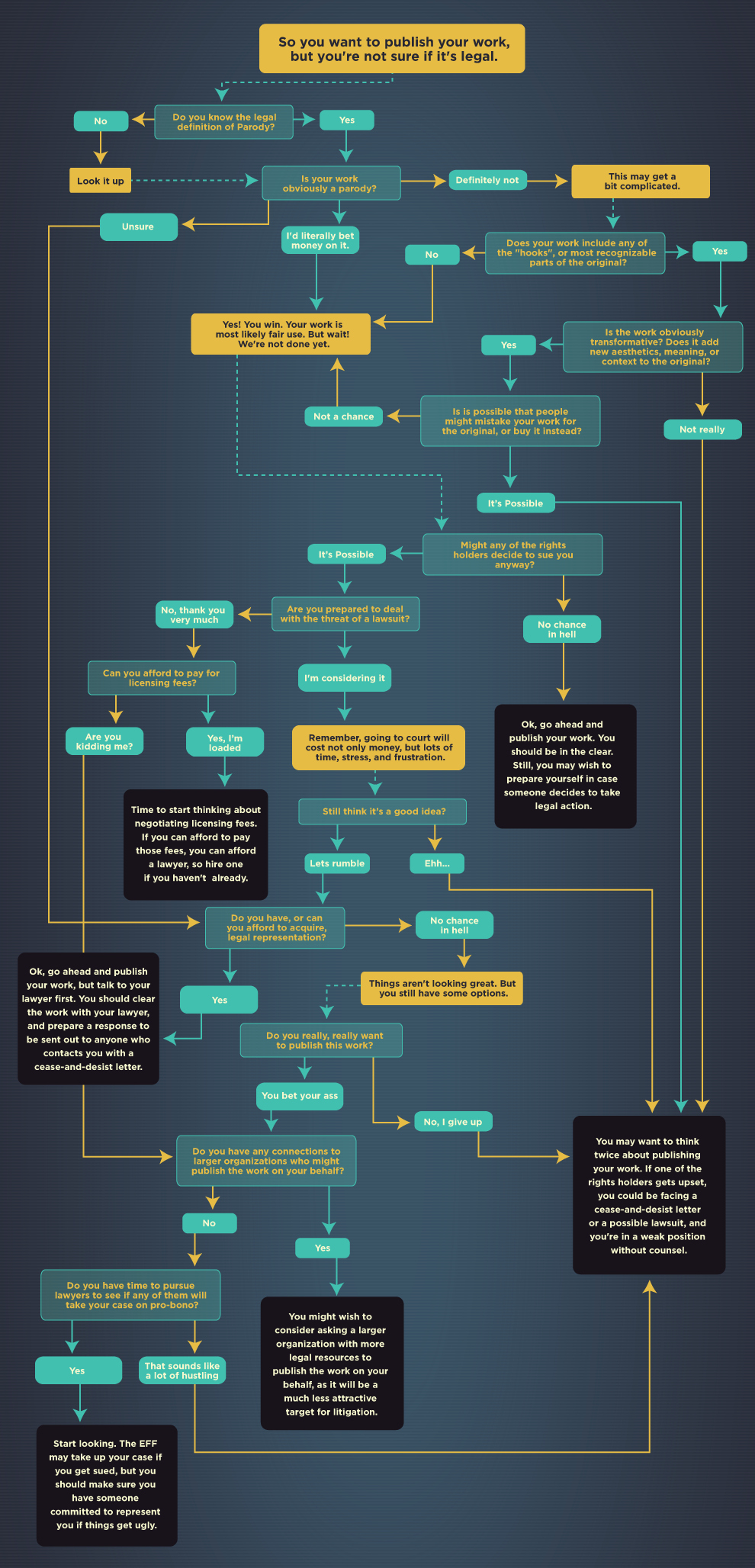
Graphic by Ben Jackson and Chris Ritter as credited on Buzzfeed
The chart above was posted on Buzzfeed back in October of 2012. It was linked to an article titled “Why Remix Culture Needs New Copyright Laws.” The article revisits many of the issues that are still prevalent in 2013 in terms of remix. One would expect major changes at this stage of media production, especially with social media, but the chart reminds independent media producers that there is much work that needs to be done.
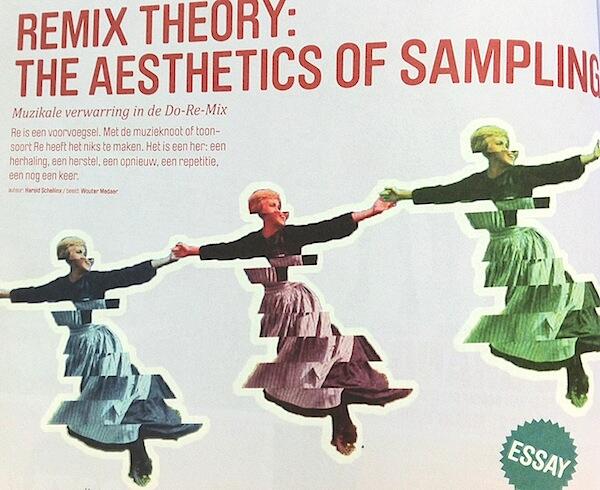
I received a tweet with the image above. I think it’s a good remix in its own right. It appropriates not only the title of my book but also the concept behind the sound of music quite well.
Note: This text was written for the peer review Journal AnthroVision 1.1 | 2012 : First issue. It was published in September of 2012. It is released here with permission from the editors. A special thanks to Nadine Wanono and the peer reviewers for all their support in the process of revising and publishing the text.This essay is the first formal release of my post-doc research for The Department of Information Science and Media Studies at The University of Bergen, Norway in collaboration with The Software Studies Lab at Calit2, University of California, San Diego during the period of 2010-2012. I will be releasing more of my research in the near future. For now, you may also look over related material, available under Projects.
For proper text citation use:
Référence électronique
Eduardo Navas, « Modular Complexity and Remix: The Collapse of Time and Space into Search », Anthrovision [En ligne], 1.1 | 2012, mis en ligne le 01 septembre 2012, consulté le 15 mars 2013. URL : http://lodel.revues.org/10/anthrovision/324
Download and read the complete article: DownLoad PDF
Excerpt:
If postmodernity consisted of the collapse of time into space, then the time of globalization at the beginning of the twenty-first century consists of the collapse of time and space into search. Culture has entered a stage in which time and space are redefined by modular access to knowledge in unprecedented fashion with the use of search engines. Search redefines the way people come to terms with historical developments that are constantly recycled and remixed with the use of new media technology. A search is usually performed with engines such as Google and Bing; technology that is founded on research that brings together private and public interests.
This text is a reflection on the implications behind search algorithms that provide people with material that is relevant in correlation to a hierarchy of supposed importance that may reach great popularity, and perhaps even go viral (large circulation online) according to the use of key terms known as meta-data. This text is an evaluation of the aesthetics of search made possible because of what I call modular complexity; meaning, the ability to function within a system of modules that are autonomous but that also effectively inform and redefine each other.[1] This, in effect, leads to the collapse of time and space into search; meaning, if the postmodern gave way to a sense of historical dismissal, such attitude is fully at play in networked culture as ahistoricity. This shift, which informs emerging markets on the global network, repurposes interdisciplinary methodologies across fields of research in the social sciences as well as the humanities.
[1] I first introduce the concept of Modular Complexity in the Essay “Remix: The Ethics of Modular Complexity in Sustainability,” written for CSPA Journal’s Spring 2010 issue. See: https://remixtheory.net/?p=461
Download and read the complete article: DownLoad PDF