1Xtra’s ‘Remix Kid’ Seani B uncovers the origins of remixing…
How has the art has changed over the years?
First developed by Jamaican reggae producers in the 1960s to create dub music, remixing was picked up by hip hop pioneers and disco DJs to develop new styles.
P Diddy is one the most famous remixers of all time – if that title is in your sights, listen up for Seani’s tips on how to put together your own remix track.
Who’s the remixer of the remixers? How has remixing blurred the boundaries between different musical genres in the UK?
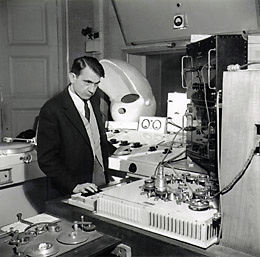
Pierre Schaeffer in 1952 playing the phonogène à clavier, a tape recorder with its speed altered by playing any of twelve keys on a keyboard. Photo courtesy of GRM.
Image and text source: http://www.newmusicbox.org/
Published: May 24, 2006
Inside the Box: The computer comes out to play
There’s often a vertical plane between musician and audience. The sheet-music stand paved the way for the upturned plastic shell of the turntable, and today, chances are that rectangle obscuring the face of the performer on stage is the screen of a laptop computer, which has emerged as a ubiquitous music-making tool.
NEW YORK (Billboard) – You could spend the better part of a day listing the things Grandmaster Flash & the Furious Five did first: In the embryonic days of the New York rap scene, they were among its first superstars, they helped pioneer the freestyle battle and Grandmaster Flash was instrumental in inventing the art of break-beat DJ’ing.
Legend also has it rapper Mele Mel was the first to dub himself an “MC”; fellow rapper Cowboy is credited with coining the term “hip-hop.”
So it makes perfect sense to add another first to the list: On March 12, Grandmaster Flash & the Furious Five will become the first hip-hop act inducted into the Rock and Roll Hall of Fame. It was 25 years ago that their groundbreaking single “The Message” helped hip-hop kick down the door into a world of bigger audiences, and in their third year of eligibility, the act — comprising Grandmaster Flash, Kid Creole, Mele Mel, Scorpio, Raheim and the late Cowboy — will join a class that includes R.E.M., Van Halen, Patti Smith and the Ronettes.
1. On a sweltering August afternoon in 1996, New York City’s Summerstage concert series brought the South Asian dance music known as bhangra to Central Park. South Asian families from all over the tri-state area sunned themselves, jostled for room, and danced in a jam-packed sandy space under sun-dappled plane trees. New York turntablist DJ Rekha added some hometown flavor, spinning bhangra remixes to much applause before the Safri Boys, one of Britain’s hottest bhangra bands, took the stage. Although bhangra remix had been transforming South Asian youth culture in the US at least since the release of UK musician Bally Sagoo’s pathbreaking “Star Crazy” album in 1991, the concert in Central Park was a particular milestone. Here, visible to a broad public, was a display of the compelling cultural forms through which South Asians of the diaspora were articulating new, composite identities. The multiple regional contrasts and tensions that define identity within the subcontinent were harmonized in this diasporic context. The result was a powerful sense of cultural unity and pride. Desi (Hindi for “homeboy” or “homegirl”) culture had definitely arrived. [1]
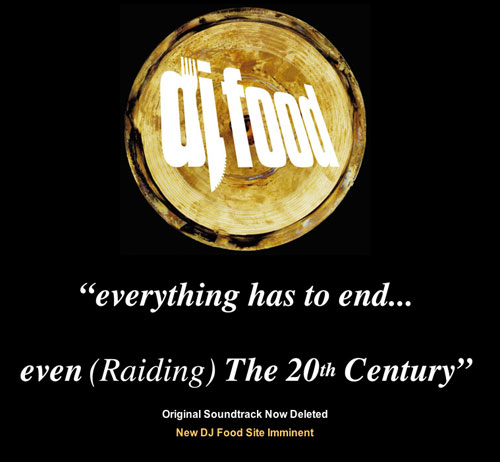
This is a 40-minute MP3 of a British radio broadcast called “DJ Food – Raiding the 20th Century” that attempted to sum up the entire cut-up/remix/mash up music movement. It’s lots of crazy, whacky, jarring, harmonious, tricksy, and serendipitous sound, and it made me laugh and think. The landing page for the MP3 has an exhaustive list of the samples employed.
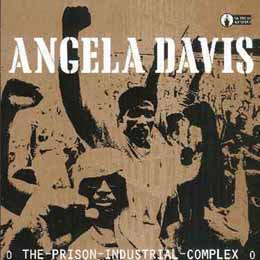
Dance Dance Revolutionary! is an arts initiative that aims to share information about radical activism through fun, participatory events. The project includes various platforms inspired by the lives of Angela Davis and Emma Goldman, two important figures in U.S. history.
As part of its ongoing activities, Dance Dance Revolutionary! hosted a re-mix contest. The objective was to creatively re-assemble songs written by the Rolling Stones and John Lennon/Yoko Ono about activist Angela Davis around the time that she was acquitted of federal murder charges in 1972.
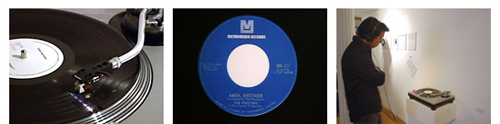
Can I Get An Amen? is an audio installation that unfolds a critical perspective of perhaps the most sampled drum beat in the history of recorded music, the Amen Break. It begins with the pop track Amen Brother by 60’s soul band The Winstons, and traces the transformation of their drum solo from its original context as part of a ‘B’ side vinyl single into its use as a key aural ingredient in contemporary cultural expression. The work attempts to bring into scrutiny the techno-utopian notion that ‘information wants to be free’- it questions its effectiveness as a democratizing agent. This as well as other issues are foregrounded through a history of the Amen Break and its peculiar relationship to current copyright law.
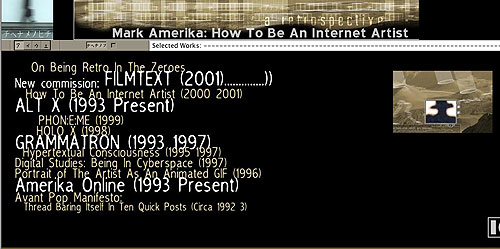
What does it mean to be a net artist? Is it a life? A style? A practice? One way to think about the growing con/fusion of net art and net lit is as a continually emergent dialogue. You see someone’s web site in Brazil and send them an email from a vacation spot in Hawaii telling them how much you admire their work — and a dialogue is born. This dialogue branches into more emails, web sites, symposiums and exhibitions. Soon, you have an instantaneously delivered multi-linear thread of narrative-potential being practiced as a form of social networking. Is this the story? Is it conceptual? Literary? Performative? What happens when the conversants agree to let the dialogues go public? Is this an activist recording or archiving of an ultra-contemporary art scene that defies categorization? Who owns it? Who buys it? Perhaps it’s a kind of creative mindshare.
I email Eugene Thacker because I am interested in what he is doing. I ask him if would like to engage in a net.dialogue, somewhere between net.lit and net.art but without all of the didactic propaganda associated with both of those terms. He writes back from New York saying he’s game and so we start sending emails back and forth and soon I put the data into an automated editing environment I call “Mark Amerika’s Brain While It Listens to MP3 Jukebox Recordings and Interacts With Whatever Software He Happens To Have Opened Up On His Screen.”
Text source: http://www.artsandletters.fau.edu/
humanitieschair/cannibal.htmlÂ
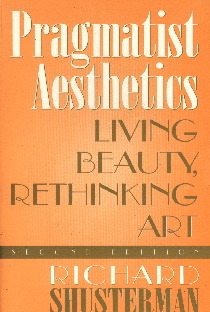
1. In your study of rap in Pragmatist aesthetics (Oxford: Blackwell, 1992) you explicitly use the concept of cannibalism to describe rap’s aesthetic of appropriation, its sampling of prerecorded music and other sounds. You even refer to the early rappers, on page 203, as “musical cannibals of the urban jungle.” What has been the reaction to this characterization of rap? (more…)