About | Remix Defined | The Book | Texts | Projects | Travels/Exhibits | Remixes/Lists| Twitter

Archive of the category 'History'

New Online Advertising Strategies Spark Privacy Worries

Image and text source: The News Hour

Originally Aired: November 6, 2007

Social networking Web sites such as MySpace and Facebook have started to allow advertisers to access users’ profiles and target the ads they deliver to that user accordingly. A media and technology writer examines the potential impact this marketing may have on individual user privacy.

GWEN IFILL: Judy Woodruff has our Media Unit look at the balance between online information’s financial potential and individual privacy.

JUDY WOODRUFF: It’s where millions of young people list their favorite hobbies, movies, friends and trends, and now all that information from the two largest social networking sites, Facebook and MySpace, with a combined total of more than 160 million users, will be made increasingly available to advertisers.

Facebook announced today that it will allow companies to show ads to its users, both when they are on and off the site, based on personal information they list online.

Yesterday, MySpace unveiled a self-service advertising tool allowing groups like small businesses, musicians and politicians to post an ad and choose who sees it. They also increased a number of categories that track user preferences by more than tenfold, in order for businesses to better target their products to the much-sought-after 18 to 25-year-old demographic.


(more…)

Drum n’ Bass History. Article originally written in 1997 by VN’s Kingsley Marshall

Image source: dfloor.net

Text source: trugroovez.com

Intro:

Drum and bass music (drum n bass, DnB) is an electronic music style. Drum and bass, originally an offshoot of the United Kingdom breakbeat hardcore and rave scene, came into existence when people mixed reggae basslines with sped-up hip hop breakbeats and influences from techno . Pioneers such as raggamuffin DJ General Levy and other DJs quickly became the stars of Drum and bass, then still called jungle . Producers such as Goldie and 4 Hero transformed the current art and turned drum and bass in more instrumental direction, spawning sub-genres like techstep and moving the genre closer to techno. Some of the more popular and defining artists include Shy FX, Ed Rush & Optical, LTJ Bukem, Goldie, and Roni Size.

Jungle music, ORIGINS:

Based almost entirely in England, Drum’n’Bass (then called ‘jungle’ ) emerged in the early ’90s. It is one of the most rhythmically complex of all forms of dance music, relying on extremely fast polyrhythms and breakbeats . Usually, it’s entirely instrumental — consisting of nothing but fast drum machines and deep bass.
As its name implies, jungle does have more overt reggae, dub, and R&B influences than most hardcore — and that is why some critics claimed that the music was the sound of black techno musicians and DJs reclaiming it from the white musicians and DJs who dominated the hardcore scene. Nevertheless, jungle never slows down to develop a groove — it just speeds along. Like most dance music genres, jungle is primarily a ‘twelve inch’ genre designed for a small, dedicated audience, although the crossover success of Goldie and his 1995 debut Timeless suggested a broader appeal.
Dozens of respected artists started fusing breakbeats with influences lifted from jazz , film music, ambient, and trip-hop. — allmusic.com

(more…)

MACHINE SOUL: A History Of Techno, by Jon Savage


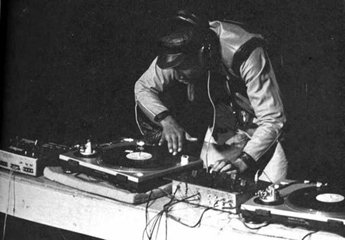
DJ Blush on the decks

Image source: Bubblefunk

Text source: Hyperreal.org

[This article originally appeared in The Village Voice Summer 1993 “Rock & Roll Quarterly” insert.]

Oooh oooh Techno city
Hope you enjoy your stay
Welcome to Techno city
You will never want to go away

–Cybotron, “Techno City” (1984)

“The ‘soul’ of the machines has always been a part of our music. Trance always belongs to repetition, and everybody is looking for trance in life… in sex, in the emotional, in pleasure, in anything… so, the machines produce an absolutely perfec t trance.”
–Ralf Hütter, 1991, quoted in Kraftwerk: Man Machine and Music, Pascal Bussy

“It’s like a cry for survival,” a panicked male voice calls out. The beat pauses, but the dancers do not. Then Orbital throw us back into the maelstrom: into a blasting Terry Riley sample, into the relentless machine rhythm, into a total environment of light and sound. We forget about the fact that we’re tired, that the person in front of us is invading our space with his flailing arms. Then, suddenly, we’re there: locked into the trance, the higher energy. It does happen, just like everybody always says: along with thousands of others, we lift off.

(more…)

Mixing, Not Mincing his Words


Photo: Jon Reid

Image and text source: Fairfax Digital

Originally published on February 4, 2005
Socially and culturally aware, this DJ is the harbinger of change, writes Ashley Crawford.

He travels to Trinidad and Istanbul, Paris and Jakarta, Moscow and New Orleans. He hangs out with Yoko Ono, Merce Cunningham, Sonic Youth and Wu-Tang Clan. He tosses off cultural references from James Joyce to Gertrude Stein, Jean Baudrillard to Mikhail Bakhtin, and he writes for a range of journals and magazines from Artforum to The Village Voice.

He is in Australia to promote his new book, Rhythm Science (published by the prestigious MIT Press) – a meditation on the “flow of patterns in sound and culture”, and he has just screened Rebirth of a Nation, his re-mix of D. W. Griffith’s 1915 film classic, Birth of a Nation, at the Sydney Festival.

(more…)

On The Mixed Up Films Of Mr. Andy Warhola, by Gregger Stalker

Image and text source: Greg.org

Originally posted on September 14, 2007

Wait, the Warhol Museum called the 1-hour excerpt of Empire released on DVD an unauthorized bootleg?

Yes they did, in 2004:

“It’s a bootleg!” says Geralyn Huxley, a curator at the Andy Warhol Museum in Pittsburgh.

Which is odd. The Italian company Raro Video has released several Warhol films on DVD over the last couple of years. Andy Warhol: 4 Silent Movies is listed as a 2005 release on Amazon, and there’s a Chelsea Girls DVD, too.Last year, Raro compiled 11 films and 8 discs into a box set, Andy Warhol Anthology, which–like all the films–is issued in region-free PAL format. There are extensive bilingual notes, interviews, and bonus material accompanying the discs, but there are also odd errors in formatting:

At least two of the silent films, Kiss and Blow Job, are mastered at the wrong speed [25fps instead of 16fps], and the once-randomly silent or audible soundtracks on the split-screen Chelsea Girls are provided in a single, seemingly arbitrary configuration which omits much well-documented dialogue.

Read the entire entry at Greg.org

24:33, by Caitlin Jones

Text and Image source: Rhizome.org

Published on September 5, 2007

To mark the occasion of what would be John Cage’s 95th birthday, WNYC has put together an amazing collection of audio and video from their archives. Video of seminal performances, interviews with the artist, as well as a few oddities including his appearance on the 1960s show ‘I’ve Got a Secret’ are posted along with writings by the composer. Cage collaborators including Joan LaBarbara, Meredith Monk, and Merce Cunningham also share their stories and insights into Cage as both a collaborator and friend. The festival airs on WNYC2 from September 5th at 12PM until 12:33PM September 6th, with video, audio, and textual documents available on their website.

http://www.wnyc.org/music/johncage.html

Beatboxing: An Oral History, by Marian Liu

(Illustration by Rob Hernandez – Mercury News)

Image and text source: Mercury News

Published on 01/04/2007

HIP-HOPPERS TURN TO VOICE-BASED RHYTHMS

On the hip-hop scene, “beatboxing” — the term for the art of creating rhythms and sound effects with the human voice — has taken a back seat to rapping, DJing, emceeing, break dancing and graffiti art since it surfaced in the ’80s.

Until now.

The popularity of beatboxing is growing, and one indication is the 2007 West Coast Open Human Beatbox Battle, which takes place Friday night at the Ashkenaz music and dance club in Berkeley, where artists will create all kinds of beats, sometimes while playing along with other instruments.

Thirty-seven-year-old Anthony Rivera (a.k.a. Click) has been beatboxing for 22 years. His work was heard in the 2002 Eminem movie “8 Mile.” Rivera says, “I’ve seen beatboxing change. People are starting to get more creative, getting closer to the actual sound (of percussion instruments) than we did back in the day.”

Read the entire article at Mercury News

Some Notes on Nine Inch Nails’ Invitation to Create Mashups

Image source: yearzero.nin.com

Note: Below are a couple of comments on Nine Inch Nails’ current project, which consists of inviting fans and music enthusiasts to mashup one of NIN’s new songs “Survivalism” to their hearts’ content. This project is welcomed and reminiscent of the pioneering project A Bush of Ghosts by Brian Eno and David Bowie. Also see: http://bushofghosts.wmg.com

———-

“Nine Inch Nails Invites Mashups,” by Jonathan at Ampheteme.org

Text source: Amphetameme.org

Published on 3-26-07

Trent Reznor’s inviting you to mash-it-up. He invites you to go absolutely nuts with his latest creation, the tracks that come together to make the song “Survivalism”. Feel free to interpret the tracks any way you wish he says, and add your own. And he’s asking you (because of his partnership with Apple I presume) to use Garageband. I don’t mind. Garageband 3’s one pretty damn cool piece of work. At any rate, I’m a big NIN fan and I’m happy to see him once again inviting remix interpretation. Pick up all the details at yearzero.nin.com.

———-

“A mashup on Garageband takes music experiences to a new level,” by Stephen Abbott

Text source: projectopus.com/

Published on 3-26-07
Trent Reznor of Nine Inch Nails is pushing the boundaries of a music experience to new levels. According to an article in Digital Music News, Reznor is making a single from the upcoming album, Year Zero, available for “remix interpretation”. The interesting twist to this is that it is being done in a sort of collaboration with the latest release of Garageband 3, part of Apple’s iLife suite.

Garageband users can adjust a number of tracks that make up “Survivalism,” and add their own elements as well. Once created, the tracks can be shared, ripped and distributed at will. According to an Apple representative, other songs from the album are also on the way.

The ability to share and distribute the personal remixes is huge. Perhaps ability is the wrong word – the encouragement to distribute these remixes is incredible. The artist is giving open permission to use his work. There could be literally thousands of interesting and unique interpretations of NIN’s musical talent. Of course, there are going to be many more versions that suck, but those will fade away soon enough.

(more…)

Ghetto Ambient, by Greg Smith

Image and text source: Serial Consign

I’ve been a longtime fan of musician and artist Sebastian Meissner who releases beautiful and often unsettling ambient music under the moniker Klimek on Kompakt. I began a dialog with Sebastian when I tipped him off that I had used a Klimek track to score my Kamera Obscura project, and as we chatted back and forth I realized he was the creative force behind a number of other projects that have showed up on my radar over the years.

Sebastian is also behind or was involved in: Bizz Circuits, Autopoieses (with Ekkehard Ehlers) and Random Inc. In addition to the Klimek material that I find so mesmerizing, the Random Inc. record Walking In Jerusalem was one of my favourite albums of 2002, and Autopoieses’s locked-groove laden La Vie À Noir Transposed didn’t leave my crate for two years when I was still playing records.

(more…)

Regressive and Reflexive Mashups in Sampling Culture, by Eduardo Navas


Grandmaster Flash on the Wheels of Steel some time in the early days of hip hop.

Image source: greatestcities.com

Update as of 8/13/10.  The revised version of this text is now available online as Remix Theory post 444.

Update as of 4/29/10: This text has been revised for the book publication Mashup Cultures. In the revised print version, I introduce a series of new terms along with a diagram.  The 2007 draft is shared below in the tradition of online sharing.  The final argument while it has not necessarily changed is more precise in the revised print version, which I encourage those interested to read.

This text was published on June 25, 2007 in Vague Terrain Journal as a contribution to the issue titled Sample Culture.

Today, sampling is practiced in new media culture when any software users including creative industry professionals as well as average consumers apply cut/copy & paste in diverse software applications; for professionals this could mean 3-D modeling software like Maya (used to develop animations in films like Spiderman or Lord of the Rings );[1] and for average persons it could mean Microsoft Word, often used to write texts like this one. Cut/copy & paste is a vital new media feature in the development of Remix. In Web 2.0 applications cut/copy & paste is a necessary element to develop mashups; yet the cultural model of mashups is not limited to software, but spans across media. Mashups actually have roots in sampling principles that were first initiated in music culture around the seventies with the growing popularity of music remixes in disco and hip hop culture; and even though mashups are founded on principles initially explored in music they are not always remixes if we think of remixes as allegories. This is important to entertain because, at first, Remix appears to extend repetition of forms in media, in repressive fashion; but the argument in this paper is that when mashups move beyond basic remix principles a constructive rupture develops that shows possibilities for new forms of cultural production that question standard commercial practice.

(more…)

Current Projects


    Books


    Remix Theory | is an online resource by Eduardo Navas. To learn more about it read the about page.

    Logo design by Ludmil Trenkov

    http://www.mentalhealthupdate.com/