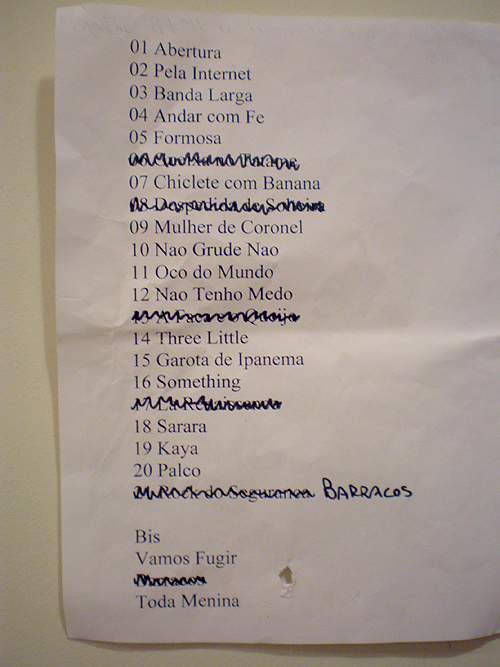
Image note: My partner, Annie, swiftly caught Gilberto Gil’s concert song list as this one was about to be thrown by one of the roadies at the end of the show.
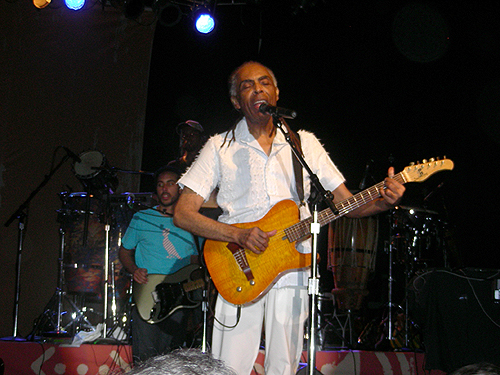
I attended Gilberto Gil’s concert at the 4th & B in San Diego this past Monday. The turnout was quite impressive. I did not take my digital camera as I thought the audience was not allowed to take footage, but upon arriving, I noticed cameras everywhere; people were not hiding them and were using them freely, from cell-phones to small digital video-cams.
I later learned when reading an article in the Union Tribune that Gil actually promotes the recording of his concerts by the audience for later upload to video websites such as Youtube. Gil embraces new technologies as a way to communicate and spread his message, which as Brazil’s Minister of Culture includes a sense of responsibility for Brazil’s music history. It seems that Gil is fully in tune with Remix Culture.
Image taken by Annie Mendoza
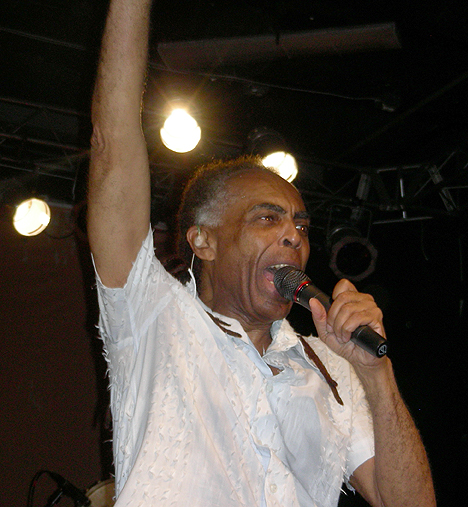
He delivered a two hour strong set which included original material as well as covers. The songs that stood out are three of perhaps the most recognizable songs in the world: “Three Little Birds” by Bob Marley, “Girl from Ipanema” by Antonio Carlos Jobim, and “Something” by the Beatles. He did a little twist on these songs to show the complexity of current global culture. “Three Little Birds” was played in Bossa Nova Style, “Girl from Ipanema” in Reggae, and “Something” was a fusion of both music genres.
Image taken by Annie Mendoza
Below are a number of links to Gilberto Gil’s concert in San Diego, so you can judge for yourself what a great performer Brazil’s Minister of Culture is.
More video material has been uploaded to YouTube in the past six months than has ever been aired on all major networks combined, according to cultural anthropologist Michael Wesch. About 88 percent is new and original content, most of which has been created by people formerly known as “the audience.”
Wesch will discuss the three-year-old video-sharing Web site in a lecture titled “The Anthropology of YouTube” at 4 p.m. on Monday, June 23, in the Montpelier Room on the sixth floor of the Library of Congress’ James Madison Building, 101 Independence Ave. S.E., Washington, D.C.
Sponsored by the Library’s John W. Kluge Center, the event is free and open to the public; no tickets or reservations are required. The lecture will be available at a later date as a webcast at www.loc.gov/today/cyberlc/.
CONGRESS is considering a major reform of copyright law intended to solve the problem of “orphan works” — those works whose owner cannot be found. This “reform” would be an amazingly onerous and inefficient change, which would unfairly and unnecessarily burden copyright holders with little return to the public.
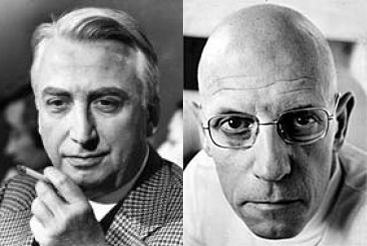
This text is a theoretical excerpt from one of my chapters on the role of Remix in Art. It outlines how the theories of Roland Barthes and Michel Foucault on authorship are relevant to New Media, particularly their link to the interrelation of the user and the maker/developer in terms of sampling (a vital element of Remix as discourse). While the text does place a certain emphasis on art, the propositions extend to various areas of culture. It was previously presented as a lecture for ICAM at UCSD on April 6, 2005: http://navasse.net/icam/icam110_spring05_schedule.html
Remix is Meta
The act of remixing (which I refer to in terms of discourse as Remix) developed as a meta-action. Its specificity in the second half of the twentieth century can best be understood when realizing that the strategies by artists throughout the first half of the twentieth century had to be assimilated to then be recycled as part of the postmodern condition in the second half—a time when remix proper developed in music. The acts of collage, photomontage and the eventual development of mixed media had to be assimilated, not only by the visual arts, but also mainstream media for the concept of remixing to become viable in culture. Remix’s dependency on sampling questioned the role of the individual as genius and sole creator, who would “express himself.” Sampling, then, allows for the death of the author; therefore, it is no coincidence that around the time when remixes began to be produced, during the sixties and seventies, authorship—as discourse—was entertained by Roland Barthes and Michel Foucault, respectively. For them, “writing” in the sense that Rousseau would promote the expressive power of the individual no longer was possible. Sampling allows for the postmodern condition (which some consider to be part of modernism) to come through. To this aspect of sampling we will turn to in the next section. What follows is an outline of Barthes’s and Foucault’s respective theories which were conversant with contemporary art practice, during the period when both authors developed their theories, as it will become evident throughout my argument, their ideas are quite relevant to media culture.
The Role of Author and the Viewer
In his essay, “The Death of the Author,” Roland Barthes questions the concept of authorship. For him it is the text that speaks to the reader. He writes, “A text is made of multiple writings, drawn from many cultures and entering into relations of dialogue, parody and contestation, but there is one place where this multiplicity is focused and that place is the reader, not, as was hitherto said, the author.”[1] With this statement he summarizes his argument that we should treat the text not as something coming from a specific person, but as something that takes life according to how the reader interprets the writing as a collage of diverse sources. For Barthes, it is the reader who holds the real potential to make discourse productive. He looks at specific authors, like Proust, Mallarme and Valery as authors who “Restore the place of the reader.”[2] The author ceases to matter for Barthes because only in this way can the text be set free, for to have “an Author is to impose a limit on that text, to furnish it with a final signified, to close the writing.”[3] Barthes wants the reader to overthrow the myth of the author as “genius” as it has been promoted since the renaissance. For Barthes, the text’s unity is not in its origin but its destination. And only the reader can define that. It is the reader who completes it.
Michel Foucault also questions the role of the author in contemporary culture, but unlike Barthes, who only pointed out the necessity to shift our cultural attention from the author to the reader, Foucault concludes that even though the death of the author as a great individual has been claimed, the notions supporting such claim actually have only renegotiated the privilege in authorship.[4] To prove this Foucault examines two notions supporting contemporary discourse. The first is the concept of the work, which includes everything an author has written, and the second is the notion of writing, which during Foucault’s time and even in our times pretends to function autonomously. Foucault goes on to claim that this is not so and sets out to prove his point by explaining the definition of his own term “The author function.” Foucault considers the author function to provide a way of controlling discourse. This actually is not too different from how Barthes considers the idea of authorship being a way of limiting the possibilities of the text. The Author Function is a classificatory function.[5] It is not universal, although such discourse could be presented as such. The author function is not created by a single individual but rather it is a complex web of power shifts that leads up to the construct of the author.[6] The author function becomes clear when Foucault explains it in relation to Marx and Freud, two “authors” who created discourses following their names, Marxism and Freudianism (or psychoanalysis). Foucault reasons that these two authors developed concepts that were reevaluated by later generations. Such discourses can be changed which is not necessarily true for the field of the natural sciences, whenever one refers back to the origin of the argument to question it, as he explains, “A study of Galileo’s works could alter our knowledge of the history, but not the science, of mechanics; whereas a re-examination of the books of Freud and Marx can transform our understanding of psychoanalysis or Marxism.[7]
In other words, discourse as developed by an author can be changed. While Foucault went further than Barthes and explained the power dynamics supporting the author, he also agrees with Barthes that one day the author, or the “author function” for him, will disappear: “We can easily imagine a culture where discourse would circulate without any need for an author. Discourses, whatever their status, form, or value, and regardless of our manner of handling them, would unfold in a pervasive anonymity. No longer the tiresome repetitions.”[8] One can notice hope in Foucault’s final statement for a time when a more democratic model would be at play; this has been a pronounced interest of artists and media researchers, and has provided fuel for the historical and neo-avant-garde to stay active since the beginnings of modernism. Barthes and Foucault’s reflections on authorship were already being put into action in their own time with Conceptual and Minimal art practices, which relied largely on appropriation and allegory to derive critical commentary. The notion of authorship which they examined can now be assessed, especially in relation to new media practice, which is largely dependent on the “reader” or user, as the participants are commonly called. This particular dynamic is actually an extension of sampling, which started during the early days of modernism with photography and music.
Sampling allows for the death of the author and the author function to take effect once we enter late capitalism, because “writing” is no longer seen as something truly original, but as a complex act of resampling and reinterpreting material previously introduced, which is obviously not innovative but expected in new media. Acts of appropriation are also acts of sampling: acts of citing pre-existing text or cultural products. (Let us extend the term “text” here to the visual arts and media at large.) This is the reason why citations are so necessary in academic writing, and certainly is something that is closely monitored in other areas of culture, like the music industry, where sampling is carefully controlled by way of copyright law. So, writing in the sense before the enlightenment no longer takes place. Instead, the careful choices of preexisting material made by authors in all fields are revered. Our most obvious example is the work of Duchamp (which I’ve cited in my definition of Remix[9] ), who understood this so well that he decided to simply choose readymades as opposed to trying to create art from scratch; he understood the new level of writing, or creating that was at hand in modernism, which entered a stage of meta—of constant reference, relying on the cultural cache of pre-existing material.
So writing’s and art’s true power is selectivity, and this comes forth today in sampling, a privileged symptom of the postmodern. The selectivity found in the death of the author and the author function as defined above is what makes the notion of interactivity easily assimilated because of sampling. For example, once cut/copy and paste is assimilated not only as a feature for the user to write her own texts, but also to reblog pre-existing material, the user then becomes more of an editor (a remixer) of material, by reblogging under a new context, as a new composition that allegorizes its sources. This possibility of selecting and editing to develop a specific theme according to personal interests plays a key role in how the art viewer, or new media user will relate to the person who produced the object of interaction. This shift, while redefining the concept of creativity and originality also develops new challenges for the media producer.
[1] Roland Barthes, “The Death of the Author,” Image Music Text (New York: Hill and Wang, 1977), 148.
[2] Ibid.
[3] Ibid.
[4] Michel Foucault, “What is an Author,” The History of Art History: A Critical Anthology, ed. Donald Preziosi (New York and Oxford: Oxford University Press, 1998), 299-314.
[5] Ibid, 305-307 .
[6] Ibid, 308-09.
[7] Ibid, 312.
[8] Ibid, 314.
[9] See: “Remix Defined,” Remix Theory < https://remixtheory.net/?page_id=3>.
“Stereo,” Christian Marclay’s first solo exhibition at San Francisco’s Fraenkel Gallery, surveys “concepts of doubling and echoes” across the American artist’s career. Since the mid-1970s, Marclay has uniquely navigated the visual and sonic realms, exploring the materiality of equipment like the gramophone, turntables and record through processes that foreground what the artist calls the “unwanted sounds” of the mediums: the clicks, pops, scratches and deterioration that hold “expressive power” in themselves. In the past decade, Marclay has extended his position as cultural archivist with acclaimed installations like Video Quartet (2001) and Crossfire (2007), respectively comprising sequences of musical performance and gunshots assembled from dozens of feature-films.
Consisting of twenty-five works — the majority of them two-dimensional — “Stereo” offers a timely retrospective of a side of Marclay’s practice not always given due attention relative to his video and audio-based work. For Yin and Yang (1983), from his Recycled Records (1980-1986) series, Marclay cuts and reassembles two records according to the yin-yang design, rendering an unplayable product that also signifies turntable culture’s collage ethos. This approach can also be observed in paper works like Untitled (1984) and Double Tuba (1992), both of which find the artist producing fanciful modifications to instruments and equipment through paper collage. Seen within the broader scope of Marclay’s body of work, these objects offer examples of how visual art can provide conceptual space to reimagine sound and sound technology. — Tyler Coburn
The following is an interview published for the exhibition “Exposure” A Video Installation, Pre-9/11, at gallery@calit2.net, on view from April 10 to June 6, 2008. In this interview Sester’s views on Surveillance expose how elements of appropriation vital to Remix are at play in culture publicly, and which since 2001, have redefined privacy for the average person. This interview was originally published in conjunction with the text “Exposure” Pre-9/11.
Marie Sester is an artist born in France, currently living in Los Angeles. She was trained as an architect, but soon after receiving her degree realized that her real interest was in understanding the role of architecture as discourse in culture and politics. She found art an ideal space to develop her interdisciplinary projects. Sester sees her art practice as an ongoing process partly defined by a person’s desire to visualize certain things, while making others invisible. Throughout the 1990s, Sester explored how surveillance redefined our understanding of reality. In the following interview Marie Sester generously shares the story behind her three-channel installation, “Exposure,” explaining how her role as an artist allowed her access to information which she could not obtain today due to the security measures put in place after 9/11.
[Eduardo Navas]: You explain that you are interested in the concepts of transparency, visibility and access. Can you explain how these came to shape your project “Exposure” and your interest in surveillance?
[Marie Sester]: The situation that became a reality in the U.S. after 9/11 had been developing in Europe for some time. Bombing attacks were part of my reality in France, hijacking planes and taking passengers as hostages was something we lived with day to day. This was often done to ask for money, or demand for political prisoners to be released. Such unfortunate events were not part of U.S. reality.
Terrorism was already present in Europe. There were many individuals from small groups using what today we call terrorist strategies; it was at this time that surveillance devices were introduced. I was intrigued by this shift, which was a bit disturbing. As surveillance technology started to be introduced at the airport, it became normal to have one’s luggage X-ray scanned. It became common to find scanners at the airport, as well as government buildings like City Hall. The unexpected beauty of surveillance technology fascinated me.
Suddenly, there was a new form of presence and reality defined by these new devices. And I wanted to work with the images they produced. I had already been working with pre-made objects and images for some time. At that time I forged and assembled the notions of transparency, visibility and access and they are still the basis of my work. (more…)
This text was written for the exhibition “Exposure” A Video installation About Surveillance Pre-9/11 by Marie Sester. Sester’s work exposes how elements of appropriation vital to Remix are at play in surveillance, an area of culture which since 2001 has played a pivotal role in redefining privacy for the average person.
The awareness of a work of art’s historical context is closely linked to aesthetics. While viewers could, first and foremost, approach a work with the sole aim of exploring its formal qualities, at some point they must acknowledge when, how and why the work was produced, which means that the work’s history becomes an inherent part of its meaning. “Exposure,” a three-channel video installation by Marie Sester, on view at gallery@calit2 from April 10 to June 6, 2008, is a prime example of this development.
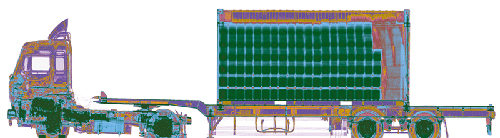
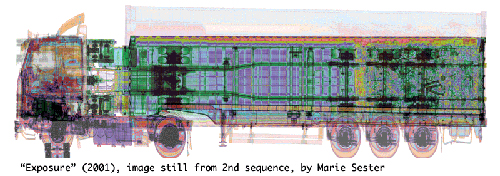
The work consists of images of x-rayed vehicles juxtaposed with architecture. Sester’s investment in exploring the aesthetics of x-ray surveillance became an obsession that initially led her to embark on the pursuit of detailed images of airport luggage, which she considered extensions of the human body. Her research eventually resulted in the x-ray images of trucks taken at Orly Airport in Paris, juxtaposed with a house located in the East Bay Hills of Northern California, now part of “Exposure.”
The installation was first exhibited as part of the exhibition “Blind Vision: Video and Limits of Perception” at the San Jose Museum of Art from August 4 through November 14, 2001. Coincidentally, the tragic events of 9/11 took place while the exhibition was on view, and the meaning of “Exposure” changed at that moment, when the concept of surveillance became directly linked to terrorist preemption. Surveillance in the past did not have such specific overtones.
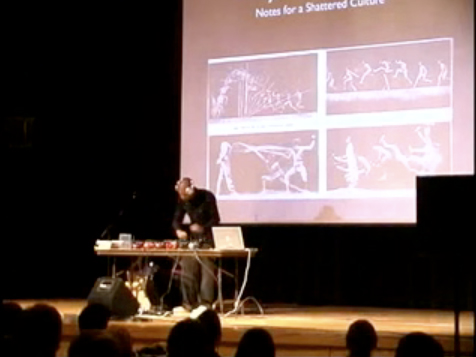
Looking for material on Remix Culture, I recently ran into this two hour lecture by DJ Spooky at University of North Carolina at Chapel Hill. Spooky beat juggles history to argue his position on sampling. From the Phonograph to the Jamaican Sound System, one gets a good sense of the potential creativity that Spooky and other promoters of Remix Culture believe in. Some of the questions at the end are quite interesting, and challenging. Definitely worth the 100 minutes of your time.
The following is a set of links I prepared for one of my classes on film and video language. I repost them here for later use, and to share with the online community. The list is not by any means exhaustive, and is not linear in any way. The top links are mashups and the bottom links are early hip hop and rock videos. They were chosen in part because of the different approaches to video making, this was necessary for the class, because the students need to understand how music video language evolved throughout the eighties and nineties on to today.
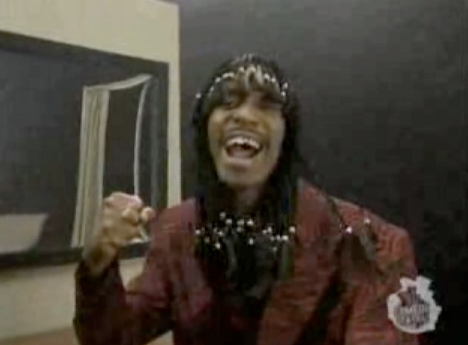
Some of the videos also show early traces of sampling, for example, Trans Europe Express was sampled by Afrika Bambaataa for Planet Rock. Also, the remix of Tour de France juxtaposed with the early version shows how electronic music has evolved while acknowledging the important paradigms set by early electrofunk compositions. The now well known mashups of Christina Aguilera and the Strokes, Madonna and the Sex Pistols, as well as Michael Jackson, Britney Spears the White Stripes and Rick James are some of the most successful remixes in this genre. Part of me admittedly rejects them for their popularity, but the creativity that has gone into the audio remix as well as the video editing have to be noted, because they have at this point set a standard in Remix Culture.
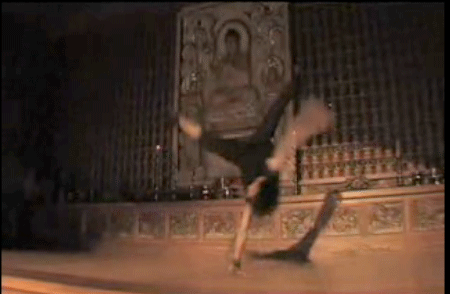
I just saw Planet B-Boy, directed by Benson Lee at Ken Cinema, in San Diego. I was hoping to get more of a historical overview about B-Boying, similarly to how Scratch, by Doug Pray, took a historical survey of turntablism but this was not the case. The film does provide a brief history of B-Boying in the United States, then quickly shows how it became a global movement. The cooption of Breakdancing by the media is briefly mentioned, to then move to 1991, when an annual B-Boy competition was started in Germany which today is globally recognized. The actual investment of the film, however, is not in B-Boying globally, but B-Boying in South Korea. They’re the best, as far as I can tell–something I knew before I saw the film–and this film was made to prove just that.
Anyone who views Planet B-Boy on the big screen will not be disappointed. All the crews, even those from Latvia, and Greece, make brief but impressive appearances. But in the end, I was left with the desire for a film that is truly sensitive to the global power of Breakdancing. What Planet B-Boy does show is that hip hop is no longer U.S. centric; today, it is owned by the world, just like soccer. A concise historical film about Breakdancing as a global movement is yet to be made. Planet B-Boy does not come close to that, but it will have to do for now.