Note: Press release about an upcoming exhibition in which I participate taking place in London at IMT Gallery during May through June of 2010.
———-
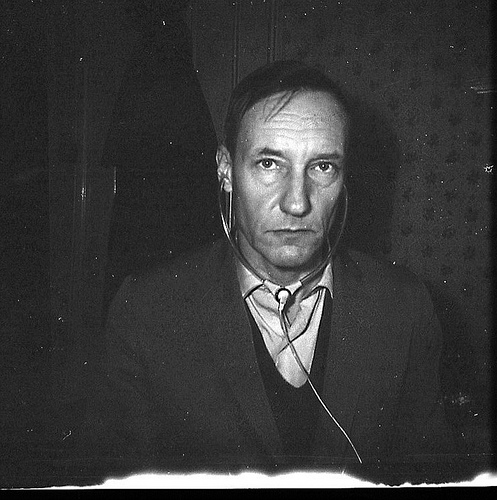
Dead Fingers Talk is an ambitious forthcoming exhibition presenting two unreleased tape experiments by William Burroughs from the mid 1960s alongside responses by 23 artists, musicians, writers, composers and curators.
Few writers have exerted as great an influence over such a diverse range of art forms as William Burroughs. Burroughs, author of Naked Lunch, The Soft Machine and Junky, continues to be regularly referenced in music, visual art, sound art, film, web-based practice and literature. One typically overlooked, yet critically important, manifestation of his radical ideas about manipulation, technology and society is found in his extensive experiments with tape recorders in the 1960s and ’70s. Dead Fingers Talk: The Tape Experiments of William S. Burroughs is the first exhibition to truly demonstrate the diversity of resonance in the arts of Burroughs’ theories of sound.
listen to your present time tapes and you will begin to see who you are and what you are doing here mix yesterday in with today and hear tomorrow your future rising out of old recordings
everybody splice himself in with everybody else
The exhibition includes work by Joe Ambrose, Steve Aylett, Alex Baker & Kit Poulson, Lawrence English, The Human Separation, Riccardo Iacono, Anthony Joseph, Cathy Lane, Eduardo Navas, Negativland, o.blaat, Aki Onda, Jörg Piringer, Plastique Fantastique, Simon Ruben White, Giorgio Sadotti, Scanner, Terre Thaemlitz, Thomson & Craighead, Laureana Toledo and Ultra-red, with performances by Ascsoms and Solina Hi-Fi.
Inspired by the expelled Surrealist painter Brion Gysin, and yet never meant as art but as a pseudo-scientific investigation of sounds and our relationship to technology and material, the experiments provide early examples of interactions which are essential listening for artists working in the digital age.
In the case of the work in the exhibition the contributors were asked to provide a “recording” in response to Burroughs’ tape experiments. The works, which vary significantly in media and focus, demonstrate the diversity of attitudes to such a groundbreaking period of investigation.
Dead Fingers Talk: The Tape Experiments of William S. Burroughs is curated by Mark Jackson. The project is supported by the London College of Communication, CRiSAP and ADi Audiovisual and has been made possible by the kind assistance of the William Burroughs Trust, Riflemaker and the British Library.
Note: I don’t normally post competition opportunities, but the following call is worth noting because it exposes a shift in remix culture: the DJ and VJ hybrid. Besides, I admit to being a Plastikman fan.
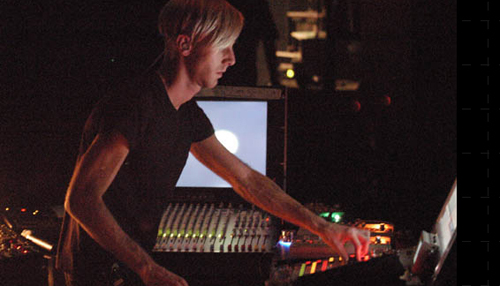
Derivative is pleased to announce the next-gen of their collaboration with techno-futurist Richie Hawtin who is unleashing PLASTIKMAN LIVE 2010 a much-anticipated series of live shows produced in collaboration with Minus & Derivative to launch at this year’s Timewarp festival on March 27th, 2010.
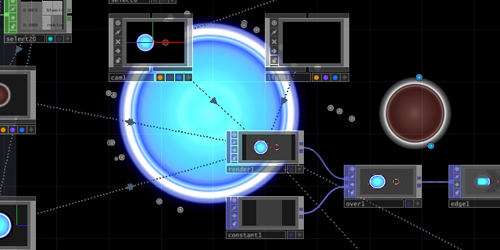
The influential Plastikman performance at MUTEK 2004 was visually driven by Derivative’s powerful software tool TouchDesigner enabling Richie to orchestrate sound and visual compositions generatively and in real time; the technology altering the course of how electronic music could be performed and experienced live.
That was then. With the current generation of TouchDesigner 077 completely reengineered, the team has built an information-rich bridge between Richie’s Ableton Live rig and Derivative’s TouchDesigner. Derivative will release the TouchDesigner-Live Bridge to its users this year. Hawtin’s visual artist Ali Demirel has been working closely with Derivative’s Jarrett Smith and Markus Heckmann in LA and Toronto to create the content and a custom performing interface for the shows.
Another Hawtin/Minus/Derivative collaboration invites the community to create their own visuals to original Plastikman tracks using TouchDesigner. Hawtin and Derivative have packaged and made available for download a complete toolset that includes a purpose-built TouchDesigner synth and 4 Plastikman tracks enabling participants with full support to produce buy cheap valtrex online visuals in the same real-time generative environment as the show’s. Winning entries are to be incorporated into the live events.
Dedicated to advancing the way we make art and visualize information and ideas, Derivative has produced live visuals and interactive art projects for an exemplary roster of international superstars that include Prada, Herzog & de Meuron and Rush. They have also developed major theme park attractions globally. In a unique alliance with raster-noton now entering its second year Derivative designed and built an expandable framework for multi-screen live performances under the guidance of label founders carsten nicolai (alva noto) and olaf bender (byetone). The collaboration resulted in a series of shows last year at Club Transmediale, Sonar, MUTEK, OFFF, and Ars Electronica that were received as precedent-setting.
TouchDesigner is the most complete authoring tool for building interactive 3D art, visualizations, prototypes and user interfaces. Its open, broad and highly-visual procedural architecture boosts and expands discovery, creativity and productivity.
TouchDesigner FTE (Free Thinking Environment) and its counterpart TouchDesigner Pro puts a free development environment with an extremely rich feature set into the hands of artists, animators, educators and “everyone else”. “TouchDesigner is our vision of what is possible in tomorrow’s software tools for building interactive applications and exploring data, imagery and sound”, Derivative founder and CEO Greg Hermanovic states. “It exploits what is possible in today’s computing technology and is positioned to grow with the foreseeable advancements in computer, graphics and mobile technologies.”
Still from video documentation, available at Dropbox
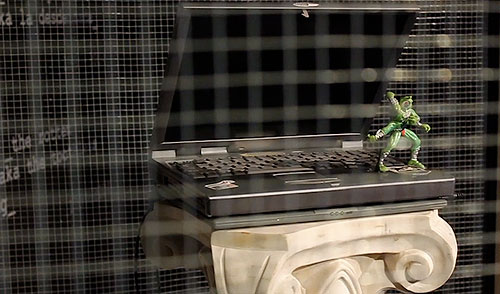
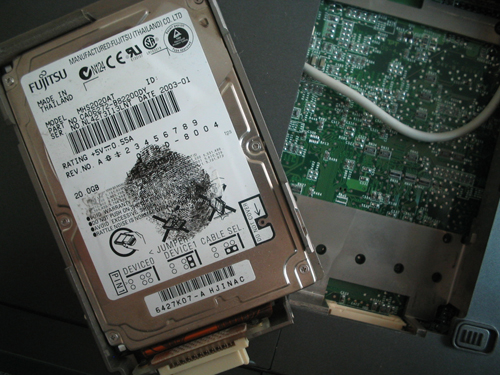
The Rotten Machine (La Maquina Podrida) is currently on display at the MEIAC, in Badajoz, Spain. On the 8th of May 2004, Brian Mackern, born and living in Montevideo, Uruguay, put for sale his personal laptop computer, in which he developed his early net art projects. He also used the machine to document early online activity–particularly from around the Americas.
When considering the history of new media, the sale was made at a moment when web 2.0 was about to change: the blog, for instance, which was one of the pivotal tools of the next stage of web development, became quite popular at this time. Simultaneously, the machine’s sale is an overt commentary on the preciousness of the work of art, which was the subject of several attempts of dematerialization during the heyday of conceptualism. The fetishization of the object of art was an issue to consider for many early online art practitioners, since in online practice there appeared to be no “object of art” to deal with directly. The Rotten Machine turns this convention on its head, and shows that “anything” can be commodified.
These are some of my brief observations on a work that deserves more analysis, and that I hope now that it enjoys its first exhibit, will be acknowledged around the world as an important contribution to the history of art.
Below is part of the official press release written by curator, Nilo Casares:
——
exhibition:::::::::::::::::::the rotten machine aka the toothless old thing
:::::::::::::::::::::::::::::1999-2004
:::::::::::::::::::::::::::::all net.art in a brian mackern’s laptop
works of:::::::::::::::::::::brian mackern
curator::::::::::::::::::::::nilo casares
technical coordination:::::::àngela montesinos
production:::::::::::::::::::
and organization:::::::::::::meiac
texts of catalogue:::::::::::rodrigo alonso
:::::::::::::::::::::::::::::andrés burbano
:::::::::::::::::::::::::::::nilo casares
:::::::::::::::::::::::::::::gabriel galli
:::::::::::::::::::::::::::::brian mackern
:::::::::::::::::::::::::::::àngela montesinos
the rotten machine is a surprising exhibition that emanates from an old laptop from 1999, owned by the uruguayan netartist brian mackern, to recreate the time when net.art had its peak brightness, and perhaps therefore, the rattle before the emergence of web 2.0 (known as social network).
his computer, the rotten machine, it’s full and complete of all the data collected until the moment it was decided to be sold, on the 8th of may, 2004. it was the working tool (the studio, in classical terms) that accompanied brian mackern between 1999 and 2004, both in his personal work and in collaborative works for other artists and net jamms, apart from his work as a vj, conferences and workshops. in short, his tool.
a computer full of information and history, acquired by the meiac in order to expose it to posterity, when the development of hardware and software will prevent us from viewing many of the art pieces hosted on this computer.
the exhibition is divided into 5 audiovisual stations navigated by brian mackern himself.
1 – anthropological station: content and hardware components of the machine. sounds generated by its operation. references to files, etc.
2 – studio station: personal work (source files and visible works). the source code of his own work and at the same time the navigation of it.
3 – internet and networking station: content related to many of the projects and online/offline collaborative groups in which brian mackern has intervened.
4 – file, documentation and analysis station: random collection of information about net.art and internet culture of that time.
5 – history station. history of net.art: remix of endless net.art sites, in different states of preservation, many of them with retrofitted code to allow navigation within the machine without internet connection.
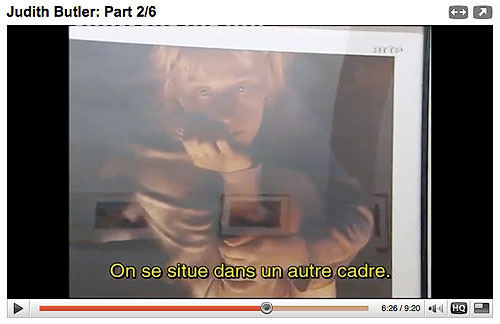
An interesting discussion on the work of Cindy Sherman takes place between Judith Butler and a gallery host. Butler discusses the representation and questioning of vulnerability of women in Sherman’s work, and also shares the formal pleasures she finds in the works of art. The subtitles are in French, and the discussion is in German; most of the documentary is in English with French subtitles. The segment on Sherman begins around 3:10 and carries over to later segments. I find this documentary excerpt worth noting because it offers a rare moment when a philosopher discusses works of art casually, yet with careful analysis.
I find some of Butler’s premises on performativity to run parallel with the development of Remix, and to be potentially useful to evaluate current concepts on cultural mixing. I say this without claiming that her work could be directly linked to Remix as discourse, but rather that a paradigmatic reflection on her ideas can be helpful in understanding the cultural variables in which remix culture plays out. Not sure how long the documentary may stay on YouTube, but here are the links for future convenient access:
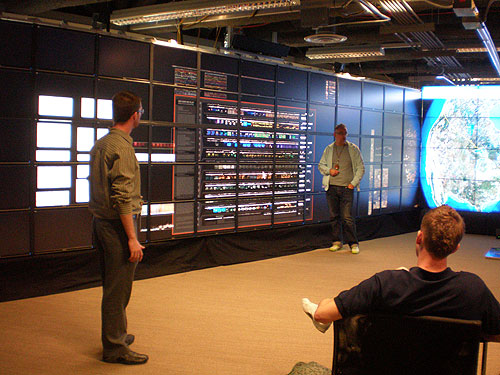
Jeremy Douglass (left) and Lev Manovich (far right) demonstrate how to analyze data on the Hyper Wall at Calit2.
The Cultural Analytics seminar took place at Calit2 on December 16 and 17 of 2009. The event brought together researchers and students from Bergen University and University of California San Diego. The two day event consisted of research presentations and demos of software tools.
Part One of Hyper Wall Demonstration during Cultural Analytics Seminar at Calit2, San Diego, December 16-17, 2009. Introduction to principles of Cultural Analytics.
I will not spend much time in this entry defining Cultural Analytics. This subject has been well covered by excellent blogs such as Open Reflections. For this reason, at the end of this entry I include a number of links to resources that focus on Cultural Analytics. Instead, I will briefly share what I believe Cultural Analytics offers to researchers in the humanities.
Part Two of Hyper Wall Demonstration during Cultural Analytics Seminar at Calit2, San Diego, December 16-17, 2009. Analysis of Vertov’s motion in scenes from Man with a Movie Camera.
This emerging field can be defined as a hybrid practice that utilizes tools of quantitative analysis often found in the hard sciences for the enhancing of qualitative analysis in the humanities. The official definition of the term follows:
Cultural analytics refers to a range of quantitive and analytical methodologies drawn from the natural and social sciences for the study of aesthetics, cultural artifacts and cultural change. The methods include data visualization techniques, the statistical analysis of large data sets, the use of image processing software to extract data from still and moving video, and so forth. Despite its use of empirical methodologies, the goals of cultural analytics generally align with those of the humanities.
One thing that separates the humanities from the hard sciences is the emphasis of qualitative over quantitative analysis. In very general terms qualitative analysis is often used to evaluate the how and why of particular case studies, while quantitative analysis focuses on patterns and trends, that may not always be concerned with social or political implications.
Part Three of Hyper Wall Demonstration during Cultural Analytics Seminar at Calit2, San Diego, December 16-17, 2009. Jeremy Douglass analyzes comic books.
What Cultural Analytics is doing, in my view, is bringing together qualitative and quantitative analysis for the interests of the humanities. In a way Cultural Analytics could be seen as a bridge between specialized fields that in the past have not always communicated well.
Consequently, when new ground is being explored, questions of purpose are bound to emerge, which is exactly what happened during seminar conversations. As the videos that accompany this brief entry will demonstrate, the real challenge is for researchers in the humanities to engage not only with Cultural Analytics tools and envision how such tools can enhance their practice, but to actually embrace new philosophical approaches that blur the lines between the hard sciences and the humanities.
Part Four of Hyper Wall Demonstration during Cultural Analytics Seminar at Calit2, San Diego, December 16-17, 2009. Cicero Da Silva explains his collaborative project, Macro.
To be specific on the possibilities that Cultural Analytics offers to the humanities, I will cite two demonstrations by Lev Manovich and Jeremy Douglass.
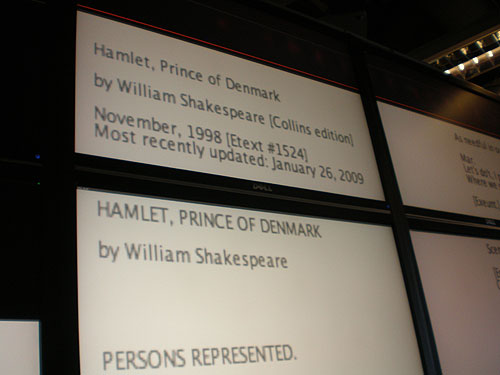
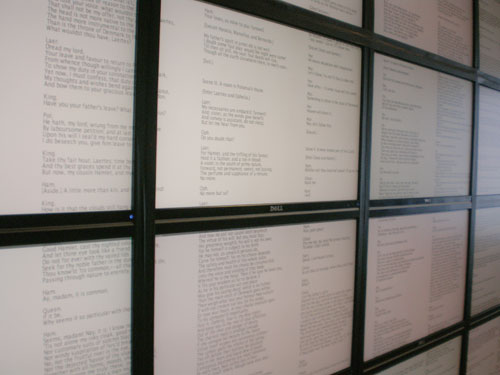
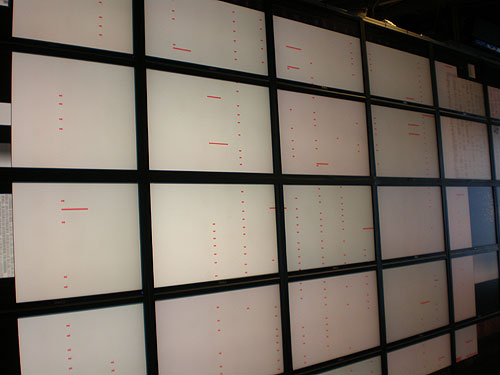
Lev Manovich at one point presented Hamlet by William Shakespeare in its entirety on Calit2’s Hyper Wall, which consists of several screens that enable users to navigate data at a very high resolution.
When seeing the entire text at once, one is likely to realize that this methodology is more like mapping. To this effect, soon after, we were shown a version of the text in which Manovich had isolated the repetition of certain words throughout the literary work.
This approach could be used by a literature scholar to study certain linguistic strategies, such as sentence structure, by an author. Let’s take this a step further and say that it has been agreed that a contemporary author is influenced by a canonical writer. How this supposed influence takes effect can be evaluated by studying certain patterns of sentences from both authors by isolating parts of literary texts for direct comparison. One could then evaluate if the supposed influence is formal, conceptual or both: perhaps the contemporary author might make ideological references that are clearly linked to the canonical author, but which are not necessarily influenced at a formal level; or it could be the other way around, or both. In this case, quantitative and qualitative analysis are combined to evaluate a case study. In other words, pattern comparison is used to understand the similarities and differences between two or more works of literature.
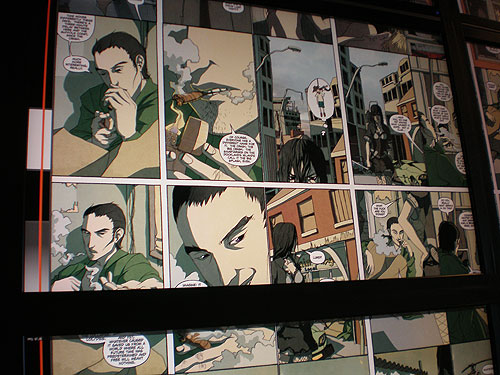
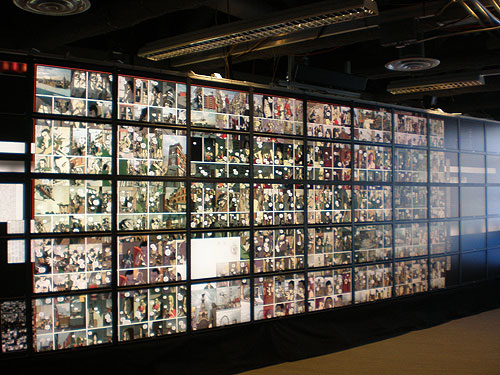
To this effect, Jeremy Douglass’s presentation of a comic book is important. He explained how by seeing an entire publication of a comic book story one can study how certain patterns in the narrative come to define the aesthetics for the reader.
While the reader may be able to experience the story in time, by actually reading it, the visualization of the comic book in grid-like fashion–as a structural map–allows the researcher to apply analysis of patterns and trends that may be more common in flows of networks to an actual narrative. Again, in this case we find quantitative and qualitative analysis complementing each other.
As noted at the end of the article “Culture is Data” (also provided below) from Open Reflections, it appears that Manovich is at times understood to argue that one should privilege quantitative over qualitative analysis. This proposition implies an either or mentality by certain researchers that needs to be reevaluated. Janneke Adema explains his answer better than I ever could:
But, on the other hand, won’t we loose a sense of meaning if we analyze culture like a thing? Manovich argues that this is of course a complementary method, we should not throw away our other ways of establishing meaning. It is a way of expanding them. And it is also an important expansion, for how is one going to ask about the meaning of large datasets? We need to combine the traditionally [sic]humanities approach of interpretation with digital techniques to find out more. And again, meaning is not the only thing to look at. It is also about creating an experience. Patterns are the new real of our society.
The most important thing to understand when evaluating the videos available with this entry is that one need not have a hyper wall to do research with Cultural Analytics methodologies; many of the tools can run on a personal computer. It’s more about adopting an attitude and willingness to do research by way of combining quantitative and qualitative analysis. At the moment I am evaluating the implementation of Cultural Analytics in my research on Remix.
Revising my evaluation of mashups led me to this journalistic piece from June 13, 2006 by Scott Conroy from 60 minutes. It is mentioned here mainly for historical purposes, as some things discussed have obviously changed since the feature was produced.
——
Teens don’t have to work very hard to be entertained anymore. Rather than trekking to the record store, they can buy their favorite music with a few clicks — and maybe try out something new while they’re at it. Reality TV, the preferred genre of many, is always on the air. They don’t even have to get up from their chairs to share photographs and gossip with friends.
American society has been assigning all-encompassing labels to generations of young people for a long time. The tendency to pigeonhole a diverse group of individuals is, in some respects, dishonest — not every Flower Child spent the ’60s tiptoeing through tulips, and many members of Generation X surely thought flannel best confined to the realm of the lumberjack.
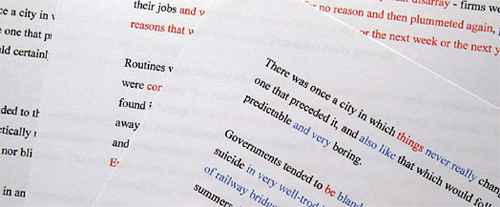
Tim Etchells (born 1962, lives and works in Great Britain) City Changes (2008) inkjet prints
As part of my residency at the Swedish Traveling Exhibitions, I visited a number of museums in the City of Gothenburg. I was not alone in this trip. I travelled with Melissa Mboweni, a contemporary art curator from South Africa, who was also a Correspondent in Residence.
This entry includes brief notes on some of the places we visited while in Gothenburg. This is also the last entry of my travels in Sweden. Other details of my research will appear in longer texts to be published at a later date in the Swedish Traveling Exhibitions’ Spana magazine.
On the afternoon of November 9, our first stop was Gothenburg’s Art Museum (Göteborgs Konstmuseum), where we were greeted by Curator Johan Sjöström. We spent sometime with an exhibition he curated on Ivar Arosenius, a prolific nineteenth century artist. The exhibit features 250 works, which, as Sjöström explained, was a selection from a larger body of work. Arosenius was a Swedish artist who grew up in Älvängen, a small town north of Gothenburg. He died in January 2, 1909 at the age of thirty due to complications of Haemophilia. I was overwhelmed by the amount of pieces on display–as I realized that an entire day would not allow for anyone to view properly all of the works. Sjöström explained that Arosenius would at times produce several pieces in one night.
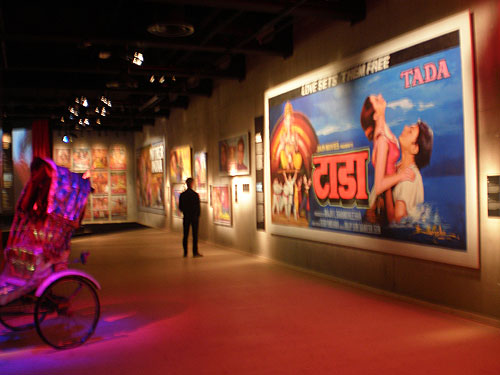
“Bollywood,” an exhibit on the film industry in India, at display at the Museum of World Culture until May of 2010.
The next day, November 10, we visited Världskulturmuseet (The Museum of World Culture). Our host was Cajsa Lagerkvist, Head of Exhibitions and Research. We spent the morning with a few of her colleagues discussing the museum’s mission. I realized that the institution was unlike any other I had visited up to this point, as it focuses on what Cajsa and her colleagues referred to as contemporary global issues. This premise is rather open ended, and gives the museum, in my view, quite a bit of freedom to develop exhibitions that are sensitive to the ever changing facets of globalization.
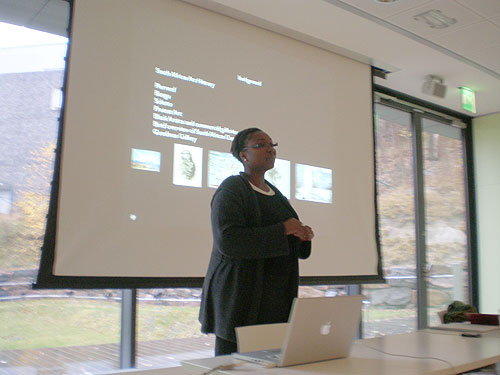
South African Curator, Melissa Mboweni, during her lecture at the Museum of World Culture
At the time of my visit they featured an exhibit on Vodou, and another on Bollywood. I was told by our hosts that last year the museum enjoyed 240,000 visits, and that many people who attend are younger than thirty. It became understandable why the Museum of World Culture emphasizes education as part of their mission. During that afternoon, Melissa Mboweni and I presented our research to curators of various museums in the city.
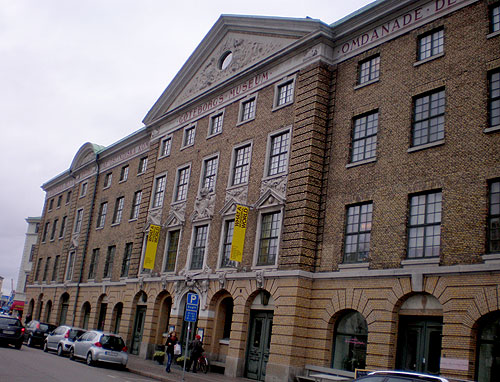
Facade of the City Museum of Gothenburg
On the morning of November 11, we visited the Stadsmuseet (City Museum of Gothenburg). Curator Christian Penalva and Project Manager Charlotta Dohlvik, along with three of their colleagues took us around the numerous galleries. The City Museum is in essence a hybrid of collections that fit well under the term cultural history. It holds a number of important archeological pieces from the Viking era as well as artifacts from the early days of trade in the eighteenth and nineteenth century; it also hosts an impressive collection of Swedish theatre and dance costumes.
The City Museum also supports contemporary activities. At the time of our visit, it featured selections of the Gothenburg Art Biennale, titled What a Wonderful World, curated by Celia prado and Johan Pousette. We had a very animated discussion as Penalva explained the museum’s interest in implementing innovative approaches to exhibiting. The museum is considering how the concept of interactivity as defined in new media practice can be beneficial to the development of future as well as already existing exhibitions.
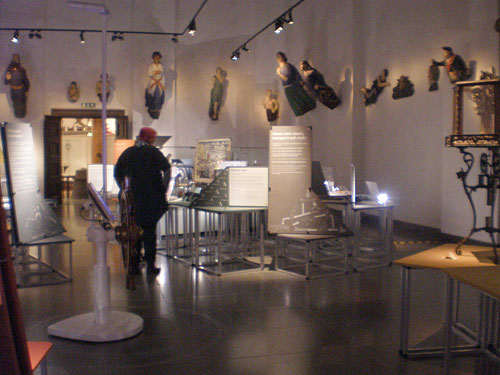
Main exhibition gallery at the Maritime Museum
During the afternoon we visited Sjöfartsmuseet (The Maritime Museum), where we were greeted by Curators Britta Söderqvist, Linda Noreen and their colleagues. They took us around the different exhibitions while explaining the special role of the museum in Gothenburg, which is important given that the Little London ( a popular reference) is a port city. Like the other museums, the Maritime Museum places an emphasis on youth education. Noreen, specifically, heads a project titled “Shoreline,” in which young citizens are encouraged to reflect through art, writing, and other creative forms of communication on what it means to live in a port city. Much of this activity is extended online.
A Virtual Aquarium display at the Maritime Museum. Direct camera feed from the ocean.
In general, the curators appear invested in exploring new forms of display. At the time, a historical exhibition of the port was on view. The idea was to present information and material in similar fashion as would be found in a working space. One display that caught my attention was a “virtual aquarium,” placed on one of the working tables (see video above). The aquarium actually is a camera feed from the sea presented on a large screen, also available online. Instead of viewing fish in a large container, the visitor can observe them in their natural environment and therefore get a sense of actual marine life.
Another place that we visited on the early evening of November 10 is Gothenburgs Konsthall, which is one of the venues hosting the Gothenburg Biennal. Curator Stina Edblom showed us around. There were quite a few good pieces in the exhibition, but I will only name one in this case, to be brief. I was particularly taken aback by Tim Echels’s “City Changes” (2008), [see image at the top of this entry]. The work consists of colored inkjet prints of a simple story about a small town. As the story is edited, the changes are recorded in different colors. Each draft is displayed in linear fashion from left to right across two gallery walls. Anyone who has a consistent relationship with writing will find Echels’s obvious–yet unexpected–focus on the act of editing quite refreshing.
Admittedly, since I struggle with ongoing edits of my own, I could not help but notice how meaning changed from one draft to the next; but I also wondered about edits that were between the drafts. Upon closer reflection, one could contemplate the possibility that the changes from one version to the next were deliberate to emphasize the flux in meaning as process, rather than trying to get a specific point across. The edits (additions and deletions) became metaphors for the physical changes in a town. Things were constructed and demolished according to the moment described within each draft. “City Changes” exposes our anxiety in trying to pin down meaning, in making it stable and fixed, when in reality ideas and their forms of manifestation are always prone for constant change.
Given my own tendency and focus on Remix as discourse, I could not help but wonder on how Echels was in some way exposing principles of selectivity: one of the basic elements necessary to develop a critical voice in a time when appropriation and recycling have become the most efficient forms of production at all levels of culture, especially the fine arts.
Our visit to Gothenburg was swift but fully packed. The purpose was to expose both Melissa Mboweni and myself to different curating approaches. Given that my own practice is in the arts, I have to admit that I learned quite a bit about aesthetics in museum display. Art exhibitions tend to be minimal in their approach, always showing only what is essential in order to do justice to the work of art. But I found the museums I visited in Gothenburg to be much more creative in their displays. This can definitely be a good thing, if the venue has a critical mission in the enrichment of culture.
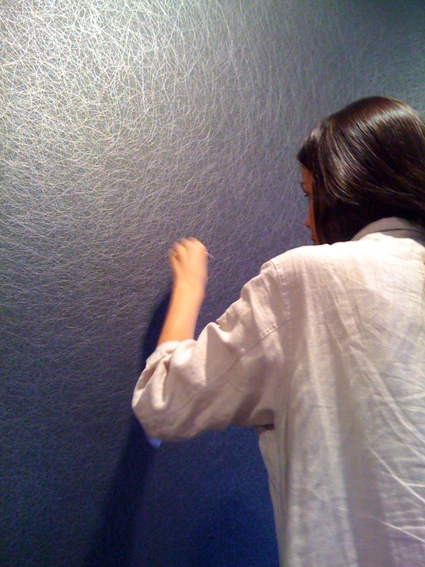
”Wall Drawing #715”, February 1993
On a black wall, pencil scribbles to maximum density. Pencil.
Courtesy Estate of Sol LeWitt
First installation: Addison Gallery of American Art, Phillips Academy, Andover, MA
First drawn by: S. Abugov, S. Cathcart, A. Dittmer, F. Dittmer, L. Fan, C. Hejtmanek, S. Hellmuth, D.
Johnson, A. Moger, A. Myers, J. Noble, G. Reynolds, A. Ross, A. Sansotta, J. Wrobel. (Varnished by
John Hogan)
Image courtesy of Magasin 3
On November 5, as Correspondent in Residence for the Swedish Traveling Exhibitions, I visited Magasin 3, located in Frihamnen (freeport), Stockholm. Curator Tessa Praun took the time to discuss with me the history of the Konsthall (art space) which opened in 1987, and has since then developed an extensive collection of contemporary art.
In the tradition of appropriation, Magasin 3 takes its name after the building’s original function as a sea port storage facility. The space is hard to find, and one must make a definite commitment to visit it. I was no exception. I first took the subway then a bus to the end of the line, then walked and (as is probably common for first time visitors) got a bit lost, but finally found the space.
The Konsthall has a low-key facade, and retains the look of an industrial space. Its name is no different than the other storage facilities in the area (there are magasin 1, 2, 4, 5, and more); because of this, it is unlikely that a casual passerby will enter the premises. This exclusivity gives Magasin 3 an elegance defined with minimal aesthetics. Appropriately enough, at the time of my visit, the konsthall featured minimal drawing installations by Sol LeWitt, curated by Elisabeth Millqvist. The Sol LeWitt exhibition opened on October 2nd 2009 and will close June 6, 2010. In what follows, I discuss LeWitt’s work as well as two video installations by british based Israeli artist Smadar Dreyfus, curated by Tessa Praun. (more…)
The following text was originally published during the month of August, 2009 as part of Drain‘s Cold issue. The journal is a refereed online journal published bi-annually. The text is republished in full on Remix Theory with permission. Drain’s copyright agreement allows for 25% of the essay to be reblogged or reposted on other sites with proper citation and linkage to the journal at http://www.drainmag.com/. I ask that their agreement be respected by the online community.
In 1964 Marshal McLuhan published his essay “Media Hot and Cold,” in one of his most influential books, Understanding Media.[1] The essay considers the concepts of hot and cold as metaphors to define how people before and during the sixties related to the ongoing development of media, not only in Canada and the United States but also throughout the world.[2] Since the sixties, the terms hot and cold have become constant points of reference in media studies. However, these principles, as defined by McLuhan, have changed since he first introduced them. What follows is a reflection on such changes during the development of media in 2009.
McLuhan is quick to note that media is defined according to context. His essay begins with a citation of “The Rise of the Waltz” by Curt Sachsk, which he uses to explain the social construction behind hot and cold media. He argues that the Waltz during the eighteenth century was considered hot, and that this fact might be overlooked by people who lived in the century of Jazz (McLuhan’s own time period). Even though McLuhan does not follow up on this observation, his implicit statement is that how hot and cold are perceived in the twentieth century is different from the eighteenth. Because of this implication, his essay is best read historically. This interpretation makes the reader aware of how considering a particular medium as hot or cold is a social act, informed by the politics of culture. McLuhan’s first example demonstrates that, while media may become hot or cold, or be hot at one time and cold at another, according to context, the terms, themselves, are not questioned, but rather taken as monolithic points of reference. To make sense of this point, McLuhan’s concepts must be defined.
A performative confrontation between hardware and software. Nick Collins vs. Nick Collins: hardware vs. Software, Old School vs. New School. One of the hightlights of the concert series organized as part of “Bifurcaciones Sonoras” (Aural Bifurcations) for Transitio MX 03.
I was able to attend most concerts that took place nightly at Fonoteca, during Transitio MX, except for the last night of Thursday the 8th. While there were many highlights, one that I found worth sharing on my blog is the performance of Nick vs. Nic. A playful sound hacking performance by Nick Collins (USA) vs. Nick Collins (England). The younger Collins (English) improvised in code, while the more seasoned Collins proved why he is one of the pioneers in circuit bending. The sound was appropriately distributed and mixed on left and right sides of the stage, allowing the audience to evaluate how software and hardware hacking can be complementary, thus creating a performative mashup: a meeting between the old school and the new school of experimental sound could not be better.