Janneke Adema has taken the time to analyze selected texts available on Remix Theory. She connects my theories of Remix to the future of the book. Adema also discusses the theories of Lev Manovich in terms of Remixability.
In the first part of New Visions for the Book, I described how the concept of the book is being used as a strategic power tool to argue for a certain knowledge system. I tried to show how within this discourse certain essentialist notions—such as authorship, stability, and authority—still hold a lot of prestige and are hard to discard. In the subsequent parts of New Visions for the Book I therefore want to take a few expeditions outside the world of the scholarly book to look at the way other disciplines and other media have struggled with or have come to terms with the above mentioned notions. I want to start with looking at the concept of remix, engaged with mostly in music and art theory but increasingly a concept applied to describe and analyse culture at large. Here I want to focus on two thinkers who have extensively theorized remix: Eduardo Navas and Lev Manovich. After taking an in depth look at Navas work on remix first, I will explore Manovich’s thoughts on the subject in the next post, contrasting it with Navas’s ideas. Finally, I will explore what the consequences of their thoughts and their analysis of remix are for the scholarly book, the knowledge order it stands for and the concepts it reifies.
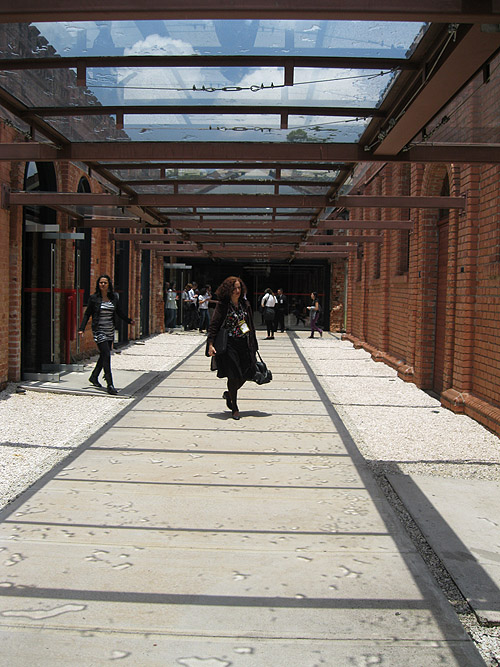
I visited Sao Paulo Brazil on November 17th, to participate in a panel discussion for Brazilian Digital Culture 2010, organized by the Brazilian Ministry of Culture. I was invited to discuss the relationship of transmedia and Remix along with Maurício Mota (Os Alquimistas), and moderator Newton Cannito (Secretary for the Audiovisual/Ministry of Culture). What follows is not so much a summary of the panel discussion, but rather a reflection on my views on transmedia and Remix, after evaluating my participation. But first, I will begin by giving some general impressions of the day I spent in Sao Paulo.
The following are videos from a performance that took place on November 11, 2010 at the Cultural Center of Spain in El Salvador, for the Exhibition, A Modular Framework.
Brian Mackern performs his remix of the film, the Stalker by Tarkovsky
Arcangel Constantini remixes noises and video games live for the audience
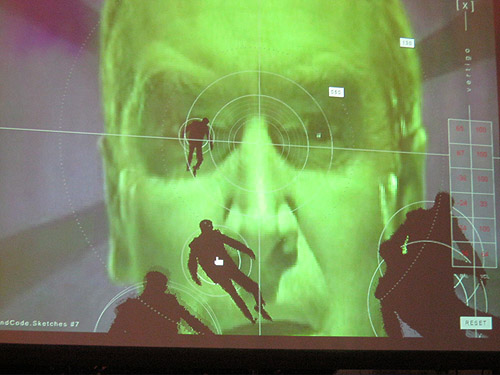
Image: Still from Brian Mackern’s performance of Cinema.tik, in which he remixes film clips from Tarkovsky and Hitchcock among other directors. Performance took place on November 11, 2010 at the Cultural Center of Spain in El Salvador.
Besides the two openings for the exhibition, A Modular Framework, there were two extra days of events. On November 10, there was a panel discussion with the artists. And on November 11 there was a performance by Arcangel Constantini, Brian Mackern and Antonio Mendoza.
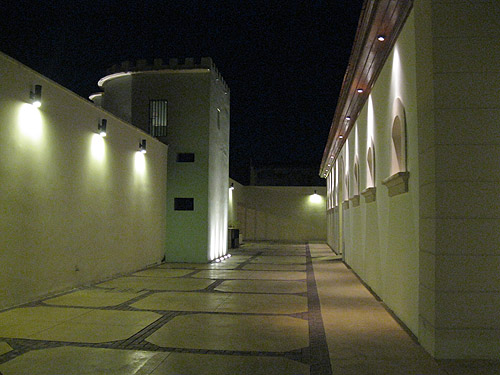
Image: Detail of the Museum of Santa Tecla, where the second opening for the exhibition, A Modular Framework took place on November 12, 2010. The museum is a former prison, where some revolutionaries during the war of the 1980’s were held. The artists who shared this space appear below. The first opening took place on November 9, 2010 at the Cultural Center of Spain in El Salvador.
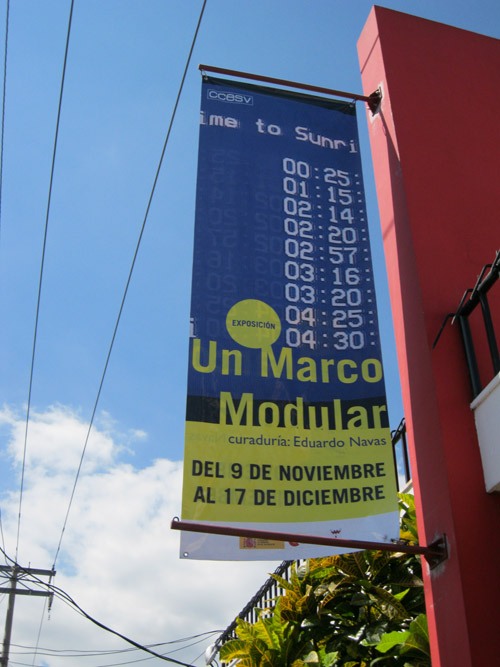
Image: Cultural Center of Spain in El Salvador’s entrance with banner announcing the exhibition, A Modular Framework.
As previously noted on Remix Theory, I curated an exhibition at the Cultural Center of Spain in El Salvador that brings together artists from Latin America, or artists who have ties to Latin America, and have been producing new media work since at least the mid-nineties. The exhibit takes place from November 9, to December 17, 2010.
The exhibit takes place in two venues, the Cultural Center and the Museum of Santa Tecla. In this post I will share brief descriptions and images of the installations that took place in the cultural Center, in subsequent posts I will share images of the exhibit at the Museum, as well as talks and performances that took place throughout the opening week. Images of the opening of November 9, 2010, follow.
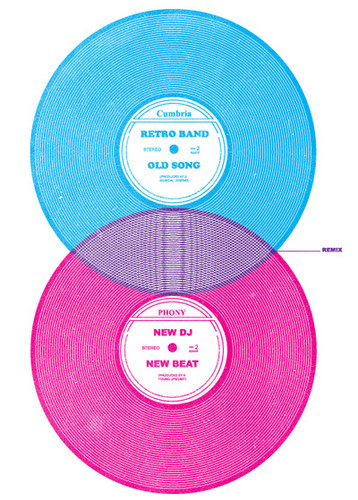
TOKYO (TR) – Fans of analog music were dealt another blow when consumer electronics company Panasonic announced earlier this month that it would be discontinuing the audio products within its Technics brand, most notably the legendary line of analog turntables.
On October 20, the company said that it was winding down production of the Technics SL-1200MK6 analog turntable, the SH-EX1200 analog audio mixer and the RP-DH1200 and RP-DJ1200 stereo headphones due to challenges in the marketplace.
“Panasonic decided to end production mainly due to a decline in demand for these analog products and also the growing difficulty of procuring key analog components necessary to sustain production,” the company said in statement issued to The Tokyo Reporter.
Last year, Japan’s last remaining vinyl pressing plant, owned by the production company Toyo Kasei, produced around 400,000 discs from its multifloor factory in Yokohama’s Tsurumi Ward, a far cry from the industry’s peak of 70 million four decades ago.
Panasonic said that sales of analog decks today represent roughly 5 percent of the figure from ten years ago. At present the company has no plans for putting analog turntables back on the market.
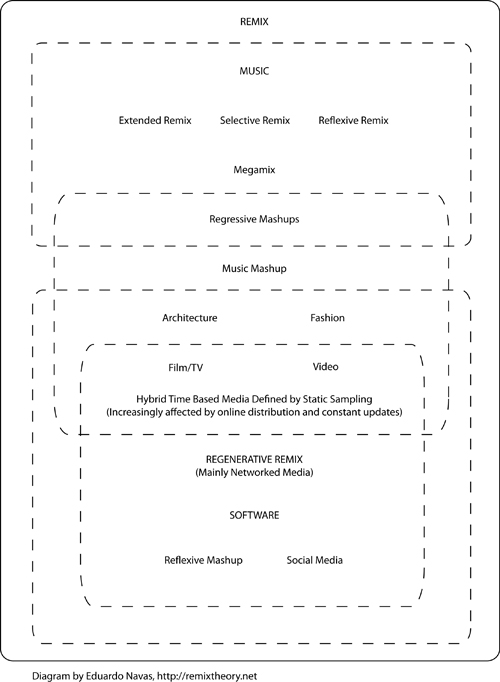
Download a high resolution version of Diagram in PDF format
This text was originally published on June 25, 2007 in Vague Terrain Journal as a contribution to the issue titled Sample Culture. It was revised in November 2009 and subsequently published as a chapter contribution in Sonvilla-Weiss, Stefan (Ed.) Mashup Cultures, 2010, ISBN: 978-3-7091-0095-0, Springer Wien/New York published in May 2010.
It is here republished with permission from the publisher and is requested that it be cited appropriately. This online publication is different from the print version in that it is missing images that help illustrate the theory of Remix that I propose. I do encourage readers to consider looking at the actual publication as it offers an important collection of texts on mashups.
I would like to thank Greg J. Smith for giving me the opportunity to publish my initial ideas in Vague Terrain, and Stefan Sonvilla-Weiss for inviting me to revise them as a contribution to his book publication.
This version brings together much of my previous writing. Individuals who have read texts such as The Bond of Repetition and Representation, as well as Turbulence: Remixes and Bonus Beats will find that many of my definitions and theories of Remix are repeated in this text. I found this necessary to make sense of a fourth term which I introduce: the Regenerative Remix. Those who have read the previous version of this text may like to skip pre-existing parts, and go directly to the section titled “The Regenerative Remix.” However, all sections have been revised for clarity, so I encourage readers to at least browse through previously written material.
An important change has been made to this text. In the original version I argued that Reflexive Mashups were not remixes. In 2007 I did not know what Reflexive Mashups could be if they were not remixes in the traditional sense, but after consideration and rewriting, I developed the concept of the Regenerative Remix. To learn more about this change in my definition of Remix as a form of discourse I invite readers to consider my revised argument. I also introduce a chart (above) which helps explain how Remix moves across culture. I also include an entirely new conclusion which will clarify my earlier position on software mashups.
A note on formatting: The text below is set up in simple text form. This means that italics and other conventions found in print publications are missing. If you would like to read a print ready version, please download a PDF file.
———-
Introduction
During the first decade of the twenty-first century, sampling is practiced in new media culture when any software users including creative industry professionals as well as average consumers apply cut/copy & paste in diverse software applications; for professionals this could mean 3-D modeling software like Maya (used to develop animations in films like Spiderman or Lord of the Rings); [1] and for average persons it could mean Microsoft Word, often used to write texts like this one. Cut/copy & paste which is, in essence, a common form of sampling, is a vital new media feature in the development of Remix. In Web 2.0 applications cut/copy & paste is a necessary element to develop mashups; yet the cultural model of mashups is not limited to software, but spans across media.
Mashups actually have roots in sampling principles that became apparent and popular in music around the seventies with the growing popularity of music remixes in disco and hip hop culture, and even though mashups are founded on principles initially explored in music they are not straight forward remixes if we think of remixes as allegories. This is important to entertain because, at first, Remix appears to extend repetition of content and form in media in terms of mass escapism; the argument in this paper, however, is that when mashups move beyond basic remix principles, a constructive rupture develops that shows possibilities for new forms of cultural production that question standard commercial practice.
My most recent text “Remix: The Ethics of Modular Complexity in Sustainability” is published in the CSPA Quarterly. The journal is the print publication for The Center for Sustainable Practice in the Arts, a non-profit that supports artists and organizations; it enables them to be ecologically and economically sustainable while maintaining artistic excellence. My text is not yet available online but I hope to have it released in a few months. I do share an excerpt at the end of this message. In the mean time, I encourage you to purchase a copy of the CSPA Quarterly, which focuses on works made with found materials.
Here is the issue release statement:
In this issue, we’re working against the stereotypes of the form, and attempting to broaden its term. As always, we’re exploring our chosen theme across disciplines and were delighted to include sculpture, visual art, theater, public art, and media art in the following pages. Instead of asking for work based on waste materials, we asked for work built from objects that already exist.
Excerpt from my text, “Remix: The Ethics of Modular Complexity in Sustainability”, page 13:
Remix and Sustainability
Within immaterial production (music and other arts dependent on forms of communication) recycling of existing material becomes an aesthetic with real repercussions. As stated in the introduction, Remix expands across culture from music to ecology: from immaterial pleasure to material responsibility. It is a binder that informs the awareness of the interrelation of one’s beliefs and actions in culture.
Once an idea or content becomes calculable, measurable as an actual thing produced, intellectual property becomes a pivotal issue: who owns the material and how should such material be re-used if it is to be recycled? Thus the result is that we live in a time where information is privileged and immaterial pleasure has become the prime commodity, as the global economy has assimilated a fourth layer of global production, which agriculture, industrial production, and the service industry support. Information plays a prime role in defining the other layers of production. As the emerging market it dictates how the others are represented. This shift places a certain stress on the sustainability of intellectual production, since ideas, its prime real estate, become more precious than ever before. Immaterial production is at the forefront of a global market that thrives on the low-cost of information production and outsourcing of repetitive labor in computing and networked services such as telemarketing, and social media to different areas around the world.