Note: The following is an announcement of Vague Terrain’s latest issue, in which I’m very happy to be a contributor. Make sure to also peruse their previous releases on Minimalism, Locative Media and Generative Art among others.
Announcement:
The latest edition of the Toronto based digital arts quarterly vagueterrain.net is now live. The issue, vague terrain 07: sample culture is a provocative exploration of contemporary sampling of sound, image and information. This body of work examines the remix as a critical practice while addressing broader issues of ownership and intellectual property.
Vague terrain 07: sample culture contains work from: brad collard, christian marc schmidt, defasten, des cailloux et du carbone, [dNASAb], eduardo navas, eskaei, freida abtan, jakob thiesen, jennifer a. machiorlatti, jeremy rotsztain, noah pred, ortiz, rebekah farrugia, and an interview with ezekiel honig conducted by evan saskin.
Revisado, Enero 2007. Publicado originalmente en Netartreview, Marzo 2005.
Este texto fue publicado en Abril del 2007 en la publicación Installando/Installing, editada por el Colectivo Chileno Troyano.
Abstracto:
Este texto considera la posición crÃtica del “colaborador†de acuerdo a Walter Benjamin durante la primera parte del siglo veinte en relación al bloger al princÃpio del siglo veinte-uno. El texto considera el concepto del anarco-comunismo y el papel que juega el intercambio de regalos en comunidades virtuales de acuerdo a Richard Barbrook, para mejor entender la posición de los blogers en la cultura de la red. (more…)
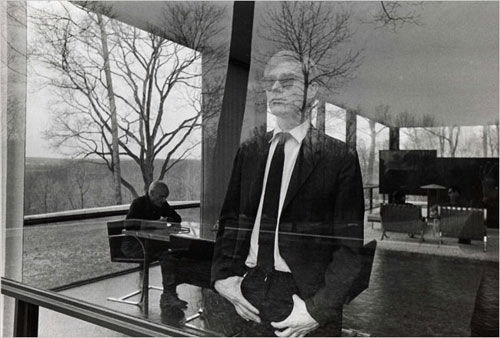
WHEN Philip Johnson’s Glass House in New Canaan, Conn., officially opens to the public on June 21, paying visitors will have a chance to explore one of the world’s most celebrated works of Modernism for the first time since its completion in 1949. The diminutive glass-and-steel building and its uncluttered interior, which have barely changed in 58 years, are so spare that it is hard to imagine that anyone ever lived there. But for nearly all that time, it was the constantly used country retreat of its round-spectacled creator, who shared it after 1960 with David Whitney.
For Mr. Johnson, pictured in 1964, and his companion, David Whitney, the Glass House was a comfortable retreat from the world.
Written for an exhibition with the same title curated by Eduardo Navas at Telic Arts Exchange, Chinatown, Los Angeles, CA. May 25 – June 16, 2007
Text released: May 25, 2007
What separates new media from previous media is, in part, waiting periods that define public and private experience; whether the download of a file from the Internet is taking longer than expected, an e-mail message has not been sent from one server to another for some unknown reason, or a large file is being rendered in video software like Final Cut Pro for output as a viewable movie, new media is largely dependent on constant moments of waiting, often referenced as latency.
Latency is used with three significations in mind. First, is the technological latency that takes place in new media culture due to the nature of the computer: the machine has to always check in loops what it must do, to then execute commands, eventually leading to the completion of a task. This is the case when someone uses Photoshop, Microsoft Word, or any other commercial application; or streams image and sound across the Internet. This constant checking in loops at hardware and software levels opens the space for latency’s second signification, which extends in social space when the user consciously waits for a response that begins and ends with the computer. Latency becomes naturalized when a person incorporates computer interaction as part of his/her everyday activities.
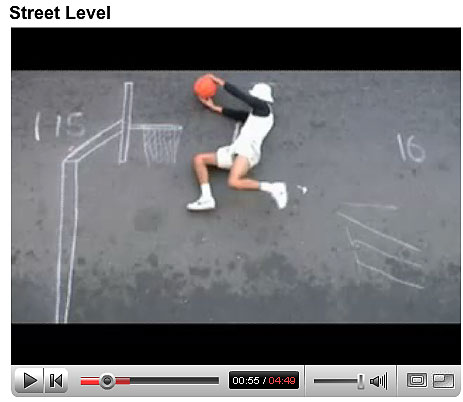
I recently received the following link to a Youtube video about the exhibition “Street Level” taking place at the Nasher Museum of Art: http://www.youtube.com/watch?v=08nwTyfjCrw
As great and as challenging the works in this exhibition may be, they do not fall in emerging Remix practice, but rather belong in appropriation art practice following the conceptual art movement from the nineteen seventies. One thing which should be pointed out is that not everything that makes references to pre-existing material is Remix. Appropriating something does not mean one automatically is remixing. Remix relies on sampling–that is an actual part–an actual section of the “thing” must be part of the “remix,” and the projects in “Street Level” are precise allegorical references to the street, or some other source that is connected to the street. Even after making this clarification I urge you to look at the Youtube video, please do take the time to view it.
Below is the brief statement sent by David Colagiovanni (thank you for the forward!):
It’s the work of 3 artists- Mark Bradford, William Cordova, & Robin Rhode
for who the streets of their respective cities act as fluid, living sources of inspiration. Found objects, urban vernacular and performative gestures help build a foundation for their art, including painting, works on paper, sculpture, photography, video, installation and other mixed media. Their work explores the ways that cultural territory is defined and space is transformed in urban environments.
(This text has been recently added to the section titled Remix Defined to expand my general definition of Remix.)
The following summary is a copy and paste collage (a type of literary remix) of my lectures and preliminary writings since 2005. My definition of Remix was first introduced in one of my most recent texts: Turbulence: Remixes + Bonus Beats, commissioned by Turbulence.org. Many of the ideas I entertain in the text for Turbulence were first discussed in various presentations during the Summer of 2006. (See the list of places here plus an earlier version of my definition of Remix). Below, the section titled “remixes” takes parts from the section by the same name in the Turbulence text, and the section titled “remix defined” consists of excerpts of my definitions which have been revised for an upcoming text soon to be released in English and Spanish by Telefonica in Buenos Aires, Argentina. The full text will be released online once it is officially published.
It is a truism today that we live in a “remix culture.” Today, many of cultural and lifestyle arenas – music, fashion, design, art, web applications, user created media, food – are governed by remixes, fusions, collages, or mash-ups. If post-modernism defined 1980s, remix definitely dominates 2000s, and it will probably continue to rule the next decade as well. (For an expanding resource on remix culture, visit remixtheory.net by Eduardo Navas.) Here are just a few examples of how remix continues to expand. In his 2004/2005-winter collection John Galliano (a fashion designer for the house of Dior) mixed vagabond look, Yemenite traditions, East-European motifs, and other sources that he collects during his extensive travels around the world. DJ Spooky created a feature-length remix of D.W. Griffith’s 1912 “Birth of a Nation” which he appropriately named “Rebirth of a Nation.” In April 2006 Annenberg Center at University of Southern California ran a two-day conference on “Networked Politics” which had sessions and presentations about a variety of remix cultures on the Web: political remix videos, anime music videos, machinima, alternative news, infrastructure hacks.[1] In addition to these cultures that remix media content, we also have a growing number of software applications that remix data – so called software “mash-ups.” Wikipedia defines a mash-up as “a website or application that combines content from more than one source into an integrated experience.”[2] At the moment of this writing (February 4, 2007), the web site www.programmableweb.com listed the total of 1511 mash-ups, and it estimated that the average of 3 new mash-ups Web applications are being published every day.[3]
Apr. 11, 2007
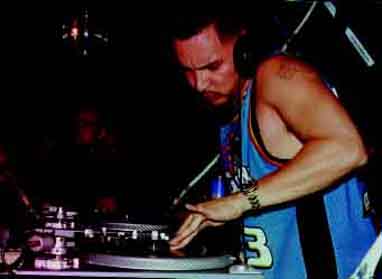
THE FAMILIAR image of the DJ hunched over a pair of turntables doesn’t quite describe the innovative approach of Paul Miller, aka DJ Spooky, That Subliminal Kid.Where other DJs remix songs, adding beats and blending melodies, Miller remixes culture in his style-blending music and as a writer, producer, critic, philosopher and multimedia artist.
On Friday at Rutgers-Camden, he’ll present his multimedia performance “Rebirth of a Nation,” bringing the art of the remix to one of history’s greatest and most controversial films, “Birth of a Nation.”
“Cut, splice, scratch – it’s all about editing,” explained Miller about transferring his DJ techniques to a visual medium. “When you see someone spin records, they’re taking bits and pieces of any performance – classical, hip-hop, etc. In the era of software, it’s all about compositional strategy.”
Text source: Creative Commons Radio
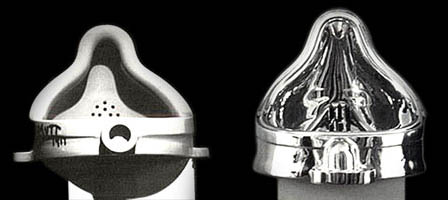
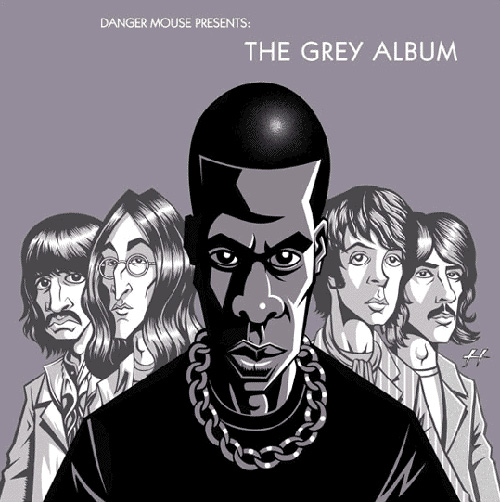
The Creative Remix, with host Benjamen Walker, is an hour-long “lawyer free” examination of the art, culture, and history of the remix. The hour kicks off with a musical analysis of DJ Dangermouse’s infamous remix of the Beatles and Jay-Z. Then we go back in time to check out the ancient Roman art of the poetry mash-up, or the Cento. Then we rewind to the 18th century to check out the birth of copyright and how it effected writers like Alexander Pope; and the early 20th century when the visual artist Marcel Duchamp used the remix to reinvent everything. We also take a field trip to the Mass Mocca museum of modern art to check out the exhibit “Yankee Remix.” Walker brings along a few grad students and a pair of curmudgeonly New England antique collectors to investigate different attitudes towards remixing.
Red Light Concert #10
TV Remix – Media criticism in real time
Philipp Rahlenbeck is jumping channels for us
Saturday, November 12, 2005, 8pm
fluctuating images, Jakobstr.3, 70182 Stuttgart
Recently, the BBC opened parts of their programme archive, as an opportunity for VJs to create video mixes out of footage from old documentaries on art, society, and nature. A special licence allowed free treatment of the images.