Eduardo Navas Interview, by Greg Smith
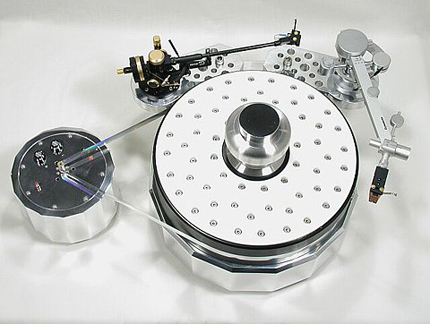
Image source: galibier design‘s quattro turntable
Text source: Serial Consign
Original post: September 24, 2007
One of my favourite blogs over the last year has been Remix Theory, a writing project quarterbacked by media theorist and artist Eduardo Navas. Eduardo is also the author of Remediative and Reflexive Mashups in Sampling Culture, a fantastic essay that beat-juggles a variety of paradigms that range from remix history through to data mashups. Eduardo and I have been firing questions back and forth over email for a few weeks and he has provided a compelling window into his research.
How did you get started researching the remix as a critical paradigm?
It was more a matter of bringing together activities that I had been exploring throughout my life. At the age of 12, during the early eighties, I became a break-dancer and at the age of 18, or so, I bought my own turntables and sound system. Then I began to DJ in the Los Angeles area, something I would do until 2001 or so. During this time I also played percussion in a couple of Salsa cover bands. I was also very involved in the visual arts since I was a kid, and when I reached my mid-twenties I decided to focus in art as a profession and enrolled in art school in the mid-1990’s.
I eventually got a BFA from Otis College of Art, followed by a residency at Skowhegan School of Art, and then I received an MFA from California Institute of the Arts. It was during my Graduate studies at Cal Arts when I became heavily invested in New Media. While at Cal Arts, I also played percussion with the Cal Arts Latin Jazz Band, and I also developed various music projects with another visual artist, Justin Peloian. Obviously, being part of a visual arts program meant that I would make “art†and so I was also heavily invested in studio based art. I was very influenced by Conceptualism. I simply loved (and still love) ideas, and I embraced my time at Cal Arts because the school has very good critical thinkers teaching.