Here are some videos from the selection “Bifurcaciones Sonoras” (Aural Bifurcations), curated by Arcángel Constantini and Rodrigo Sigal for Transitio_MX 03.
Interactive Installation by Gerardo García de la Garza (Mexico), No Materia, 2009. Sound is produced according to the distance between the visitor and the object.
Peter Vogel (Germany), Circular Structure, 1979
It was quite an experience to finally view interactive works that are historically important. Vogel developed the objects displayed in the two videos in the late seventies. Questions on our relation to the object of art were a subject of intense debate during this period. The work is now a relevant work that demonstrates the clear link between art practice during the mid-second half of the twentieth century, and the early part of the twenty-first.
Peter Vogel (Germany), Self-Stimulating Closed Loop, 1979.
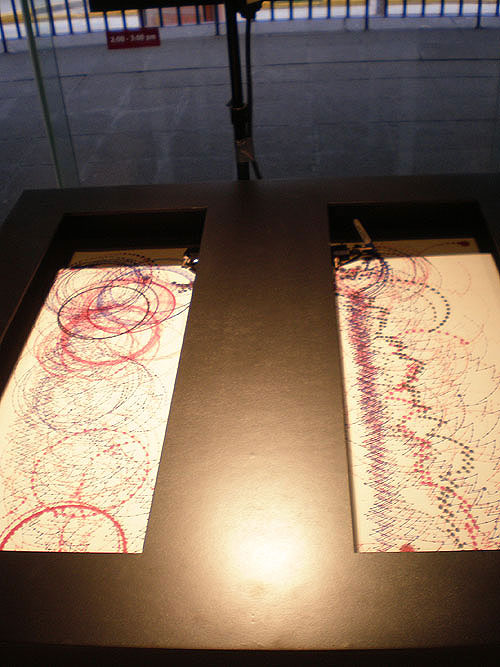
“Comeluz,” Installation by Alfredo Borboa (México), 2009. Two small robots draw circular patterns on paper. One of the young artists competing for Transitio MX 03‘s National Talent Award. The winner was “Not Yogurt,” by Gabriela Gordillo Morales.
The last three days I spent at Transitio, I mainly focused on the curatorial conferences. I was also able to attend, very briefly, workshops and lectures on viral networks as well as physical computing conducted by Nova Yang, Sabrina Raaf, and Giselle Beiguelman. There were other workshops taking place at both Centro Multimedia as well as Fonoteca; as is often the case in major events, it is simply impossible to attend everything one would like.
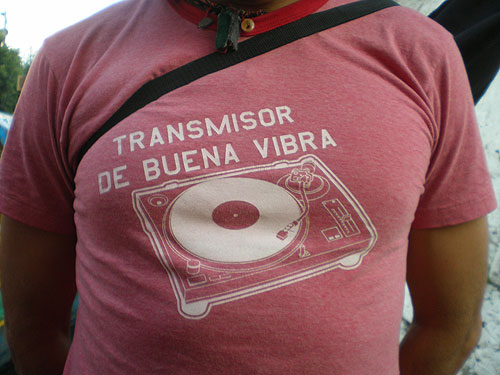
Fernando Llanos, a Mexican video artist, on Sunday, October 4, late afternoon, gracefully took a few participants of Transitio to visit Xochimilco (a local popular boat ride center). In the above image Llanos wears a shirt that displays a DJ turntable with the phrase “Transmisor de buena vibra,” (Transmitter of good vibes). I share the image as a metaphor of my experience in Transitio_MX.
Transitio MX has been full of events. Below are some of the main highlights of days three and four.
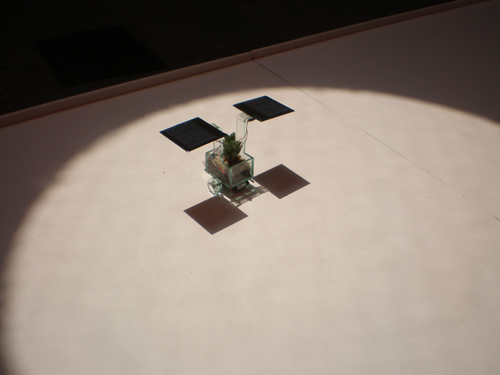
Buscando El Sol (Searching for the Sun), 2009, by Gilberto Esparza, Mexico. Part of Machiko Kusahara’s selection under device art. A small robot moves in a somewhat straight line; when it reaches the edge of the sun spot, it turns around to begin again in another direction.
——
The opening for the third biennale of Transitio_MX enjoyed an overwhelming attendance. It took place at the Cenart, where Centro Multimedia is based. About three thousand people were expected, and it seemed that all of them showed up. For ten days the festival will offer openings of exhibits, workshops, and concerts that take place in different cultural venues throughout the city.
The official opening of the festival featured my co-curation with Machiko Kusahara, titled “non-places and device art.” Unlike the other four curating duos, we opted to choose work independently that would be placed together in the gallery. In this way letting our focus on non places (my own) and on device art (Kusahara’s) inform each other.
Image: Paul Ramirez-Jonas, Another Day 2003 Jonas’s project is one of five selections made for Transitio_MX 03.
I am very excited to share information about a curatorial selection I made for Transitio_MX. This year’s event appears to be just as ambitious as its predecessors, if not more. I’m on my way to Mexico City, to participate in the opening events and symposium. The next days will be overwhelming. I will write about things as they develop, and post them here for future reference. Some information about my selections below:
First Disagreement: *Dissidence. Non places & Device art*
This curatorship deals with techno-artistic praxes. In it, disagreement revolves around the artists’ usage and reshaping of devices and how the latter lead critically towards a stance different from that in which they originated.
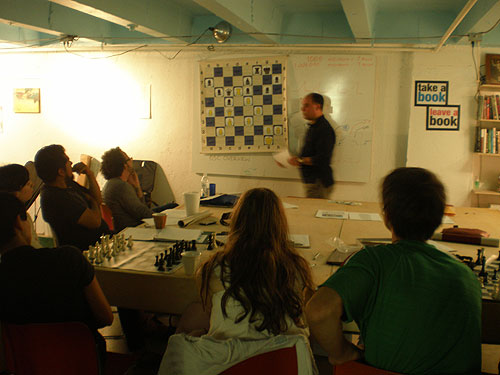
Image: Last Session of “Chess and Duchamp” a four part class led by Chess Master Mick Bighamian
On August 12 I dropped by Telix Arts Exchange to participate in the Public School‘s class titled “Chess & Duchamp.” I was not able to attend the previous three classes as I was not in Los Angeles at that time. However, being a former Chess aficionado, who also developed quite a few art projects around the board game in part influenced by Duchamp, I was almost immediately in tune with the discussion that ensued around one of Duchamp’s better known games against E. H. Smith in the International Tournement Hyeres, in January, 1928.
The analysis of the game was led by Chess Master Mick Bighamian, founder and director of the Los Angeles Chess Club. It was quite a treat to have a game analyzed in detail. Bighamian explained every possible option for each move on both sides of the board and theorized on how and why Duchamp won.
While I was at the Public School, I had the opportunity to catch up with its founder, Sean Dockray, who explained to me how activities at Telic have taken a life of their own. What I found most fascinating was that the Public School is becoming a true resource with an unconventional spin on the education, at a time when more and more commercial educational institutions are being launched. The Public School is a true antidote to both traditional university education as well as for-profit private universities. Sean mentioned that The Public School now has landed a series of workshops with a few institutions, including UCLA’s graduate program as a way to teach practical skills, such as Adruino and Processing programming to students who would not have access to this type of instruction in their own institutions. “It’s more like a form of outsourcing certain areas of education, to us” Sean commented. This activity is actually presented and contextualized by Telic as a form of performance, a work of public art that takes place as exchange of knowledge and information.
The model has sparked such interest that now the Public School is developing satellite activities in Chicago, New York, Paris and Philadelphia. I asked Sean if The Public School had some form of manifesto, or mission, and he responded “no.” And he explained that the basic drive to share information was at The Public School’s core, as simple as that sounds.
By not having a specific mission, except to have an open platform to share information based on proposals by the community that supports Telic Arts Exchange, The Public School so far has avoided the usual conflicts that modest collaborative projects experience as they turn into a full on institution, such as how much to charge (the public school figures out a fair fee for each class from the very beginning). It has been over a year at this point since the Public School started, and so far it appears to work as an organic set of activities, where people with diverse interests are encouraged to come up with subjects for classes. All they have to do is propose a class and if the proposer cannot teach the subject, then a search for a teacher takes place (this was the case with Chess and Duchamp); then, people can sign up and upon the discretion of Telic’s directors, the class is scheduled.
The Public School takes much further gestures and strategies explored in the past by artists such as Tom Marioni and his Bar, where beer was served while people socialized, which he went on to call “art.” However, The Public School does not even need to be called “public art” or even “art.” Yet, anyone invested in public practice would do a disservice to themselves if they did not look into the evergrowing series of events taking shape at The Public School; a project that I’m more than certain will become an important part of the history of public art.
Note: Here is the official launch of a collaborative project I have been part of for about two years and finally sees the light of day. Official release follows:
PLEASE HELP US SPREAD THE WORD
WE INVITE YOU TO PARTICIPATE . comment, revise, translate, submit a chapter http://networkedbook.org
Two years in the making, Networked: a (networked_book) about (networked_art) is now open for comments, revisions, and translations. You may also submit a chapter for consideration.
TAGS: active, aethetics, aggregators, authenticity, authorship, BEN FRY, BEN RUBIN, BURAK ARIKAN, collaborative, communication, data, data mining, digital traces, distributed, DIY, EDUARDO NAVAS, everyday life, flow, GOLAN LEVIN, identity, improvisation, Internet, JANET CARDIFF, JASON FREEMAN, JODI.ORG, JONATHAN HARRIS, latency, lifelogging, lifetracing, MANIK, mapping, MARK HANSEN, MARTIN WATTENBERG, MAX NEUHAUS, Mechanical Turk, mediation, memory, music, narrative, NastyNets, NATHANIEL STERN, net art, network, NICK KNOUF, nonlinear, OLIVER LARIC, participation, performative, persistance, PETER TRAUB, platform, postmodernism, presentational, privacy, prosumer, prosurfer, ranking, realism, reality, real-time, relational, remix, representation, research, RYBN, SCARLET ELECTRIC, SCOTT KILDALL, search engine, self, self-exposure, SHIFTSPACE.ORG, social networks, software, sousveillance, STEVE LAMBERT, storage, surveillance, tactical media, telepresence, THE HUB, THEY RULE, TrackMeNot, transmission, TV, user-generated, visualization, web 2.0, webcam, widget, Wikipedia Art, YES MEN
BACKGROUND
“Networked” proposes that a history or critique of interactive and/or participatory art must itself be interactive and/or participatory; that the technologies used to create a work suggest new forms a “book” might take.
In 2008, Turbulence.org and its project partners — NewMediaFix, Telic Arts Exchange, and Freewaves – issued an international, open call for chapter proposals. We invited contributions that critically and creatively rethink how networked art is categorized, analyzed, legitimized — and by whom — as norms of authority, trust, authenticity and legitimacy evolve.
Our international committee consisted of: Steve Dietz (Northern Lights, MN) :: Martha Gabriel (net artist, Brazil) :: Geert Lovink (Institute for Network Cultures, The Netherlands) :: Nick Montfort (Massachusetts Institute for Technology, MA) :: Anne Bray (LA Freewaves, LA) :: Sean Dockray (Telic Arts Exchange, LA) :: Jo-Anne Green (NRPA, MA) :: Eduardo Navas (newmediaFIX) :: Helen Thorington (NRPA, NY)
Built by Matthew Belanger (our hero!), http://networkedbook.org is powered by WordPress, CommentPress and BuddyPress.
Networked was made possible with funds from the National Endowment for the Arts (United States). Thank you.
We are deeply grateful to Eduardo Navas for his commitment to both this project and past collaborations with Turbulence.org.
Jo-Anne Green and Helen Thorington
jo at turbulence dot org
newradio at turbulence dot org
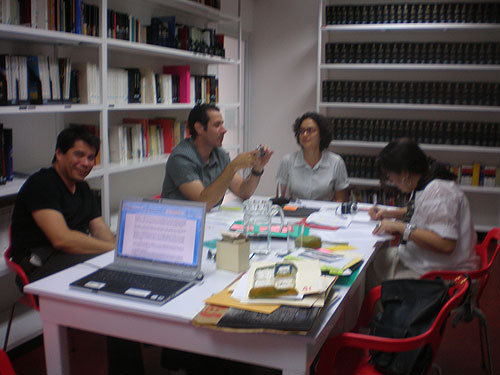
From left to right: Eduardo Navas, Seidel Brito, Mónica Mejia (CCE Program Coordinator), and Clara Astiasarán. Discussing the ongoing selections of Arte Joven.
I visited San Salvador in June. This time I was invited again by Cultural Center of Spain to be a juror for their Premio Arte Joven 2009 (Young Artist Award 2009). The prize has been in place for ten years now, and has proven to be an important cultural element in supporting young artists in their early professional development.
From far left to right: Saidel Brito and Eduardo Navas, discussing the selection process with applicants. Clara Astiasarán participated via Skype.
I was in excellent company with fellow jurors Cuban artist Saidel Brito, and Cuban art critic Clara Astiasarán. We spent several intensive hours going over 71 proposals, from which we chose eight by artists: Ernesto Bautista, Héctor Bermúdez, Boris Ciudad Real, Mauricio Esquivel, Melissa Guevara, José David Herrera, Mauricio Kabistan, and Hugo Rivas. Their projects will be featured in an exhibition in October 2009. From the selected artists three will be chosen by a different set of jurors for first, second, and third place awards that include cash prizes. The October exhibition is complemented with a well produced catalogue.
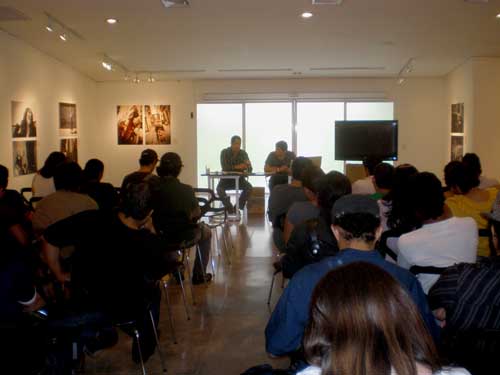
Aside from meeting with the eight artists to discuss the possibilities of installation and development of their proposals, we, as jurors, also decided to meet with all applicants to explain the selection process and encourage artists to meet each other and converse. This was a way to support and expand the growing art community of El Salvador. The turn out was great and we had an extensive and constructive exchange about art practice and professional development.
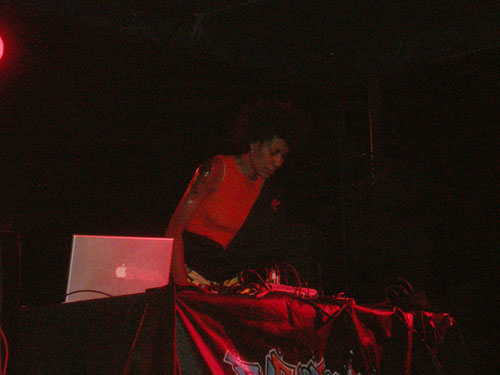
DJ A Todo Color, warming up the crowd for recording artists Ikah and Ari Puello on the International Day of Music, June 20, 2009.
Ikah keeps the crowd shaking during her set.
During my stay in San Salvador, on Saturday June 20, I was able to attend a concert also organized by the Cultural Center of Spain in collaboration with the Cultural French Alliance, featuring local rap artists, including Pescozada and Five o Three. This was the second year in which the French initiated public event “International Day of Music” was extended to the streets of San Salvador. The main feature of the night was Latina Urbana, a touring act consisting of Ikah, based in Madrid; and Arianna Puello, based in Barcelona. Both recording artists consistently tour throughout Latin America. They were gracefully supported by the beats of DJ A Todo Color (DJ total color), also from Barcelona.
Ari Puello breaking it down from beginning to end.
The evening was well organized as Pescozada and Five o Three warmed up the crowd for Ikah, who with her R & B compositions kept the crowd going. Ari Puello closed the evening with a strong set of some of her best hits. Ikah has one album and Puello has four. Puello is actually considered an important artist in Latin American rap. Many people in the audience sang along with her while waving their hands in acknowledgment of her well calculated rhyme and beat.
Just saw this shirt at a local Waffle shop in State College. We asked the guy wearing it where he got it, and he said, with a blank stare, “from DC…”
“Ahh!” we said… “Of course!”
On the web, leave it to Boing Boing to have the tip:
“Photographer and Boing Boing pal Glen E Friedman, who shot many of the iconic photographs of the hiphop band Run DMC, shares this t-shirt with us — he’s seeing them everywhere in NYC, I understand they’re all over the place. But this was the first time I’d seen the design, so I LOLed and blogged. Larger view. Link to a few related shots.”
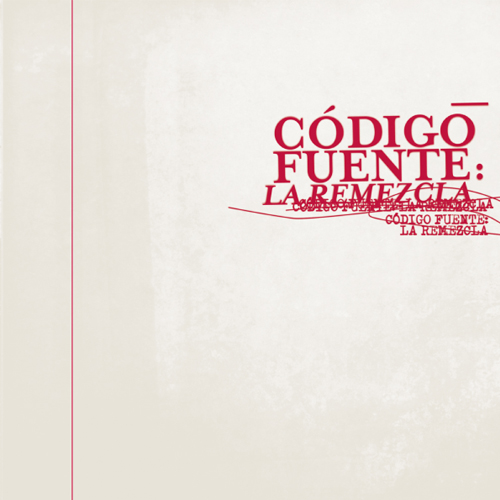
Just got notice from Zemos 98 of their new book, Codigo Fuente: La Remezcla, which brings together a range of articles on Remix in culture and media. The book is in Spanish. I look forward to reading it and highlight some of the essays. Kudos to Zemos 98.