Note: Medialab Prado has released online the video documentation of my presentation of “Remix, The Bond of Repetition and Representation” for Interactivos during the summer of 2008. The presentation emphasizes the concept of Visual Play, which was the thematic for the workshops sessions in that year. A different version of the text was later published at the end of the same year by Telefónica, and is available online, through Remix theory as post 361. The introduction is in Spanish, but the text presentation itself is in English. The video is also downloadable with a Spanish voiceover translation. Much of the material presented has also become parts of various texts also available on Remix Theory. Abstract of the text follows below as published on Medialab’s website:
This text, “Remix: The bond of Repetition and Representation,” entertains the historical importance of Remix in culture at large. It places particular importance on how the image is constantly appropriated in the visual arts as well as other areas of mass culture with unprecedented efficiency. This is done to understand the dialectics at play within Remix, itself and to further understand the principles behind concepts such as “Visual Play” in the emerging network culture. As it becomes clear in the following essay, in order for remix culture to come about, certain dynamics had to be in place, and these were first explored in music, around the contention of representation and repetition. This essay defines the concept of Remix in relation to these two terms, and then moves on to examine its role in media and art. There are three Remix definitions introduced in this essay: The Extended, The Selective and the Reflexive Remixes. These definitions are outlined historically and examined in various areas of culture including the visual arts, pop culture as well as game culture. The essay ends with a critical reflection on what one can do with an awareness of Remix as a dialectical manifestation.
Note: The following is an interview about a book that’s coming out on the history of the vocoder. Quite interesting. My only observation is that the interviewer casually links early Hip Hop with pop culture and this is missed by the interviewee. Historians know that early Hip Hop was also an avant-garde movement, though with different preocupations of previous groups who may have deliberately linked themselves with the nineteenth century concept. Still worth the listen/reading.
If you’ve listened to pop music in the past 40 years, you’ve probably heard more than a few songs with a robotic sound. That’s thanks to the vocoder, a device invented by Bell Labs, the research division of AT&T. Though the vocoder has found its way into music, the machine was never intended for that function. Rather, it was developed to decrease the cost of long-distance calls and has taken on numerous other uses since.
Music journalist Dave Tompkins has written a book about the vocoder and its unlikely history. It’s called How to Wreck a Nice Beach: The Vocoder From World War II to Hip-Hop.
Tompkins says the machine played a significant role in World War II. After the U.S. government discovered that Winston Churchill’s conversations with Franklin D. Roosevelt were being intercepted and deciphered by the Germans, it decided to invest in speech-encoding technology. So the National Defense Research Committee commissioned Bell Labs in 1942 to develop a machine — and Bell Labs delivered.
The vocoder wasn’t without its flaws. Intelligibility of speech sometimes proved a problem, but Tompkins says pitch control was a bigger concern.
“They didn’t mind world leaders sounding like robots, just as long as they didn’t sound like chipmunks,” he says. “Eisenhower did not want to sound like a chipmunk.”
Recently received a link from Joshua Pablo Rosenstock about his video, Shrine to the Funky Drummer. The video presents Rosenstock as a subject who is greatly influenced by James Brown’s “Funky Drummer.” We quickly learn that his interest is a jumping point to understand how the song’s basic drum beat has become part of Hip Hop consciousness.
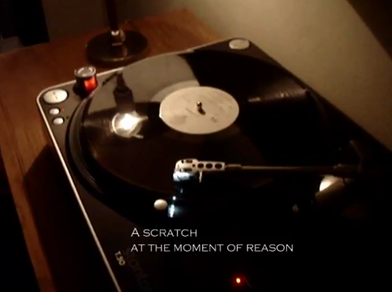
While the video, in my opinion could be edited (the intro is too long, and some footage does not match the sound), it does provide some historical context as to the art of sampling and its place in Hip Hop Culture. It starts with Rosenstock listening to a scratched 45, and then playing the beat on a drum set. The next set of scenes are about DJ’s manipulating The Funky Drummer’s break beat, complemented with random interviews with record diggers and turntablists. The video then goes back to Rosenstock who no longer plays a drum set, but a set of samples from a drum machine.
Shrine to the Funky Drummer reminds me a bit about Nate Harrison’s Amen Brother Break. Though very different in approach, both videos can be complementary references for understanding the history of Remix. I understand that Shrine to the Funky Drummer’s current version is a rough cut, so I look forward to the final production.
Last week, I headed to Montréal for the 11th incarnation of the Elektra International Digital Arts Festival in Montréal. The five day event attracted artists and industry professionals from as far away as Dakar, Seoul, Istanbul and Shanghai, as well as various countries across Europe and North America, to the cosmopolitan Québeqois city, which is quickly, as many of us already knew, establishing a name for itself as THE creative hotbed for electronic arts. There was much to take in each day, and while it can’t all be discussed here, this post represents a compendium of the most interesting, evocative and stimulating experiences from my time there.
The Conferences
For those presenting at the International Marketplace for Digital Arts, the future, in the (wink) words of Chip Douglas, is very much now. The “professional rendez-vous” as it was dubbed by Elektra’s organizers, was a two-day blitz of presentations, debates and dialogues, given by over 30 international artists, producers, agents, broadcasters, curators, institutional directors and event organizers. While the format of the conference itself could be described as both a massive speed dating session and networking boot camp, leaving not quite enough space for attendees to fully digest all that was being offered, the conceptual framework of the event – arranged as a space to foster collaborations and to develop new, cross-border distribution networks, was clearly taken advantage of by all observers and presenters alike.
[Re]Cuts was specifically developed in January of 2010 for an exhibition at IMT Gallery in London. The video is inspired by Burroughs’s experimentation with tape recordings. The exhibit takes place from May 28 through July 18 2010. I thank Mark Jackson for the invitation and the opportunity to exhibit my work.
excerpt from the actual project webpage:
[Re]Cuts is a remix of image, sound, and text inspired by William Burroughs’s aesthetics of tape recording. The video is also influenced by his cut-up method as defined for writing in “The Cut-Up Method of Brion Gysin.” The video does not follow the strict cup-up rules professed by Burroughs, but rather considers his aesthetics as a point of reference to develop a non-sensical narrative.
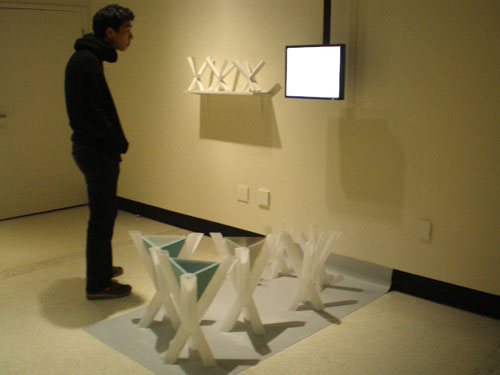
Gallery Visitor viewing one of the Raaf’s works at gallery@calit2.
Sabrina Raaf’s art works, Icelandic Rift, Meandering River, and Grower II among other works, are currently on view at gallery@calit2.net from April 2 to June 4, 2010. The exhibition is titled A Light Green Light: Towards Sustainability in Practice, curated by Steve Dietz.
Raaf’s work aims to reflect on issues of the environment–a research topic that fits quite well with Calit2’s mission. The press release reads:
The gallery@calit2 goes green this spring with an exhibition by Chicago-based artist Sabrina Raaf, whose custom-built robotic sculptures and site specific installations include a series of experiments that address issues of sustainable practice, the construction of social spaces, and prototyping for modular green architecture.
Raaf’s work may appear sci-fish to some viewers, but the precision of her execution, both materially and conceptually, demonstrates that to envision a green future is possible. I read the robotic sculptures as an open-ended invitation to imagine a world in which we acknowledge and respect earth’s ecology.
Video of Grower II and other structures part of Icelandic Rift.
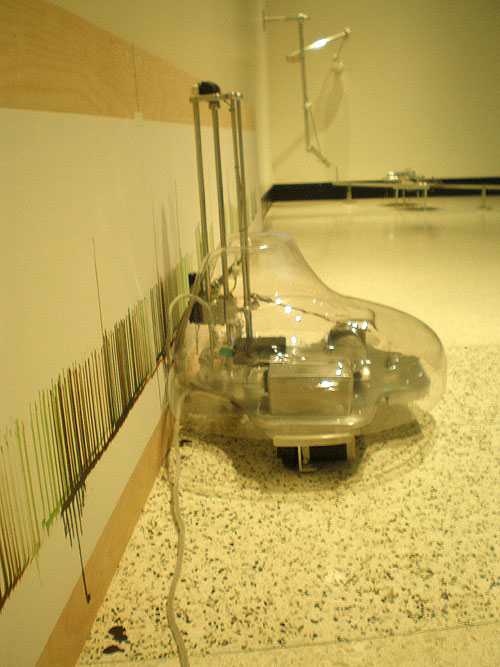
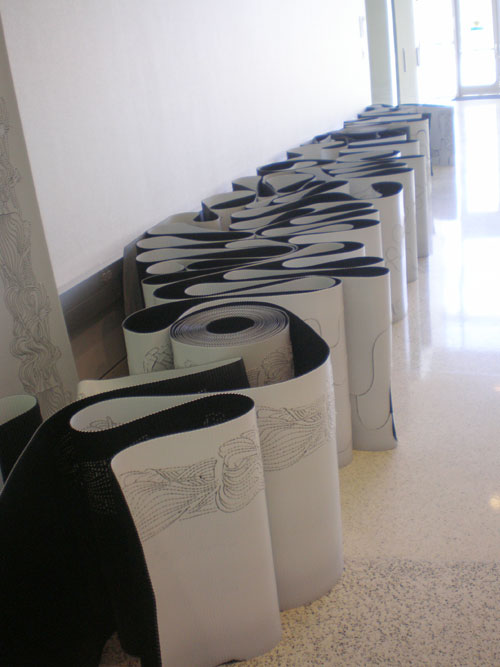
Grower II, which I was honored to curate as part of Transitio_MX last October, draws lines of different shades of green on a long piece of paper according to the level of carbon dioxide in the air.
Detail of one of Icelandic Rift’s structures.
A robotic sculpture part of Icelandic Rift, (2006-07)
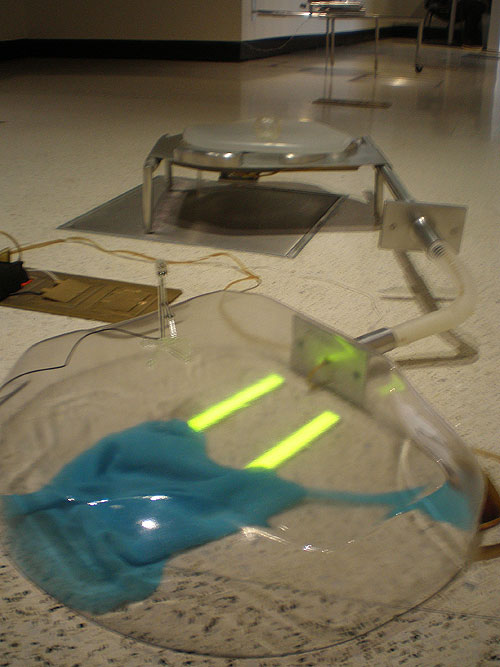
Icelandic Rift, 2006-07 consists of abstract robotic-like structures inspired by the Icelandic landscape, which Raaf had the opportunity to experience at one point in person. Materials include aluminum, cast acrylic, urethane, ferrofluid, and custom kinetics and electronics.
Detail of another Icelandic Rift Structure.
Meandering River (2009), installed just to the left of the gallery’s entrance
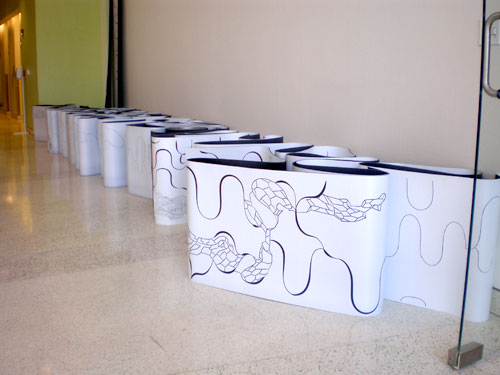
Meandering River is inspired by the article “Meandering River as a Self Organization Process” (1996), written by Henrik Stolum in which the author describes procedural mathematics that enable scientists to research river morphology.The drawings on thermal screens, which can be displayed in multiple forms, are engraved by a robot.
Meandering River, installed just to the left of the gallery’s entrance.
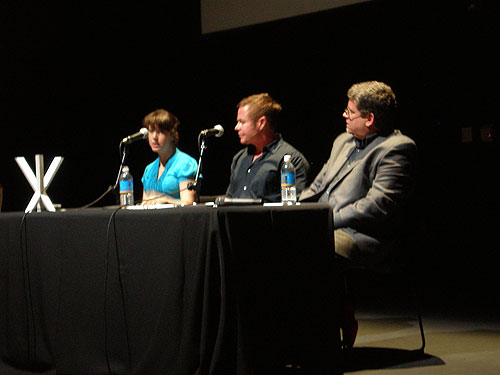
Sabrina Raaf (left), Jordan Crandall (middle), and Steve Dietz (right), discuss the exhibition during a panel presentation held prior to the opening reception on April 2, 2010.
The following is a presentation separated into two parts; it was produced for the conference Re*-Recycling_Sampling_Jamming, which took place in Berlin during February 2009.
Part One (above) introduces the three chronological stages of Remix, while part two (below) defines how the three chronological stages are linked to the concept of Authorship, as defined by Roland Barthes and Michel Foucault. Also see my previous entry “The Author Function in Remix” which is a written excerpt of the theory proposed in part two.
Below is the abstract that summarizes the content of the two videos. Total running time is around fifteen minutes.
———–
Text originally published on Re*- on February 2009:
SAMSTAG_28.02.2009_SEKTION IV_15-20 UHR
12_15:00 Remix[ing]. The Three Chronological Stages of Sampling
Eduardo Navas, Künstler und Medienwissenschaftler, University of California in San Diego (USA)
Sampling is the key element that makes the act of remixing possible. In order for Remix to take effect, an originating source must be sampled in part or as a whole. Sampling is often associated with music; however, this text will show that sampling has roots in mechanical reproduction, initially explored in visual culture with photography. A theory of sampling will be presented which consists of three stages: The first took place in the nineteenth century with the development of photography and film, along with sound recording. In this first stage, the world sampled itself. The second stage took place at the beginning of the twentieth century, once mechanical recording became conventionalized, and early forms of cutting and pasting were explored. This is the time of collage and photo-montage. And the third stage is found in new media in which the two previous stages are combined at a meta-level, giving users the option to cut or copy (the current most popular form of sampling) based on aesthetics, rather than limitations of media. This is not to say that new media does not have limitations, but exactly what these limitations may be is what will be entertained at greater length.The analysis of the three stages of sampling that inform Remix as discourse is framed by critical theory. A particular focus is placed on how the role of the author in contemporary media practice is being redefined in content production due to the tendency to share and collaborate. The theories on authorship by Roland Barthes and Michel Foucault are entertained in direct relation to the complexities that sampling has brought forth since it became ubiquitous in popular activities of global media, such as social networking and blogging.
Note: Press release about an upcoming exhibition in which I participate taking place in London at IMT Gallery during May through June of 2010.
———-
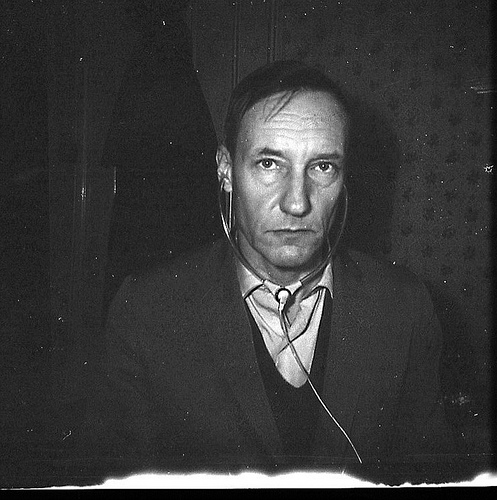
Dead Fingers Talk is an ambitious forthcoming exhibition presenting two unreleased tape experiments by William Burroughs from the mid 1960s alongside responses by 23 artists, musicians, writers, composers and curators.
Few writers have exerted as great an influence over such a diverse range of art forms as William Burroughs. Burroughs, author of Naked Lunch, The Soft Machine and Junky, continues to be regularly referenced in music, visual art, sound art, film, web-based practice and literature. One typically overlooked, yet critically important, manifestation of his radical ideas about manipulation, technology and society is found in his extensive experiments with tape recorders in the 1960s and ’70s. Dead Fingers Talk: The Tape Experiments of William S. Burroughs is the first exhibition to truly demonstrate the diversity of resonance in the arts of Burroughs’ theories of sound.
listen to your present time tapes and you will begin to see who you are and what you are doing here mix yesterday in with today and hear tomorrow your future rising out of old recordings
everybody splice himself in with everybody else
The exhibition includes work by Joe Ambrose, Steve Aylett, Alex Baker & Kit Poulson, Lawrence English, The Human Separation, Riccardo Iacono, Anthony Joseph, Cathy Lane, Eduardo Navas, Negativland, o.blaat, Aki Onda, Jörg Piringer, Plastique Fantastique, Simon Ruben White, Giorgio Sadotti, Scanner, Terre Thaemlitz, Thomson & Craighead, Laureana Toledo and Ultra-red, with performances by Ascsoms and Solina Hi-Fi.
Inspired by the expelled Surrealist painter Brion Gysin, and yet never meant as art but as a pseudo-scientific investigation of sounds and our relationship to technology and material, the experiments provide early examples of interactions which are essential listening for artists working in the digital age.
In the case of the work in the exhibition the contributors were asked to provide a “recording” in response to Burroughs’ tape experiments. The works, which vary significantly in media and focus, demonstrate the diversity of attitudes to such a groundbreaking period of investigation.
Dead Fingers Talk: The Tape Experiments of William S. Burroughs is curated by Mark Jackson. The project is supported by the London College of Communication, CRiSAP and ADi Audiovisual and has been made possible by the kind assistance of the William Burroughs Trust, Riflemaker and the British Library.
Still from video documentation, available at Dropbox
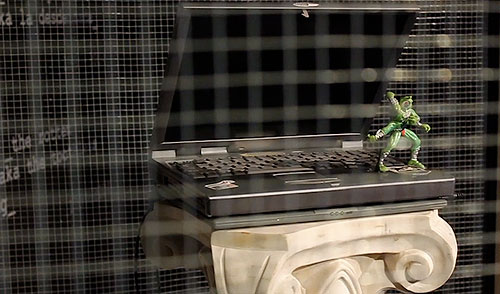
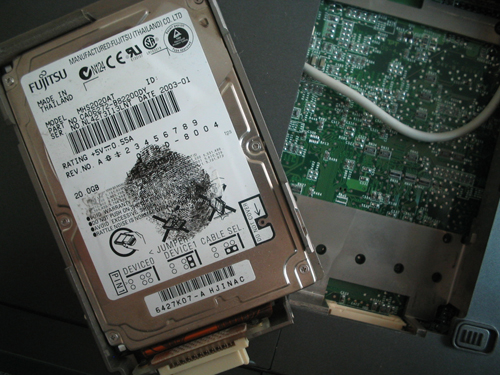
The Rotten Machine (La Maquina Podrida) is currently on display at the MEIAC, in Badajoz, Spain. On the 8th of May 2004, Brian Mackern, born and living in Montevideo, Uruguay, put for sale his personal laptop computer, in which he developed his early net art projects. He also used the machine to document early online activity–particularly from around the Americas.
When considering the history of new media, the sale was made at a moment when web 2.0 was about to change: the blog, for instance, which was one of the pivotal tools of the next stage of web development, became quite popular at this time. Simultaneously, the machine’s sale is an overt commentary on the preciousness of the work of art, which was the subject of several attempts of dematerialization during the heyday of conceptualism. The fetishization of the object of art was an issue to consider for many early online art practitioners, since in online practice there appeared to be no “object of art” to deal with directly. The Rotten Machine turns this convention on its head, and shows that “anything” can be commodified.
These are some of my brief observations on a work that deserves more analysis, and that I hope now that it enjoys its first exhibit, will be acknowledged around the world as an important contribution to the history of art.
Below is part of the official press release written by curator, Nilo Casares:
——
exhibition:::::::::::::::::::the rotten machine aka the toothless old thing
:::::::::::::::::::::::::::::1999-2004
:::::::::::::::::::::::::::::all net.art in a brian mackern’s laptop
works of:::::::::::::::::::::brian mackern
curator::::::::::::::::::::::nilo casares
technical coordination:::::::àngela montesinos
production:::::::::::::::::::
and organization:::::::::::::meiac
texts of catalogue:::::::::::rodrigo alonso
:::::::::::::::::::::::::::::andrés burbano
:::::::::::::::::::::::::::::nilo casares
:::::::::::::::::::::::::::::gabriel galli
:::::::::::::::::::::::::::::brian mackern
:::::::::::::::::::::::::::::àngela montesinos
the rotten machine is a surprising exhibition that emanates from an old laptop from 1999, owned by the uruguayan netartist brian mackern, to recreate the time when net.art had its peak brightness, and perhaps therefore, the rattle before the emergence of web 2.0 (known as social network).
his computer, the rotten machine, it’s full and complete of all the data collected until the moment it was decided to be sold, on the 8th of may, 2004. it was the working tool (the studio, in classical terms) that accompanied brian mackern between 1999 and 2004, both in his personal work and in collaborative works for other artists and net jamms, apart from his work as a vj, conferences and workshops. in short, his tool.
a computer full of information and history, acquired by the meiac in order to expose it to posterity, when the development of hardware and software will prevent us from viewing many of the art pieces hosted on this computer.
the exhibition is divided into 5 audiovisual stations navigated by brian mackern himself.
1 – anthropological station: content and hardware components of the machine. sounds generated by its operation. references to files, etc.
2 – studio station: personal work (source files and visible works). the source code of his own work and at the same time the navigation of it.
3 – internet and networking station: content related to many of the projects and online/offline collaborative groups in which brian mackern has intervened.
4 – file, documentation and analysis station: random collection of information about net.art and internet culture of that time.
5 – history station. history of net.art: remix of endless net.art sites, in different states of preservation, many of them with retrofitted code to allow navigation within the machine without internet connection.
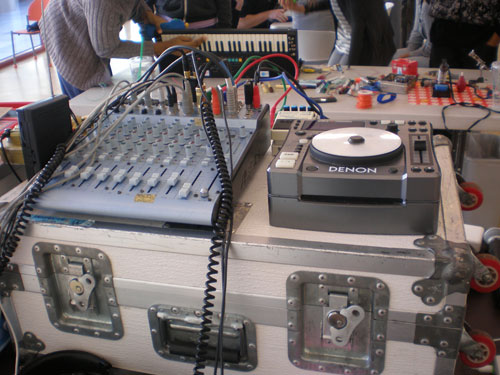
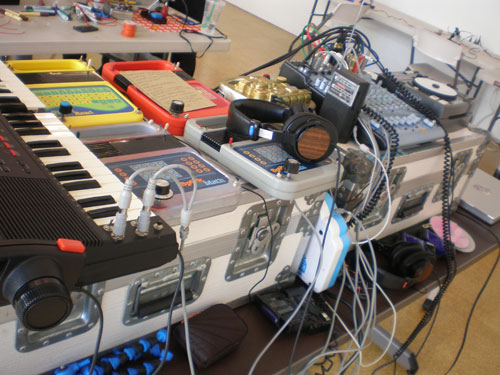
Sound set up by Beatrix*Jar, combines hacked battery operated toys with prerecorded samples played on a vintage Denon CD-DJ machine.
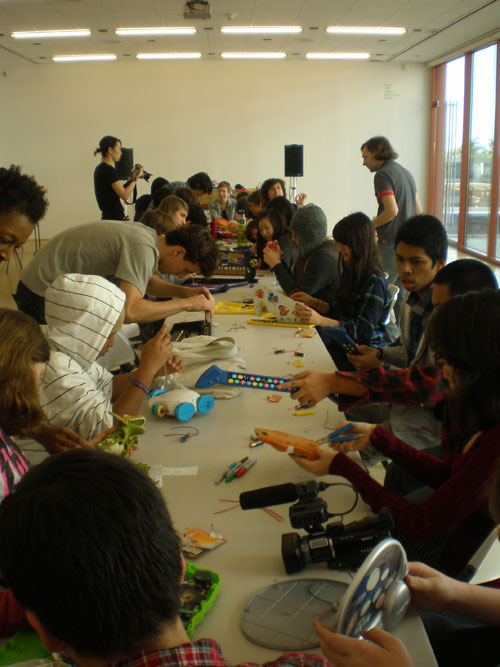
On January 23, I attended a circuit bending workshop at Museum of Contemporary Art San Diego (MCASD) taught by the experimental music duo, Beatrix*jar. The hacking session was organized specifically for teenagers, who were more than ready to open up battery operated instrumental toys to release the ghost in the machine.
Another shot of Beatrix*Jar’s set up.
I was interested in attending the event in order to get a sense of how teenagers in a time of inter-connectivity relate to low-tech hacking. I left the museum with a positive reaction as I confirmed that tinkering is not a trend but a constant creative staple for generations of the past, present, and future.
Video of Beatrix*Jar’s six minute improvisational performance
The session began with a six minute performance by the sound art collective, which clearly got the young hackers excited about the possibilities of circuit bending. Beatrix*Jar, who have a background in art, are quick to claim that when they got started they had no music training. This was their way of saying “anyone can do it!” They complemented their demos with historical information, and encouraged participants to read Reed Ghazala’s Extreme Tech Circuit Bending.
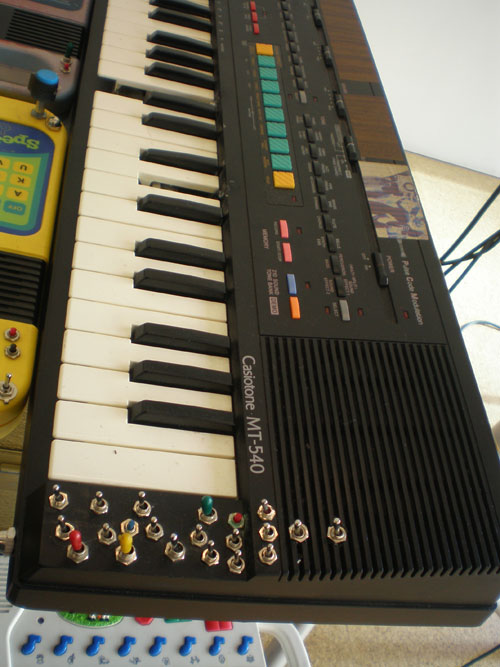
A hacked Casio keyboard. The on/off switches on the sides add customized sounds found by benders who participate in the ongoing workshop sessions held at different venues by Beatrix*Jar.
After explaining the beginnings of circuit bending, they quickly moved to demonstrating how to open up the toys, and find unexpected sounds.
Opening the gadgets to release the ghost in the machine. Circuit bending frenzy at its best.
Gabrielle Wyrick, Education Curator, who kindly hosted me for the afternoon, explained that the workshops for teenagers are part of a program set up to encourage kids of all ages to realize that the museum is a place to visit and learn, interact, have fun, and most of all be creative. Workshops like these, Wyrick explained are at times held for adults as well. It appears that the concept of interactivity is finding its way everywhere, even to institutions such as museums that in the past posed as monolithic entities. A good thing this is, as Wyrick explains that the MCASD wants to embrace audience involvement. The museum is redefining itself as a place which searches for ways to reveal the creative process in visitors, who can experiment with similar strategies that inform the creative drive of artists who actually have exhibits in the museum.
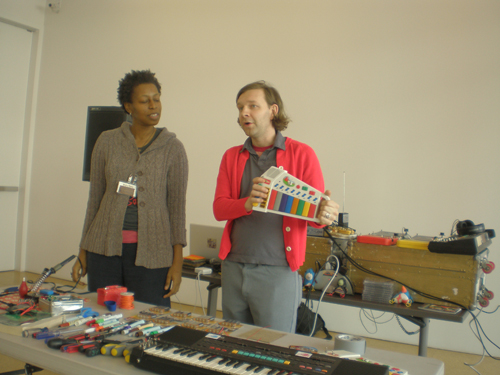
Beatrix*Jar explain how to hack battery operated instrumental toys.
For me it was a treat to see a hacking duo having a lot of fun with second-hand gadgets that can be found at any garage sale. Creativity is the best value money can’t buy.