About | Remix Defined | The Book | Texts | Projects | Travels/Exhibits | Remixes/Lists| Twitter

Archive of the category 'Mash Up/mashup'

Washingtonpost.com Teams Up with Readers for Remix, by Tara Calishain

Image: Washington Post Remix

Text source: Information Today
Posted On December 12, 2005

Note: This text summarizes the expectations of an online project by the Washington Post, which is no longer active. The project is worth keeping in mind as a stepping stone and experiment to develop interesting tools for Web 2.0

The Washington Post Co. has launched a new site called Post Remix, described as “the Post’s official mashup center.” Available at http://blogs.washingtonpost.com/post_remix, Post Remix spotlights reader creativity with both washingtonpost.com RSS feeds and other streams of content The Post is making available. The site launched around mid-November, and that’s been plenty of time for interesting content to appear on it. A blog format provides an overview of reader-submitted projects, ordered by date. Among the spotlighted applications are a site that offers Amazon.com book suggestions based on washingtonpost.com content, automated text-to-speech podcasts of Post stories, and a “Tag Cloud” overview of washingtonpost.com content. All these applications use RSS feeds of washingtonpost.com content.

(more…)

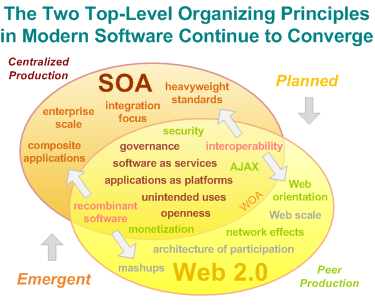
Mashup design Patterns, by Alex Barnett

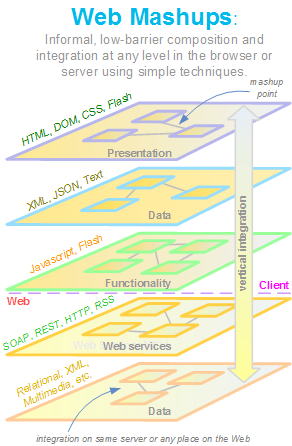
Image and text source: Alex Barnett Blog

Posted on May 22 2007

In the middle of last year, I invited Dion to meet with me and other members of Microsoft’s Data Programmability team to discuss REST in the context of data access over the web. Dion’s perspective is one of the reasons our team was able to recognise the potential of a RESTful programming model against relational data, manifested today as Project Astoria.

I’ve been waiting to read Dion’s thoughts on Project Astoria (via John Musser). It’s an interesting take, contextualizing Astoria within the overall architectural trends we’re seeing take place.

(more…)

Some Notes on Nine Inch Nails’ Invitation to Create Mashups

Image source: yearzero.nin.com

Note: Below are a couple of comments on Nine Inch Nails’ current project, which consists of inviting fans and music enthusiasts to mashup one of NIN’s new songs “Survivalism” to their hearts’ content. This project is welcomed and reminiscent of the pioneering project A Bush of Ghosts by Brian Eno and David Bowie. Also see: http://bushofghosts.wmg.com

———-

“Nine Inch Nails Invites Mashups,” by Jonathan at Ampheteme.org

Text source: Amphetameme.org

Published on 3-26-07

Trent Reznor’s inviting you to mash-it-up. He invites you to go absolutely nuts with his latest creation, the tracks that come together to make the song “Survivalism”. Feel free to interpret the tracks any way you wish he says, and add your own. And he’s asking you (because of his partnership with Apple I presume) to use Garageband. I don’t mind. Garageband 3’s one pretty damn cool piece of work. At any rate, I’m a big NIN fan and I’m happy to see him once again inviting remix interpretation. Pick up all the details at yearzero.nin.com.

———-

“A mashup on Garageband takes music experiences to a new level,” by Stephen Abbott

Text source: projectopus.com/

Published on 3-26-07
Trent Reznor of Nine Inch Nails is pushing the boundaries of a music experience to new levels. According to an article in Digital Music News, Reznor is making a single from the upcoming album, Year Zero, available for “remix interpretation”. The interesting twist to this is that it is being done in a sort of collaboration with the latest release of Garageband 3, part of Apple’s iLife suite.

Garageband users can adjust a number of tracks that make up “Survivalism,” and add their own elements as well. Once created, the tracks can be shared, ripped and distributed at will. According to an Apple representative, other songs from the album are also on the way.

The ability to share and distribute the personal remixes is huge. Perhaps ability is the wrong word – the encouragement to distribute these remixes is incredible. The artist is giving open permission to use his work. There could be literally thousands of interesting and unique interpretations of NIN’s musical talent. Of course, there are going to be many more versions that suck, but those will fade away soon enough.

(more…)

Regressive and Reflexive Mashups in Sampling Culture, by Eduardo Navas


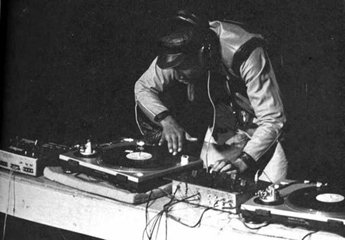
Grandmaster Flash on the Wheels of Steel some time in the early days of hip hop.

Image source: greatestcities.com

Update as of 8/13/10.  The revised version of this text is now available online as Remix Theory post 444.

Update as of 4/29/10: This text has been revised for the book publication Mashup Cultures. In the revised print version, I introduce a series of new terms along with a diagram.  The 2007 draft is shared below in the tradition of online sharing.  The final argument while it has not necessarily changed is more precise in the revised print version, which I encourage those interested to read.

This text was published on June 25, 2007 in Vague Terrain Journal as a contribution to the issue titled Sample Culture.

Today, sampling is practiced in new media culture when any software users including creative industry professionals as well as average consumers apply cut/copy & paste in diverse software applications; for professionals this could mean 3-D modeling software like Maya (used to develop animations in films like Spiderman or Lord of the Rings );[1] and for average persons it could mean Microsoft Word, often used to write texts like this one. Cut/copy & paste is a vital new media feature in the development of Remix. In Web 2.0 applications cut/copy & paste is a necessary element to develop mashups; yet the cultural model of mashups is not limited to software, but spans across media. Mashups actually have roots in sampling principles that were first initiated in music culture around the seventies with the growing popularity of music remixes in disco and hip hop culture; and even though mashups are founded on principles initially explored in music they are not always remixes if we think of remixes as allegories. This is important to entertain because, at first, Remix appears to extend repetition of forms in media, in repressive fashion; but the argument in this paper is that when mashups move beyond basic remix principles a constructive rupture develops that shows possibilities for new forms of cultural production that question standard commercial practice.

(more…)

IBM Executive Declares Web 2.0 Technology to Drive New Business Applications

Note: Archived for historical purposes.

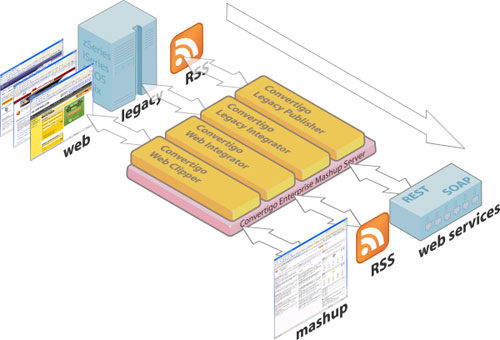
Image source: http://www.twinsoft.fr/intl/fr/
cariocaweb/convertigo-ems-enterprise-mashup-server.htm

Text source: IBM

New “IBM Enterprise Mashup” Technology Allows for Creation of Five Minute Custom Applications

NEW YORK, NY – 15 Jun 2006: NY PHP Conference — In a keynote speech to leading technology executives, Rod Smith, IBM’s vice president of emerging Internet technologies, declared that the technologies underpinning blogs, wikis and innovative sites like Google Maps and Wikipedia on the Web will transform the way productivity applications are developed — in some cases in as little as five minutes — using the ever-expanding palette of Web 2.0 components available for free on the Internet.

According to Smith, the rapid adoption of Web 2.0 technologies is encouraging clients to experiment by marrying the growing combinations of online Web services with existing data and information from inside their business, enabling the creation of new applications that bring the experience and utility of popular next-generation Internet applications to business users.

(more…)

Is IBM making enterprise mashups respectable? by Dion Hinchcliffe

Image and text source: ZDnet

June 18th, 2006

ZDNet blog colleague Joe McKendrick beat me to the punch earlier this week with an excellent analysis of the fascinating ramifications of IBM’s recent statements at the New York PHP Conference aimed at mainstreaming mashups and Web 2.0 technologies.  If IBM is getting seriously involved in this, there must be something to it, and certainly Rod Smith’s comments are receiving considerable attention.

Interestingly, most enterprises I talk to these days barely have mashups on their radar, yet I also continually hear from those same folks about how hard it is to create increasingly integrated business applications, as well as the slow pace of rolling out new functionality to users and customers.  There indeed seems to be a rising corporate appetite for faster, more effective ways of building applications particularly when reusing existing IT software and information assets.

(more…)

Step Away From the Sampler, by Peter Kirn

Image and text source: Key Board Mag

January 2005

Court rules all digital sampling illegal and the record industry objects — but you still have options

Get this: According to a fall 2004 ruling by the 6th Circuit U.S. Court of Appeals, any use of a digital sample of a recording without a license is a violation of copyright, regardless of size or significance. In its decision in Bridgeport Music et al. vs. Dimension Films, the court said simply, “Get a license or do not sample. We do not see this as stifling creativity in any way.”

“As far as sampling of recordings, they didn’t make it gray; they made it a line in the sand,” says Jay Cooper, a leading entertainment arts lawyer and a former president of the National Academy of Recording Arts and Sciences (NARAS). Previously, courts had applied the question of size and significance to copyright infringement claims, but the new ruling changes that for sampling. Cooper says, “I think they went a little far afield from what the law has been in the past. Basically, the law has generally been there has to be more than a minimal use . . . this case basically said that you could take one note and that could be copyright infringement. They really did say that.”

(more…)

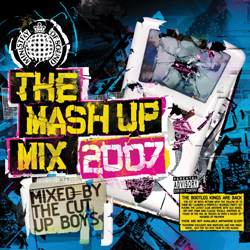
The Mash Up Mix 2007

Image and text source: Discogs

Note: This is definitely one of the most nostalgic mashups I’ve encountered so far. It features some important and popular songs since the eighties, and the best part is that it’s non-linear; jumping from one time period to the next, all in the name of the right [re]mix. “Rhythmic modularity” is what I call this type of aesthetic which disregards linear history.

Label: Ministry Of Sound
Catalog#: MOSCD135
Format: 2 x CD, Mixed
Country: UK
Released: 19 Feb 2007
Genre: Electronic, Hip Hop, Pop
Style: House, Hip Hop, Trance
Credits: DJ Mix – Cut Up Boys
Notes:
Rating: 5.0/5 (2 votes) Rate It
Submitted by: DukeD

(more…)

Free Tool Offers ‘Easy’ Codin, by Jonathan Fildes


Scratch’s creator Mitchel Resnick building a character

Image and text source: BBC

May 14, 2007

A free programming tool that allows anyone to create their own animated stories, video games and interactive artworks has been developed.

Primarily aimed at children, Scratch does not require prior knowledge of complex computer languages.

Instead, it uses a simple graphical interface that allows programs to be assembled like building blocks.

The digital toolkit, developed in the US at MIT’s Media Lab, allows people to blend images, sound and video.

“Computer programming has been traditionally seen as something that is beyond most people – it’s only for a special group with technical expertise and experience,” said Professor Mitchel Resnick, one of the researchers at the Lifelong Kindergarten group at MIT.
(more…)

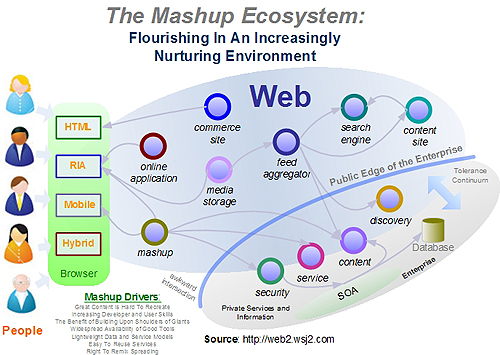
The Web 2.0 Mashup Ecosystem Ramps Up, by Dion Hinchcliffe


Image and text source: Soa Web Services

4 February 2006

2.63 new mashups a day.  That’s what John Musser’s terrific new Mashup Feed site says is current the creation rate.  If that rate flattens out today, which isn’t likely, that’s over 960 new mashups every year.  Mashups, composite web applications partially constructed from the services and content from other web sites, are taking off with an amazing speed.  Yet they are a relatively new phenomenon in terms of being this widespread and pervasive.  All this even though mashups, like blogs and wikis, were actually possible from the creation date of the first forms-capable browser.  So why the sudden widespread interest?

(more…)

Current Projects


    Books


    Remix Theory | is an online resource by Eduardo Navas. To learn more about it read the about page.

    Logo design by Ludmil Trenkov

    http://www.mentalhealthupdate.com/